




Blog
How to Calculate IPS Backup Time for Your Home — 2026 Formula Guide

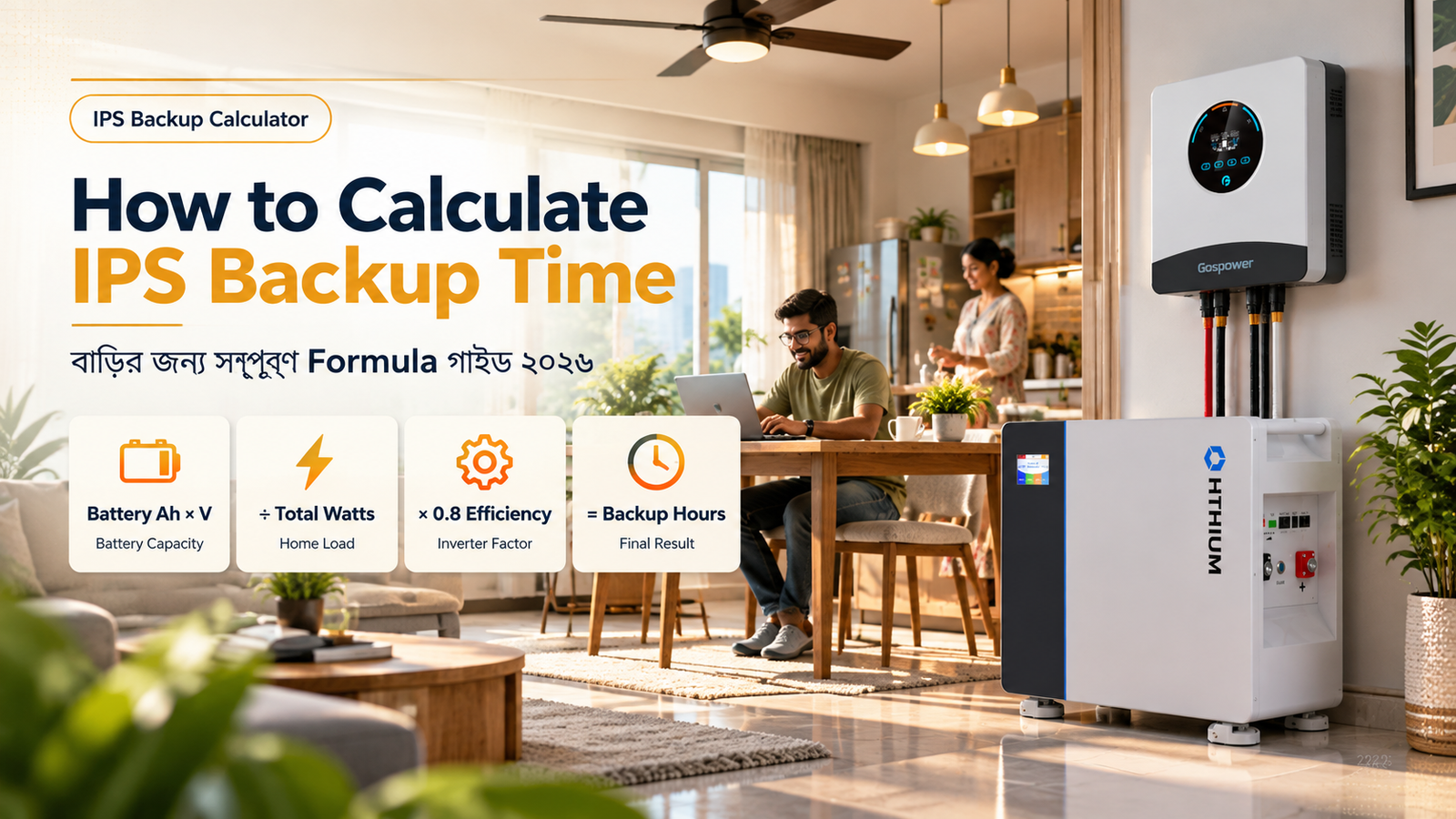
When load shedding hits, the first question every Bangladeshi homeowner asks is: how long will my IPS last? Knowing your IPS backup time isn’t guesswork — it’s a simple calculation based on your battery capacity and the appliances you want to run. This guide shows you the exact formula, a ready-made load table, and real-world examples for common Bangladeshi homes in 2026.
Whether you’re running ceiling fans in a Dhaka apartment or powering lights in a village home during long outages, this calculator approach will help you size your IPS correctly and avoid unpleasant surprises during blackouts.
The IPS Backup Time Formula — Simple and Accurate
Backup time depends on two things: how much power your appliances draw (in watts) and how much energy your battery stores (in watt-hours). The formula is:
Backup Time (hours) = Battery Capacity (Wh) ÷ Total Load (W)
For practical accuracy, multiply by the Depth of Discharge (DoD) and Inverter Efficiency.
The full practical formula is:
Backup Time = (Battery Ah × Battery Voltage × DoD × Efficiency) ÷ Total Load (W)
Let’s break down each term:
- Battery Ah — the capacity printed on your battery (e.g., 100Ah, 150Ah)
- Battery Voltage — usually 12V for a single battery, 24V for two in series
- DoD (Depth of Discharge) — how much of the battery you can safely use:
- Tubular / AGM lead-acid: 50% (draining deeper damages it)
- LiFePO4 (Lithium Iron Phosphate): 80–90% (safely uses almost full capacity)
- Inverter Efficiency — typically 85–90% (use 0.85 to be conservative)
- Total Load (W) — sum of watts of all running appliances
Step 1 — Know Your Total Home Load (Watts)
Add up the wattage of every appliance you plan to run during a power cut. Here is a reference table for common Bangladeshi home appliances in 2026:
| Appliance | Typical Watts (BD Market) | LED / Inverter Model |
|---|---|---|
| Ceiling Fan (56 inch) | 75 W | 30–45 W (BLDC) |
| LED Bulb / Tube Light | 9–18 W | 7–12 W |
| LED TV (32 inch) | 40–60 W | 30–45 W |
| WiFi Router | 10–15 W | 10–15 W |
| Laptop / Charger | 45–90 W | 45–65 W |
| Phone Charger (×2) | 10–20 W | 10–20 W |
| Refrigerator (165L) | 100–150 W average* | 80–120 W (inverter fridge) |
| Ceiling-mount AC (1 ton) | 1,000–1,200 W | 700–900 W (inverter AC) |
| Water Pump (0.5 HP) | 375 W running, 750 W surge | — |
| CFL/Tube (old type) | 23–36 W | Replace with LED to reduce load |
*Fridge compressor is NOT continuous — average on-time ~30–40% of an hour. Use average watts in your calculation, not peak watts.
Step 2 — Calculate Battery Watt-Hours (Wh)
Your IPS battery is rated in Amp-hours (Ah) at a specific voltage. Convert to Watt-hours using:
Battery Wh = Ah × Voltage
Example: 150Ah × 12V = 1,800 Wh
Common IPS battery configurations in Bangladesh 2026:
| Configuration | Total Wh (Nominal) | Usable Wh (Lead-Acid, 50% DoD) | Usable Wh (LiFePO4, 85% DoD) |
|---|---|---|---|
| 1× 100Ah / 12V | 1,200 Wh | 600 Wh | 1,004.8 Wh |
| 1× 150Ah / 12V | 1,800 Wh | 900 Wh | 1,004.8Wh |
| 2× 100Ah / 12V (parallel) | 2,400 Wh | 1,200 Wh | 2,009.6Wh |
| 1× 200Ah / 24V | 4,800 Wh | 2,400 Wh | 4,019.2 Wh |
Step 3 — Apply the Full Formula (Worked Examples)
Example 1: Small Dhaka Apartment (2-room, basic setup)
Load: 3 fans (75W each) + 4 LED lights (12W each) + 1 router (12W) + 2 phone chargers (15W)
Total Load = 225 + 48 + 12 + 15 = 300W
Battery: 150Ah / 12V tubular (DoD 50%, efficiency 85%)
Usable Wh = 1,800 × 0.50 × 0.85 = 765 Wh
Backup Time = 765 ÷ 300 = 2.55 hours ≈ 2 hours 33 minutes
Same load with HiTHIUM LiFePO4 150Ah (DoD 85%):
Usable Wh = 1,800 × 0.85 × 0.85 = 1,301 Wh
Backup Time = 1,301 ÷ 300 = 4.34 hours ≈ 4 hours 20 minutes
Example 2: Medium Family Home (4-room, TV + Laptop)
Load: 4 fans (75W) + 6 LED lights (12W) + 1 TV (50W) + 1 laptop (65W) + 1 router (12W)
Total Load = 300 + 72 + 50 + 65 + 12 = 499W ≈ 500W
Battery: 2× 150Ah / 12V tubular in parallel (300Ah, DoD 50%):
Usable Wh = 3,600 × 0.50 × 0.85 = 1,530 Wh
Backup Time = 1,530 ÷ 500 = 3.06 hours ≈ 3 hours
With HiTHIUM LiFePO4 200Ah / 24V system (DoD 85%):
Usable Wh = 4,800 × 0.85 × 0.85 = 3,468 Wh
Backup Time = 3,468 ÷ 500 = 6.93 hours ≈ 6 hours 56 minutes
Example 3: Village Home (Off-Grid, Long Outage)
Load: 2 fans (75W) + 4 LED lights (9W) + 1 mobile charger bank (20W)
Total Load = 150 + 36 + 20 = 206W ≈ 200W
Battery: 100Ah / 12V LiFePO4 (DoD 85%):
Usable Wh = 1,200 × 0.85 × 0.85 = 867 Wh
Backup Time = 867 ÷ 200 = 4.33 hours ≈ 4 hours 20 minutes
IPS Backup Time Quick Reference Table — 2026
Use this table to estimate your backup time based on load and battery type:
| Home Load | 150Ah Tubular (50%) | 150Ah LiFePO4 (85%) | 314 Ah LiFePO4 (85%) |
|---|---|---|---|
| 240W (2 fans + 4 lights) | 3 hr 49 min | 6 hr 31 min | 4 hr 16 min |
| 300W (3 fans + TV + lights) | 2 hr 33 min | 3 hr 21 min | 3 hr 33 min |
| 500W (4 fans + TV + laptop + lights) | 1 hr 32 min | 2 hr 36 min | 4 hr |
| 800W (fridge + fans + lights) | 57 min | 1 hr 37 min | 2 hr 50 min |
| 1000W (fridge + AC + fans + lights) | 38 min | 1 hr 5 min | 2hr |
Why LiFePO4 Gives You Nearly Double the Backup Time
A standard tubular battery is rated at 150Ah but you can only safely use 50% of that — otherwise you’ll shorten its life dramatically. That means only 75Ah is actually available. A HiTHIUM LiFePO4 battery of the same 314 Ah can safely discharge to 85%, giving you 127.5Ah of real usable power — that’s 70% more backup time from the same-sized battery.
In 2026, LiFePO4 IPS systems from HiTHIUM are available from BDT 33,725 for a compact home setup, while full household all-in-one systems start around BDT 2,87,000. The longer backup time and 11,000+ charge cycles (vs 300–500 for tubular) make the math clear for most Bangladeshi families.
See our full comparison: Lithium IPS vs Tubular Battery — Which Saves More Money?
Common Mistakes That Reduce IPS Backup Time
- Including appliances you don’t actually need — Every extra watt shortens backup. Turn off TVs and chargers if you just need fans and lights.
- Ignoring surge wattage — Motors, pumps, and old-style ACs draw 2–3× their rated wattage on startup. Your IPS inverter must handle these peaks even if the runtime calculation uses average watts.
- Old batteries — A 3-year-old tubular battery may only hold 60–70% of its rated capacity. Your backup time will be shorter than the formula suggests.
- Over-discharging tubular batteries — Draining past 50% to get “more time” accelerates degradation. You’ll replace the battery a year early — costing more in total.
- Inefficient appliances — Replace old CFL bulbs (23W each) with LED bulbs (9W each). Four bulbs save 56W — equivalent to freeing up one extra fan.
For commercial loads measured in tens of kilowatts the same formula applies, but the inverter must also be sized for startup surges; see our guide to industrial battery storage sizing.
How Many Fans Can Your IPS Run? (Quick Answer)
This question comes up constantly, so here’s a direct answer:
| IPS Capacity | Max Fans (75W each) | + 4 LED Lights | + 1 Router |
|---|---|---|---|
| 650VA / 500W | 6 fans | 5 fans | 5 fans |
| 1000VA / 800W | 10 fans | 9 fans | 9 fans |
| 1500VA / 1200W | 16 fans | 15 fans | 14 fans |
| 2000VA / 1600W | 21 fans | 20 fans | 19 fans |
Note: These are maximum load figures. Always keep 20% headroom below your inverter’s rated wattage to avoid overheating and reduce efficiency losses.
Frequently Asked Questions — IPS Backup Time
How do I calculate IPS backup time at home without a formula?
The simplest method: multiply your battery Ah by battery voltage to get total Wh. Divide by your total appliance watts. Then multiply by 0.5 for tubular batteries or 0.85 for LiFePO4, and by 0.85 for inverter efficiency. Example: 314Ah ×3.2V = 1,004.8Wh. For 300W load with LiFePO4: 1,004.8 × 0.85 × 0.85 ÷ 300 = 2.41 hours.
Why does my IPS run shorter than the calculation suggests?
Three common reasons: (1) your battery is aging and has lost capacity — a 2-year-old tubular battery may only hold 65–70% of its rated Ah; (2) your actual load is higher than you estimated — check if you forgot standby devices like set-top boxes, modems, and power strips; (3) you are discharging below the safe limit, which triggers the IPS cutoff before the battery reaches empty.
Can I run a refrigerator on IPS? How long will it last?
Yes, if your IPS inverter has enough VA rating to handle the fridge’s startup surge (usually 3–5× running watts). A 165L fridge draws about 100–150W on average during a load-shedding window. With a 150Ah LiFePO4 battery and 300W total load (fridge + 2 fans + lights), expect approximately 3.5–4 hours. With a tubular battery of the same size, expect 2–2.5 hours.
What is the backup time of a 1000VA IPS with 150Ah battery?
A 1000VA (800W) IPS with 150Ah / 12V tubular battery gives approximately: for a 300W load — 2.5 hours; for a 500W load — about 1.5 hours. With a HiTHIUM 314Ah LiFePO4 battery, setup gives 3.33 hours at 300W load and 2 hours at 500W. The LiFePO4 advantage is real usable capacity, not just nominal specs.
How long does a HiTHIUM lithium IPS last during load shedding?
HiTHIUM LiFePO4 IPS systems are designed for Bangladesh’s load-shedding patterns. A typical 314Ah / 3.2V HiTHIUM unit running 300W of home load (3 fans + lights + router) delivers approximately 3.33 hours per full charge. The 314Ah system delivers 3.33 hours at the same load. Battery lifespan: 11,000+ cycles vs 300–500 cycles for tubular, meaning your per-cycle cost is 8–10× lower.
Does temperature affect IPS backup time in Bangladesh?
Yes. In Bangladesh’s summer heat (35–40°C), lead-acid batteries degrade faster and may lose 10–20% capacity during high-temperature months. LiFePO4 batteries are much more temperature stable — they operate safely from 0°C to 60°C and lose only 2–5% capacity in summer heat. This makes lithium IPS significantly more reliable during Bangladesh’s hottest months when load shedding is also most frequent.
How to Increase Your IPS Backup Time — 5 Practical Tips
- Switch to LED bulbs — Replace every CFL (23W) with LED (9W). Four bulbs save 56W. That’s nearly a free extra hour of backup from the same battery.
- Use BLDC ceiling fans — BLDC fans draw 28–35W vs 75W for regular fans. Running 4 fans saves 160W — a game changer for backup time.
- Upgrade to LiFePO4 — The single biggest upgrade. A HiTHIUM lithium IPS gives you 70% more usable capacity from the same battery size. Most customers double their backup time after switching.
- Avoid unnecessary loads — Unplug phone chargers when fully charged. Turn off the TV if no one is watching. Small standby loads add up over a 4-hour outage.
- Maintain your battery — For tubular batteries: keep electrolyte levels topped up with distilled water. For LiFePO4: keep it in a cool, dry place. A well-maintained battery holds close to its rated capacity for years.
Ready to Stop Guessing Your Backup Time?
HiTHIUM LiFePO4 IPS systems come with a smart display that shows your remaining backup time in real time — no formula needed. Browse our range of lithium IPS systems from BDT 33,725, or visit our Dhaka showroom for a free load calculation and recommendation.
📞 Call us: +880 1711-000000 | 🏪 Showroom: Mirpur, Dhaka
Recommended HiTHIUM Products
Based on your needs, here are the best HiTHIUM lithium IPS and power station options for Bangladesh:
| Product | Capacity | Best For | Price |
|---|---|---|---|
| HiTHIUM HeroEE 2 (1000W, 2kWh) | 1000W, 2kWh | Medium homes, fridge + fans + TV | ৳78,100 |
| HiTHIUM HeroEE 16 (16kWh) | 16kWh | Large homes, offices, factories | ৳3,36,000 |
Free delivery across Bangladesh. WhatsApp us for consultation: Contact HiTHIUM

14 thoughts on “How to Calculate IPS Backup Time for Your Home — 2026 Formula Guide”