




Blog
IPS for CCTV and Security System Backup in Bangladesh — 2026 Guide

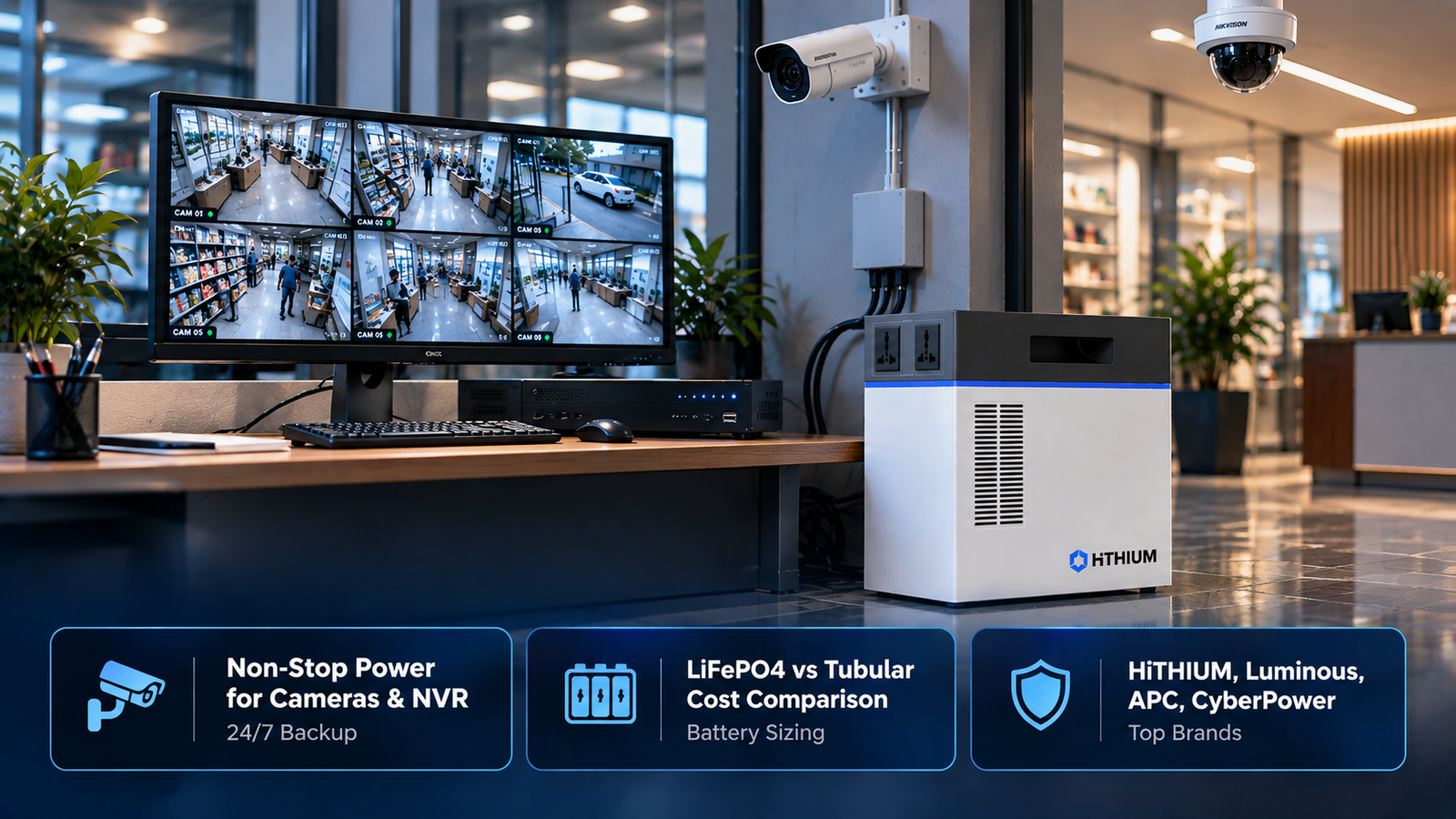
Power outages in Bangladesh are a daily reality. For homes and businesses relying on CCTV cameras and security systems, even a few minutes without power means total blackout of surveillance coverage. A reliable IPS (Integrated Power Supply) keeps your CCTV cameras, NVR/DVR recorders, alarms, and access control systems running through load shedding and unexpected outages — 24 hours a day, 7 days a week.
This guide explains exactly how to choose, size, and install an IPS for your CCTV and security system in Bangladesh. We cover runtime calculations, battery sizing, LiFePO4 vs tubular battery comparisons, and the top IPS brands available in the local market in 2026.
Why Your CCTV System Needs a Dedicated IPS
Most Bangladeshi homes and businesses install CCTV cameras but power the system from the same mains line that powers everything else. When load shedding hits, the UPS on your router may keep the internet running, but the cameras go dark — right when you need them most.
A dedicated IPS for security systems solves three critical problems:
- Continuous recording: Your NVR or DVR never stops recording. No gaps in footage during outages.
- Camera uptime: IP cameras and analog cameras both need power. Even PoE cameras draw from the same source.
- Alarm and access control: Electronic locks, motion sensors, and alarm panels all need uninterrupted power to function.
In Dhaka, Chattogram, and other major cities, load shedding can last 4-8 hours per day during peak summer months (April-September). A CCTV system without backup power is effectively useless for half the year.
How to Calculate IPS Capacity for CCTV Systems
Getting the right IPS capacity starts with understanding your total load. Most people undersize their IPS, which leads to shorter-than-expected runtime during outages.
Step 1: List All Security Equipment
Every device in your security setup draws power. Here is a realistic breakdown for a typical Bangladeshi home or small business:
| Device | Typical Wattage | Common Quantity | Total Watts |
|---|---|---|---|
| IP Camera (indoor) | 10-15W | 4-8 | 40-120W |
| IP Camera (outdoor with IR) | 15-25W | 2-4 | 30-100W |
| NVR Recorder (8-16 channel) | 20-50W | 1 | 20-50W |
| DVR Recorder | 15-30W | 1 | 15-30W |
| Router (for remote viewing) | 10-15W | 1 | 10-15W |
| Monitor (CCTV display) | 30-60W | 1 | 30-60W |
| Electronic Lock | 5-15W | 1-2 | 5-30W |
| Motion Sensor Panel | 3-5W | 1 | 3-5W |
Typical total load for 8-camera home system: 150-250W
Typical total load for 16-camera business system: 300-500W
Step 2: Calculate Required Battery Capacity
The formula for backup time is:
Backup Time (hours) = Battery Capacity (Ah) × Voltage (V) × 0.8 ÷ Total Load (W)
The 0.8 factor accounts for inverter efficiency losses. For example, if your CCTV system draws 200W and you want 8 hours of backup:
Required Ah = (200W × 8h) ÷ (12V × 0.8) = 167Ah
This means you need a 200Ah battery at 12V to comfortably power an 8-camera CCTV setup for 8 hours during load shedding. With LiFePO4 batteries, you get the full rated capacity even at high discharge rates — unlike tubular batteries that lose 20-30% capacity when drawing heavy current.
LiFePO4 vs Tubular Battery for CCTV Backup
Choosing the right battery chemistry is one of the most important decisions for a security system IPS. CCTV systems run 24/7, making battery cycle life and depth of discharge critical factors.
| Feature | LiFePO4 | Tubular Lead-Acid |
|---|---|---|
| Cycle Life | 11,000 cycles | 500-800 cycles |
| Depth of Discharge | 80-90% | 50% |
| Maintenance | Zero (sealed) | Regular water topping |
| Charge Time | 2-3 hours | 8-10 hours |
| Weight (314Ah) | ~8.5 kg | ~65 kg |
| Cost (2026 BD price) | 35,000-55,000 BDT | 15,000-25,000 BDT |
| 5-Year Total Cost | 33,725 BDT | 45,000-75,000 BDT |
| Warranty | 5 years | 1-2 years |
For CCTV systems, LiFePO4 batteries are the clear winner. Security cameras draw consistent low power over long periods — exactly the scenario where LiFePO4 excels. A LiFePO4 battery also handles frequent partial charges from solar panels if you add solar backup to your system.
Read our detailed guide on LiFePO4 battery lifespan in Bangladesh for more data on long-term cost savings.
Best IPS Recommendations for CCTV Systems in Bangladesh 2026
Based on capacity, reliability, and availability in the Bangladeshi market, here are the top IPS options for security system backup:
For Small Homes (4-8 Cameras)
A 1000VA-1500VA lithium IPS with a 100-200Ah LiFePO4 battery provides 6-10 hours of backup for a basic home CCTV setup. This covers the most common load shedding duration in Dhaka (4-6 hours) with a comfortable buffer.
Recommended capacity: 1000VA/12V with 100Ah LiFePO4 battery
Expected runtime: 8-12 hours for 4 cameras + NVR + router
Price range: 25,000-40,000 BDT (IPS unit + battery)
For Businesses (8-16 Cameras)
Businesses with larger camera counts need a 3000VA-5000VA IPS with 200-400Ah battery capacity. A three-phase system may be needed for very large installations with 20+ cameras plus access control and alarm systems.
Recommended capacity: 3000VA/24V with 200Ah LiFePO4 battery bank
Expected runtime: 8-10 hours for 16 cameras + NVR + monitor + router
Price range: 60,000-100,000 BDT (complete system)
For Critical Facilities (Banks, Warehouses, Apartments)
High-security installations need redundant power systems. A primary IPS plus a backup battery bank ensures zero downtime. Many Bangladeshi banks and warehouses use HiTHIUM lithium IPS systems for exactly this purpose.
Recommended capacity: 5000VA+ with 400Ah LiFePO4 battery bank
Expected runtime: 12-24 hours with extended battery bank
Price range: 100,000-200,000+ BDT
Check our full product catalog for current IPS models and pricing.
Installation Tips for CCTV IPS Systems
Proper installation ensures your IPS delivers maximum runtime and your security system stays protected. Follow these guidelines specific to Bangladeshi conditions:
- Location: Place the IPS and batteries in a cool, ventilated area. Dhaka summers push temperatures above 40°C — heat reduces battery life significantly. Avoid installing in direct sunlight or enclosed metal cabinets without airflow.
- Dedicated circuit: Run a separate electrical line from the IPS to your security equipment only. Mixing security loads with household loads (fans, lights, TV) reduces available backup time.
- Surge protection: Add a surge protector between the IPS output and your NVR/DVR. Voltage spikes during grid switchover can damage sensitive recording equipment. This is especially important in areas with unstable voltage (most of rural Bangladesh).
- Battery ventilation: Even sealed LiFePO4 batteries benefit from airflow. Do not stack batteries in a closed cupboard. Leave at least 15cm clearance on all sides.
- Cable sizing: Use appropriate cable gauge for the distance between the IPS and security equipment. For runs over 10 meters, use 2.5mm² cable to avoid voltage drop. See our cable size guide for detailed calculations.
- Earthing: Proper grounding protects both the IPS and connected equipment. Follow our earthing guide for safe installation practices.
IPS vs Solar Home System for CCTV — Which is Better for Bangladesh?
Many Bangladeshi homeowners ask whether they should use a solar home system or a traditional IPS for their CCTV setup. Here is a practical comparison:
Solar works well when: You have reliable sunlight (most of Bangladesh gets 4-5 hours daily), the CCTV system is in a location with good sun exposure for panels, and you want zero ongoing electricity cost for security.
IPS works better when: Load shedding is the primary concern (most urban areas), you need instant switchover with zero camera downtime, or your CCTV installation is indoors without direct sunlight access.
The best solution for Bangladesh: A solar-charged lithium IPS. This gives you free daytime power from the grid/solar, automatic battery backup during outages, and zero manual intervention. HiTHIUM’s solar-compatible IPS systems are designed exactly for this use case.
For detailed guidance, see our comparison of IPS vs generator for home use.
Frequently Asked Questions
How long can an IPS power CCTV cameras during load shedding in Bangladesh?
A 1000VA IPS with 100Ah LiFePO4 battery can power 4-6 CCTV cameras plus an NVR for 8-12 hours. A 3000VA system with 200Ah battery powers 12-16 cameras for 6-10 hours. Actual runtime depends on camera resolution, IR usage, and whether a monitor is connected. For most Bangladeshi homes facing 4-6 hours of daily load shedding, a 1000VA lithium IPS provides more than enough coverage.
What size IPS do I need for 8 CCTV cameras?
For 8 CCTV cameras with a 16-channel NVR and router, you need approximately 150-250W of total power. A 1000VA to 1500VA IPS with a 100Ah LiFePO4 battery at 12V provides 6-10 hours of backup. If your cameras include outdoor units with IR night vision (which draw more power), go with a 1500VA unit and 150Ah battery for extra headroom.
Is LiFePO4 battery better than tubular battery for CCTV backup?
Yes, LiFePO4 batteries are significantly better for CCTV applications. They deliver 11,000+ cycles versus 500-800 for tubular batteries, require zero maintenance, charge in 2-3 hours (versus 8-10 hours for tubular), and maintain full capacity at high discharge rates. While the upfront cost is 2-3x higher, the 5-year total cost of ownership is actually lower for LiFePO4 due to the longer lifespan and no maintenance costs.
Can I use a regular home IPS for my CCTV system?
You can, but a dedicated IPS is better. A regular home IPS shares battery capacity with all connected loads (fans, lights, router). During load shedding, the CCTV system competes with everything else for limited battery power. A dedicated IPS ensures your security system always has full battery access. If budget is tight, you can share a home IPS but should run CCTV on a separate output circuit to maintain priority.
How much does an IPS for CCTV cost in Bangladesh in 2026?
For a basic home CCTV setup (4-8 cameras), expect to pay 25,000-40,000 BDT for a complete IPS system with LiFePO4 battery. For business installations (8-16 cameras), costs range from 60,000-100,000 BDT. Critical facility systems with extended battery banks can cost 100,000-200,000+ BDT. LiFePO4 batteries have become more affordable in Bangladesh over the past two years, making them the recommended choice for new installations.
Do I need a separate IPS for my CCTV or can I share with my home UPS?
A separate dedicated IPS is strongly recommended for CCTV systems. Security cameras need 24/7 power with zero interruption. A shared home UPS will drain faster when other loads (fans, lights, TV) are also connected during outages. Most Bangladeshi homes face 4-8 hours of daily load shedding — a dedicated CCTV IPS ensures your surveillance stays active throughout. The cost difference is minimal compared to the security risk of having cameras go dark during a power cut.
Contact HiTHIUM for CCTV IPS Solutions
HiTHIUM Bangladesh offers a complete range of lithium IPS systems designed for security and surveillance applications. Our team can help you calculate the right capacity for your specific CCTV installation and recommend the best battery configuration.
Whether you need a simple home setup for 4 cameras or a multi-building system for a commercial complex, our engineers will design a solution that fits your budget and backup requirements.
Ready to secure your CCTV power supply? Visit our product catalog or contact our team for a free consultation and capacity assessment.
For more guides on IPS sizing and setup, explore our complete resource library including how to calculate IPS backup time and our guide to the best lithium IPS in Bangladesh.
📖 Related Guides — HiTHIUM Bangladesh
Recommended HiTHIUM Products
Based on your needs, here are the best HiTHIUM lithium IPS and power station options for Bangladesh:
| Product | Capacity | Best For | Price |
|---|---|---|---|
| HiTHIUM HeroEE Light 1 (500W, 1kWh) | 500W, 1kWh | Small homes, 5 fans + 3 lights + router + CCTV | ৳50,800 |
| HiTHIUM HeroEE 2 (1000W, 2kWh) | 1000W, 2kWh | Medium homes, fridge + fans + TV + lights | ৳78,100 |
Free delivery across Bangladesh. WhatsApp us for consultation: Contact HiTHIUM

One thought on “IPS for CCTV and Security System Backup in Bangladesh — 2026 Guide”