




Blog
IPS Cable Size Guide for Bangladesh Homes

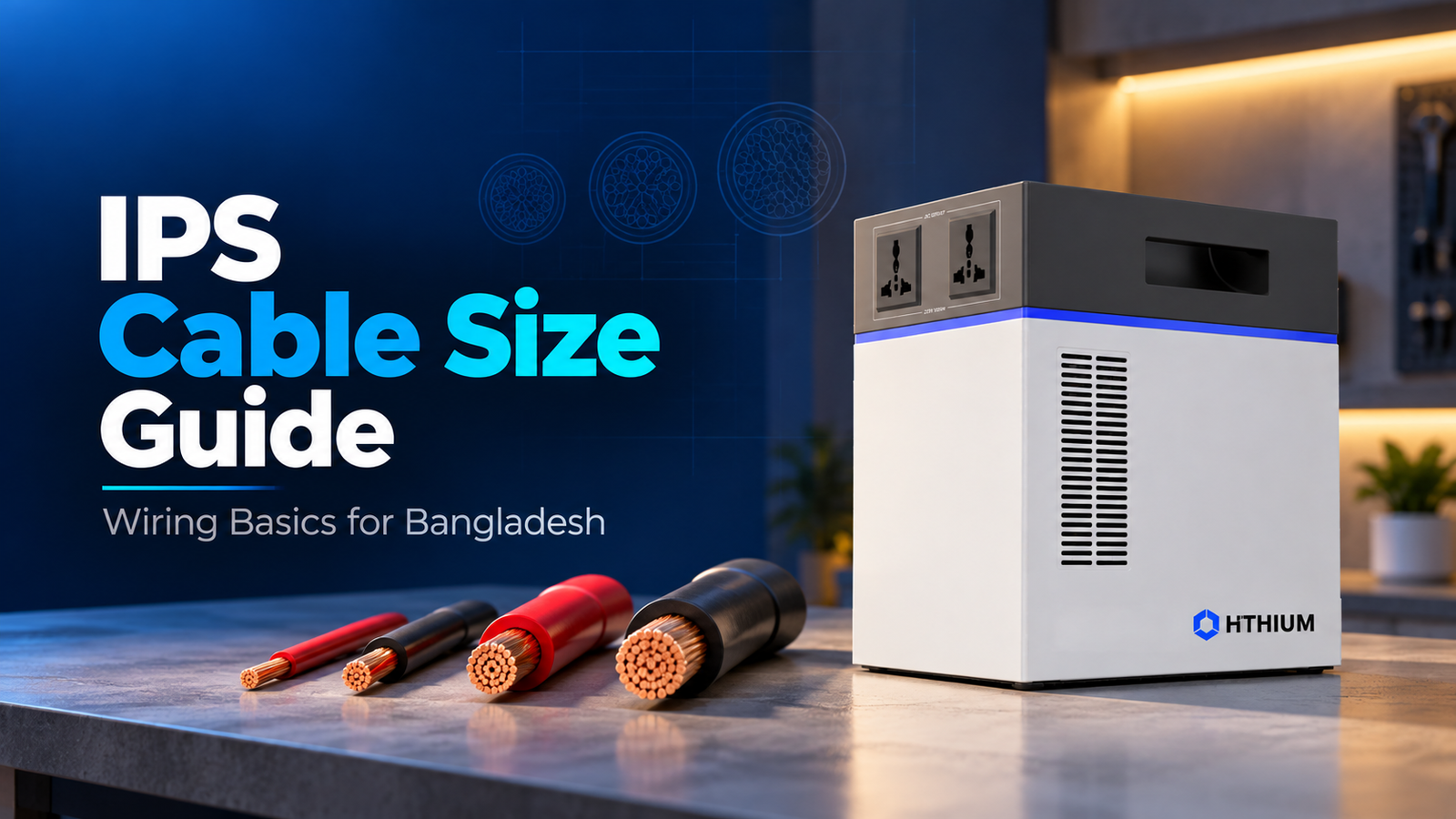
IPS Cable Size Guide for Bangladesh Homes
IPS cable size is not a small installation detail. In Bangladesh, wrong cable selection can cause voltage drop, hot wires, weak backup performance, battery stress, and in worst cases electrical fire. A 600VA IPS, a 1000VA IPS, and a 2000VA lithium IPS do not need the same cable thickness because their current load is different.
This guide explains how Bangladeshi homeowners can choose safe IPS cable size for fans, lights, routers, refrigerators, computer setups, and apartment backup lines. It is written for practical use, but final wiring must be checked by a licensed electrician because every home has different distance, load, earthing, and distribution-board condition.
If you are planning a new lithium IPS installation, compare product capacity first from the HiTHIUM lithium IPS guide. For overall product selection, also read our Best IPS in Bangladesh buying guide.
Why does IPS cable size matter?
IPS cable size matters because the cable must safely carry current from the IPS to the load without overheating or losing voltage. A thin wire may work for one fan and one light, but it can become unsafe when the same line runs a refrigerator, multiple fans, router, and computer. Cable heating is often hidden inside walls, so users notice the problem only when backup becomes unstable or switches feel warm.
In Bangladesh, many homes still use old wiring designed for basic lighting loads. When a modern inverter, lithium battery, or high-capacity IPS is added, the wiring should be reviewed again. The IPS unit may be efficient, but poor cable selection can reduce usable backup time and create safety risk.
For 2026 installations, we recommend treating cable size as part of the total IPS design, not as an afterthought. The system should be planned together: IPS VA rating, battery type, load list, cable distance, earthing, circuit breaker, and changeover wiring.
Quick cable size table for common home IPS setups
The table below gives a practical starting point for Bangladeshi homes. It is not a replacement for an electrician’s calculation, but it helps homeowners understand what to ask for before installation.
| IPS size | Typical load | Suggested copper cable | Best use |
|---|---|---|---|
| 600VA | 2 fans + 3 LED lights + router | 1.5 sq mm | Small flat or bedroom backup |
| 1000VA | 3-4 fans + 4-6 lights + router | 2.5 sq mm | Medium home backup line |
| 1500VA | Fans, lights, computer, small fridge | 4 sq mm | Family apartment |
| 2000VA+ | Heavy mixed load | 6 sq mm or engineer-approved size | Large home or office backup |
Use copper cable from a reliable brand. Avoid unknown low-price cable because many cheap wires have lower copper content than advertised. For long cable runs, your electrician may recommend one size higher to reduce voltage drop.
How do you calculate IPS cable size?
To calculate IPS cable size, estimate the load current, check the cable distance, then choose a wire that can carry the current with a safety margin. A simple rule is: higher watt load and longer distance need thicker cable. For home users, the calculation should be verified by an electrician because the same IPS can behave differently depending on wiring route and load pattern.
Use this simple process before buying cable:
- List the appliances that will run on backup.
- Add their approximate wattage.
- Divide total watts by 220V to estimate current.
- Add at least 25% safety margin.
- Check cable distance from IPS to distribution board.
- Select copper cable size based on current and distance.
Example: 3 ceiling fans at 75W each, 5 LED lights at 12W each, one Wi-Fi router at 15W, and one desktop setup at 150W equals about 450W. At 220V, current is about 2 amps, but startup surge, wire length, and future load expansion matter. That is why many medium home backup circuits use 2.5 sq mm copper cable rather than the thinnest option.
Recommended IPS cable sizes by home type in Bangladesh
Small apartment or single room backup
For one bedroom, study room, or small rented flat, a 600VA to 800VA IPS usually runs lights, fans, router, and phone chargers. A 1.5 sq mm copper cable may be enough for a short backup line if the load is controlled. Do not connect refrigerator, pump, microwave, iron, kettle, or AC to this circuit.
Medium family flat
For a family flat in Dhaka, Chattogram, Sylhet, or Cumilla, a 1000VA to 1500VA IPS is common. A 2.5 sq mm copper backup line is usually more practical because it gives better safety margin and supports moderate expansion. If you plan to run a computer or refrigerator during load-shedding, ask the electrician to check surge current.
Large home or office backup
For large apartments, duplex homes, clinics, shops, or small offices, a 2000VA+ IPS may need 4 sq mm, 6 sq mm, or larger cable depending on load and distance. For commercial use, read our Best IPS for Dhaka Office guide before planning the wiring.
What happens if the IPS wire is too thin?
If the IPS wire is too thin, it can heat up, waste power, reduce backup performance, and damage switches or terminals over time. The IPS may trip, the output voltage may drop, and appliances may restart during load change. These problems are common when a home upgrades the IPS but keeps old low-capacity wiring.
Warning signs include warm switchboards, burning smell, flickering lights, humming sound, frequent breaker trip, melted plug points, and backup time lower than expected. If any of these signs appear, turn off the load and call an electrician. Do not keep using the system because cable heat can spread inside wall conduits.
Thin cable is also a hidden cost. It may save a few hundred taka during installation, but it can reduce efficiency every day. In a 2026 Bangladesh home where load-shedding may happen for hours, a safe cable system protects the IPS investment and the family.
Copper vs aluminium cable for IPS installation
Copper is preferred for IPS wiring because it carries current better, handles heat better, and gives more stable connection at terminals. Aluminium cable is cheaper, but it needs larger size for similar current capacity and may loosen over time if not installed carefully.
| Factor | Copper cable | Aluminium cable |
|---|---|---|
| Conductivity | Higher | Lower |
| Heat handling | Better | Needs careful sizing |
| Terminal reliability | More stable | Can loosen if poorly fitted |
| Initial cost | Higher | Lower |
| Best use | Home IPS and critical backup | Only when engineer-approved |
For most home IPS systems, copper is the safer long-term choice. If a contractor suggests aluminium only to reduce cost, ask for the exact current rating and written specification.
IPS cable size, MCB, and earthing must work together
Safe IPS installation is not only about wire thickness. The cable, MCB, earthing, changeover switch, terminals, and distribution board must match. A thick cable with poor earthing is still unsafe. A good IPS with loose terminals will still create heat.
Use a dedicated backup circuit where possible. Label the IPS-supported switch lines so family members know which appliances can run during load-shedding. Keep high-load appliances on grid-only lines unless the IPS capacity is designed for them.
For grounding details, read our IPS earthing and grounding guide. If your IPS shows fault codes after installation, check the IPS troubleshooting and error codes guide.
2026 installation cost estimate in Bangladesh
Cable cost changes by copper price, brand, city, and wire length. In 2026, homeowners should budget not only for cable but also for MCB, changeover switch, conduit, labor, lugs, and proper testing.
| Item | Budget range | Notes |
|---|---|---|
| 1.5 sq mm copper cable | Lower cost | Short light backup lines |
| 2.5 sq mm copper cable | Medium cost | Common home IPS line |
| 4-6 sq mm copper cable | Higher cost | Heavy load or long distance |
| MCB/changeover accessories | Varies by brand | Do not use unknown cheap parts |
| Electrician labor | Depends on route | Higher for concealed wiring |
A safe installation may cost more upfront, but it protects the IPS, battery, appliances, and wiring. For lithium systems, the wiring quality matters even more because the battery can deliver stable power for long periods.
FAQ: IPS cable size in Bangladesh
What is the best IPS cable size for home?
For many Bangladeshi homes, 2.5 sq mm copper cable is a practical choice for a medium IPS backup circuit. Small single-room loads may use 1.5 sq mm, while heavy loads or long cable runs may need 4 sq mm or 6 sq mm.
Can I use normal house wire for IPS?
You can use existing wiring only if it is in good condition and rated for the backup load. Old or thin wiring should be replaced before connecting a new IPS, especially for 1000VA or higher systems.
Does cable length affect IPS performance?
Yes. Longer cable runs increase voltage drop and may require thicker cable. If the IPS is far from the distribution board, ask your electrician to calculate cable size using distance and load current.
Is copper cable better for IPS?
Yes, copper cable is usually better for home IPS wiring because it has higher conductivity, better heat performance, and more reliable terminal connection than aluminium cable.
What cable size is needed for a 1000VA IPS?
A 1000VA home IPS often uses 2.5 sq mm copper cable for normal fan, light, router, and small electronics backup. The final size depends on actual load and cable distance.
Who should install IPS wiring?
A qualified electrician should install IPS wiring. The electrician must check load, cable size, MCB rating, earthing, changeover switch, and terminal tightness before handover.
Final recommendation
Choose IPS cable size based on load, distance, and safety margin. Do not copy a neighbor’s wiring plan because their appliances, cable route, and IPS capacity may be different. For most medium homes, 2.5 sq mm copper cable is a sensible starting point, while larger systems need professional calculation.
HiTHIUM Bangladesh recommends planning the full backup system before installation: IPS model, lithium battery capacity, wiring, earthing, MCB, and appliance priority. Visit the HiTHIUM shop or contact the Bangladesh team for model selection support before final wiring work.
Recommended HiTHIUM Products
Based on your needs, here are the best HiTHIUM lithium IPS and power station options for Bangladesh:
| Product | Capacity | Best For | Price |
|---|---|---|---|
| HiTHIUM HeroEE 2 (1000W, 2kWh) | 1000W, 2kWh | Medium homes, bulbs + fans + TV | ৳78,100 |
| HiTHIUM HeroEE 16 (16kWh) | 16kWh | Large homes, offices, factories | ৳3,36,000 |
Free delivery across Bangladesh. WhatsApp us for consultation: Contact HiTHIUM

3 thoughts on “IPS Cable Size Guide for Bangladesh Homes”