




Blog
Lithium IPS for Grocery Stores and Shops Bangladesh

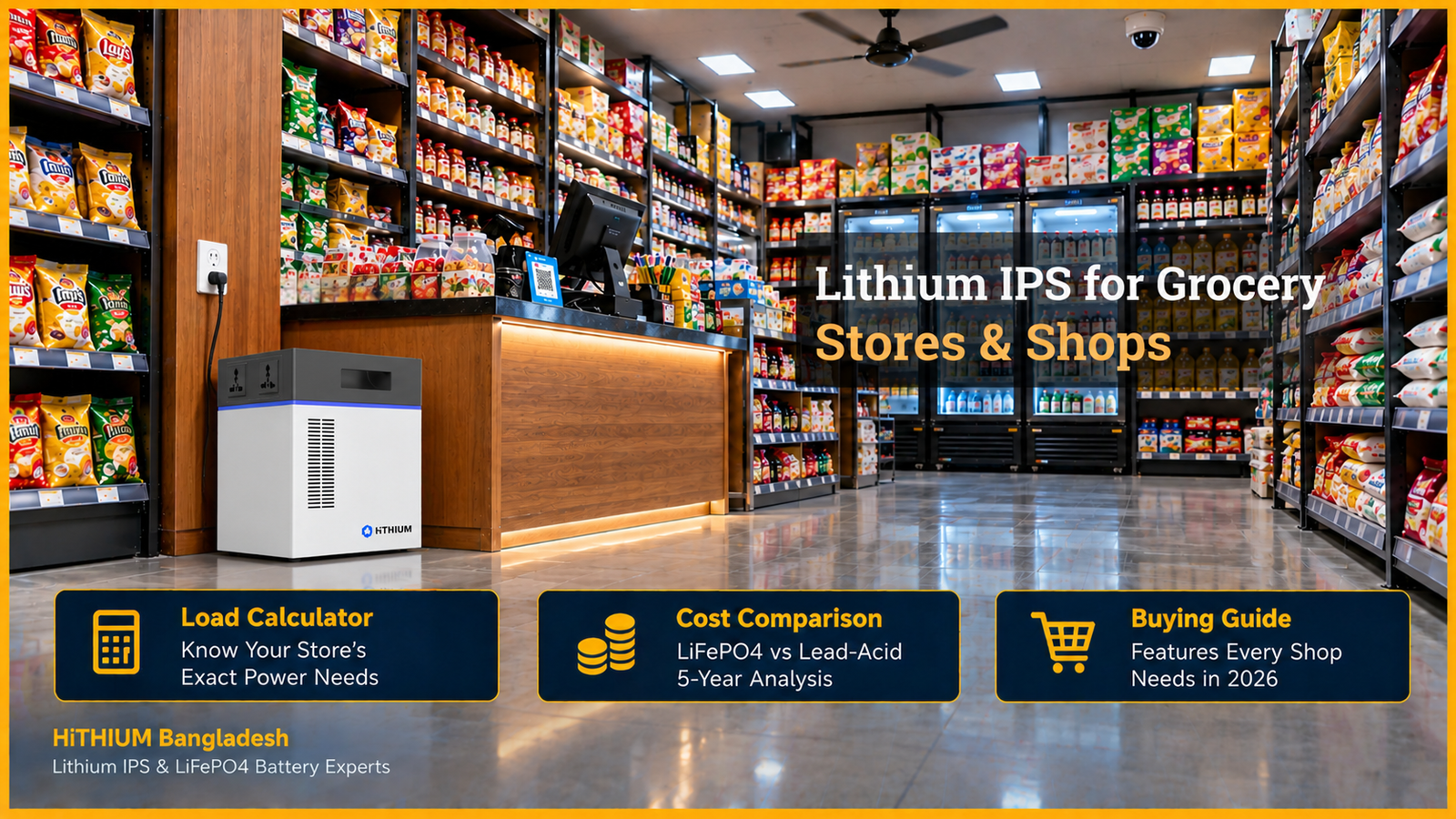
Running a grocery store or convenience shop in Bangladesh means dealing with unpredictable load shedding, power fluctuations, and the constant risk of spoiled inventory. A reliable backup power system isn’t optional — it’s a business necessity. A lithium IPS can keep your refrigerators, freezers, lights, and billing systems running smoothly during every power cut, protecting thousands of taka worth of perishable stock every month.
In this guide, we’ll explain why lithium IPS is the best backup power choice for grocery stores and convenience shops in Bangladesh, what capacity you need, how to calculate your load, and what to look for when buying one.
Why Grocery Stores and Convenience Shops Need a Lithium IPS in Bangladesh
Bangladesh experiences 8–14 hours of load shedding daily in many areas, especially during summer months. For grocery stores, even a 30-minute power outage can cause:
- Refrigerator compressor failure — frozen goods thaw, dairy spoils, and meat becomes unsafe
- Point-of-sale (POS) system shutdown — you can’t process transactions or track inventory
- Lighting loss — customers can’t browse products, reducing sales
- Security system gaps — CCTV and alarm systems go offline during the most vulnerable time
A regular generator is noisy, fuel-hungry, and requires constant maintenance. A lithium IPS is silent, starts instantly, needs almost no maintenance, and runs for years on the same battery. For small businesses where every taka counts, lithium IPS offers the lowest cost of ownership over 5–10 years.
How to Calculate the Right IPS Capacity for Your Store
The right IPS size depends on how many appliances you need to run simultaneously during a power outage. Here’s a typical breakdown for a small grocery store in Bangladesh:
| Appliance | Typical Wattage | Quantity | Total Watts |
|---|---|---|---|
| Deep freezer | 150–200W | 1 | 200W |
| Refrigerator | 100–150W | 1 | 150W |
| Cooler/AC | 800–1200W | 1 | 1000W |
| LED lights | 15–40W each | 8 | 160W |
| POS system + printer | 80–120W | 1 | 100W |
| CCTV (NVR + 4 cameras) | 60–80W | 1 | 70W |
| Ceiling fans | 60–75W each | 2 | 140W |
| Total | 1,820W |
For this setup, you’d need at least a 2000VA (2kVA) lithium IPS for essential loads only, or a 3000VA (3kVA) system if you want to run everything including the AC. The HiTHIUM lithium IPS range offers models from 1000VA to 5000VA to match different store sizes.
How many hours will a lithium IPS run a small grocery store?
A 2000VA lithium IPS with a 100Ah LiFePO4 battery will run essential grocery store loads (freezer, fridge, lights, POS) for approximately 4–6 hours. Adding a second battery bank extends this to 8–12 hours, which covers a typical evening load shedding period in Bangladesh.
Lithium IPS vs Lead-Acid IPS for Commercial Use
Many shop owners still use lead-acid (tubular or VRLA) batteries with their IPS. Here’s why lithium is a better investment for a commercial setting:
| Feature | Lithium (LiFePO4) | Lead-Acid (Tubular) |
|---|---|---|
| Lifespan | 25+ years (11,000+ cycles) | 2–4 years (800–1200 cycles) |
| Backup time (same capacity) | 90–95% usable | 50% usable (can’t fully discharge) |
| Maintenance | Zero (sealed, no water topping) | Monthly water topping required |
| Weight | 60–70% lighter | Very heavy (60–80 kg per battery) |
| Charging time | 2–3 hours full charge | 8–12 hours full charge |
| Heat tolerance | Operates up to 60°C | Performance drops above 40°C |
| 5-year total cost | ৳ 33,725 (no battery replacement cost only purchasing cost) | ৳60,000–1,20,000 (battery replacements) |
The fast charging is especially important for shops. During short power returns (15–30 minutes between load shedding cycles), a lithium battery recovers 40–60% of its charge, while a lead-acid battery recovers less than 10%. This means your store stays protected even during erratic power supply.
Is a lithium IPS worth the higher upfront cost for a small shop?
Yes. While lithium IPS costs 30–50% more upfront than lead-acid, the total cost of ownership over 5 years is 30–40% lower. You avoid battery replacement costs (lead-acid needs replacing every 2–3 years), maintenance labor, and the hidden cost of spoiled inventory from unreliable backup. Most shop owners recover the price difference within 18–24 months.
Top Features to Look for in a Commercial Lithium IPS
When choosing a lithium IPS for your grocery store or convenience shop, prioritize these features:
- Minimum 2000VA capacity — Small shops with 1–2 refrigerators need at least 2000VA. Medium stores with AC should go for 3000VA.
- Deep discharge protection — The BMS (Battery Management System) should prevent the battery from discharging below 10%, protecting your investment.
- Automatic voltage regulation (AVR) — Bangladesh’s grid voltage fluctuates between 150V–280V. AVR protects sensitive POS equipment and refrigerator compressors.
- Fast charging support — Look for models that charge to 80% within 2 hours. This is critical during erratic load shedding.
- Parallel capability — Some models allow you to connect two IPS units for extra capacity as your business grows.
- LCD display or WiFi monitoring — Monitor battery percentage, load, and runtime remotely — useful when you’re not physically at the shop.
Learn more about smart features in our smart IPS buying guide.
Real-World Setup: 2000VA Lithium IPS for a Dhaka Convenience Store
Here’s a practical example from a typical convenience store in Dhaka’s Mirpur area:
- Store size: 200 sq ft, 1 freezer, 1 fridge, 6 LED lights, 2 fans, POS system, 4-camera CCTV
- IPS selected: HiTHIUM 2kWh lithium IPS with 314Ah LiFePO4 battery
- Total load: ~1,000W (essential loads only)
- Backup time: 2 hours (covers evening load shedding)
- Cost: ৳ 78,100 for the complete system
- Monthly savings: ৳3,000–5,000 vs running a generator (fuel + maintenance)
The shop owner reported zero food spoilage incidents since installing the lithium IPS, compared to 2–3 incidents per month previously with the old lead-acid system that couldn’t keep up during extended outages.
Can I use solar panels to charge a lithium IPS in my shop?
Yes, most modern lithium IPS models support solar panel input. A 300W–500W solar panel array can supplement grid charging during daytime, reducing your electricity bill and providing backup power independence. HiTHIUM IPS models with solar input automatically switch between grid, solar, and battery power. See our solar panel setup guide for detailed instructions.
Maintenance Tips for Commercial Lithium IPS
Lithium IPS requires minimal maintenance, but these practices will maximize its lifespan in a commercial environment:
- Keep the unit ventililated — Don’t stack inventory on or around the IPS. Maintain at least 30cm clearance on all sides for heat dissipation.
- Avoid running beyond rated capacity — Consistently overloading the IPS shortens battery life. Use the load calculation guide to stay within limits.
- Check connections quarterly — Loose battery terminals cause voltage drops and can trigger BMS errors. Learn how to maintain terminals properly.
- Firmware updates — Some smart IPS models receive OTA (over-the-air) firmware updates that improve performance and safety. Check for updates every 3–6 months.
- Monitor battery health — Use the LCD display or WiFi app to track state of health (SoH). If it drops below 80%, plan for battery replacement. See our battery health testing guide.
Frequently Asked Questions
How much does a lithium IPS cost for a grocery store in Bangladesh?
A complete lithium IPS system for a small grocery store (2000VA with 100Ah battery) costs between ৳42,000 and ৳55,000 in Bangladesh in 2026. A 3000VA system with a larger battery costs ৳55,000–৳75,000. Prices vary by brand and battery capacity. HiTHIUM offers competitive pricing with warranty coverage and local service support.
How long does a lithium IPS last for commercial use?
A quality LiFePO4 lithium IPS battery lasts 25 years or 11,000 cycles for commercial use. In a typical grocery store with daily load shedding (1 cycle per day), the battery will still hold 80% capacity after 11 years. Lead-acid batteries in the same usage pattern typically need replacement every 2–3 years.
Can I connect multiple refrigerators to one lithium IPS?
Yes, but you need to calculate the total starting wattage. A refrigerator’s compressor draws 3–5× its running wattage during startup. If you have two refrigerators (150W each running), the combined starting surge could be 1,000–1,500W. A 2000VA lithium IPS handles this easily, but add the remaining loads carefully to stay within the rated capacity.
Is it safe to run a lithium IPS in a hot shop environment?
LiFePO4 batteries are safer and more heat-tolerant than lead-acid batteries. They operate reliably up to 60°C, compared to lead-acid which loses capacity rapidly above 40°C. However, keep the IPS away from direct sunlight and ensure adequate ventilation. In Bangladesh’s hot climate, lithium IPS actually outperforms lead-acid in real-world conditions.
Do I need a separate inverter and battery, or an all-in-one IPS?
For most grocery stores, an all-in-one lithium IPS (inverter + battery integrated) is the better choice. It saves space, simplifies installation, and comes with a matched BMS that optimizes battery life. Separate inverter + battery setups offer more flexibility but require technical knowledge to match components correctly. HiTHIUM’s all-in-one models are designed for plug-and-play installation.
Get the Right IPS for Your Store
Every grocery store and convenience shop has different power needs. Whether you run a small corner shop in Old Dhaka or a larger supermarket in Uttara, choosing the right lithium IPS capacity ensures your business never loses a single rupee to power outages.
Ready to protect your business from load shedding? Contact HiTHIUM Bangladesh for a free consultation. We’ll help you calculate your exact load requirements and recommend the best lithium IPS system for your store. Visit our shop to browse the full range of lithium IPS products, or call us for expert advice.
For more guides, check our complete lithium IPS buying guide and learn how to extend your IPS battery life with simple maintenance habits.
Recommended HiTHIUM Products
Based on your needs, here are the best HiTHIUM lithium IPS and power station options for Bangladesh:
| Product | Capacity | Best For | Price |
|---|---|---|---|
| HiTHIUM HeroEE Light 1 (500W, 1kWh) | 500W, 1kWh | Small homes, 5 fans + 4 lights + router | ৳50,800 |
| HiTHIUM HeroEE 2 (1000W, 2kWh) | 1000W, 2kWh | Medium homes, fridge + fans + lights | ৳78,100 |
Free delivery across Bangladesh. WhatsApp us for consultation: Contact HiTHIUM
