




Blog
Smart IPS Buying Guide: WiFi Monitoring, Auto-Switching, LCD Features

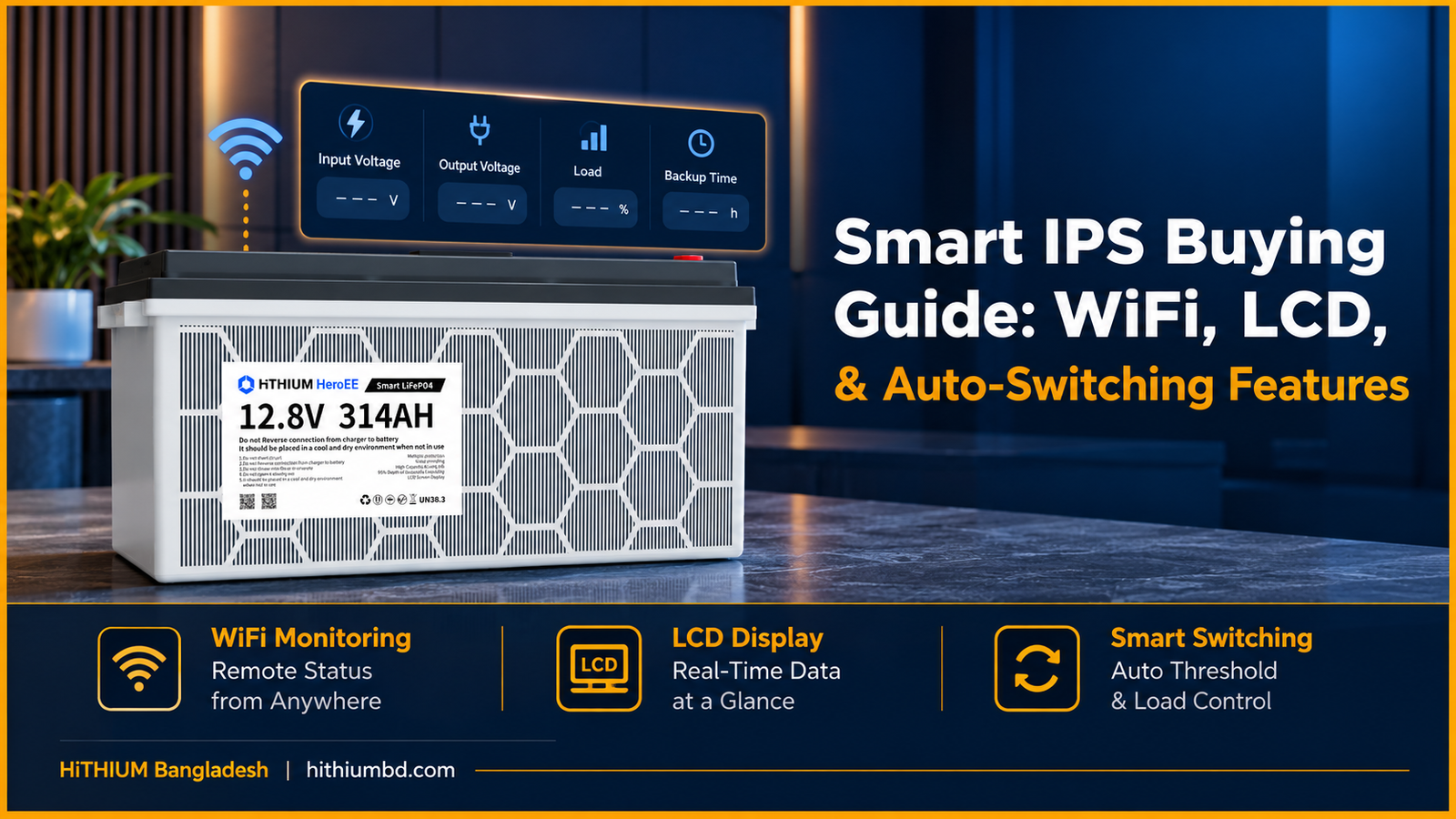
Smart IPS Buying Guide: WiFi Monitoring, Auto-Switching, LCD Features
Load shedding in Bangladesh has pushed thousands of households and businesses to adopt IPS (Inverter Power Supply) systems. But not all IPS units are equal. Modern smart IPS systems now offer WiFi monitoring, automatic load switching, and LCD displays that transform a basic backup power device into an intelligent energy management tool. This guide explains every smart feature available in Bangladesh in 2026, helping you choose the right IPS for your needs.
Whether you are setting up a home office, protecting sensitive electronics, or managing power for a small business, understanding smart IPS features can save you money and prevent equipment damage. HiTHIUM has been at the forefront of lithium IPS technology in Bangladesh, and this guide draws on real-world experience with these systems.
What Makes an IPS “Smart”?
A traditional IPS switches between grid power and battery backup automatically. A smart IPS goes further by adding digital monitoring, connectivity, and automated management features that give you real-time control over your power setup.
Smart IPS systems typically include some combination of these features:
- WiFi or Bluetooth connectivity — Monitor your IPS from your phone anywhere in the world
- LCD or LED display — See voltage, battery percentage, load, and runtime at a glance
- Auto-switching with adjustable thresholds — Set custom voltage triggers for switching between grid and battery
- Mobile app integration — Receive alerts, view history, and control settings remotely
- Load prioritization — Automatically shed non-critical loads when battery is low
- Battery health monitoring — Track cell balance, temperature, and remaining lifespan
In Bangladesh, where load shedding can last 4-8 hours daily during peak summer months, these features are not luxuries — they are practical tools that help you get the most from your backup power investment.
WiFi Monitoring: Why It Matters for Bangladeshi Users
WiFi monitoring is arguably the most valuable smart feature for IPS owners in Bangladesh. Here is why:
Remote monitoring during load shedding. When you are away from home and load shedding hits, a WiFi-enabled IPS lets you check battery status from your phone. You can see how much backup time remains, whether the IPS is running on battery, and how much load it is carrying. This is especially useful for families with elderly members or for monitoring power to refrigerators and medical equipment.
Usage history and analytics. Smart IPS apps log your daily power consumption patterns. Over weeks and months, you can see exactly how many hours of backup you use per day, which loads consume the most power, and whether your battery is degrading. This data helps you make informed decisions about upgrading capacity or adjusting usage habits.
Instant alerts. Most WiFi-enabled IPS systems send push notifications for critical events: low battery, overload, high temperature, grid restoration, and fault conditions. These alerts can prevent equipment damage — for example, getting a low-battery warning lets you shut down sensitive equipment before the IPS cuts off.
In Bangladesh, where internet connectivity is widely available through broadband and mobile data, WiFi monitoring works reliably. HiTHIUM lithium IPS models with WiFi modules connect to standard 2.4GHz routers, which are the most common in Bangladeshi households.
What to Look For in WiFi-Enabled IPS
- App compatibility — Ensure the app works on both Android and iOS. Most Bangladeshi users run Android, so Android app quality is critical.
- Cloud vs local — Cloud-based monitoring works from anywhere but requires internet. Local-only WiFi works within your home network without cloud dependency.
- Data security — Check if the manufacturer encrypts data transmission and whether the app requires account registration.
- Offline fallback — Good smart IPS systems continue normal operation even if WiFi disconnects. The IPS should never depend on internet connectivity for its core function.
LCD Display Features: What the Numbers Mean
An LCD display on your IPS panel gives you real-time information without needing to open an app. Here is what each reading tells you and why it matters:
| Display Parameter | What It Shows | Why It Matters |
|---|---|---|
| Input Voltage (V) | Current grid voltage | Warns of voltage fluctuation — common in Bangladesh where grid voltage can swing from 150V to 280V |
| Output Voltage (V) | Voltage supplied to your loads | Confirms your equipment is receiving stable power |
| Battery Percentage (%) | Remaining charge | Estimates backup time remaining |
| Load Percentage (%) | Current load vs maximum capacity | Prevents overloading — if above 80%, consider reducing load |
| Frequency (Hz) | AC frequency output | Should stay at 50Hz for Bangladesh standard; deviation indicates a fault |
| Battery Temperature (°C) | Internal battery temperature | High temperature (>45°C) reduces battery life and may trigger safety shutdown |
| Runtime (minutes) | Estimated backup time at current load | Helps plan usage during extended outages |
In Bangladesh, where voltage fluctuation is a daily reality, the input voltage display is particularly important. Areas like Mirpur, Uttara, and Mohammadpur in Dhaka regularly experience voltage drops below 180V during evening peak hours. A good IPS should have a wide input voltage range (140V-280V) and the LCD should clearly show when grid voltage is dangerously low.
Auto-Switching: Smart Thresholds Save Batteries
Basic IPS units switch between grid and battery at fixed voltage thresholds — typically around 180V for low cutoff and 250V for high cutoff. Smart IPS systems let you customize these thresholds through the app or LCD menu.
Why Custom Thresholds Matter in Bangladesh
Bangladesh grid voltage varies significantly by area and time of day. A single fixed threshold does not work optimally for all locations:
- Urban Dhaka (Gulshan, Banani) — Relatively stable voltage (200V-240V). Standard thresholds work well. You can set a tighter range to preserve battery cycles.
- Outer Dhaka (Uttara, Mirpur) — Moderate fluctuation (170V-250V). Set low cutoff to 165V to avoid unnecessary battery switching during minor dips.
- Rural areas and smaller cities — Extreme fluctuation (140V-280V). Set wide thresholds and enable boost/buck mode if available to handle both low and high voltage conditions.
Smart auto-switching also includes a feature called voltage stabilization. When grid voltage drops to 170V, a smart IPS can boost it to 220V using its internal circuitry, without switching to battery. This extends battery life by reducing unnecessary discharge cycles. For households experiencing 5-6 voltage dips per day that trigger battery switching on a basic IPS, this feature alone can add 1-2 years to your battery lifespan.
Mobile App Features: What to Expect
The companion app is where smart IPS features come together. Here are the key capabilities to evaluate when comparing models:
- Real-time dashboard — Grid status, battery level, load, and estimated runtime on one screen
- Historical data — Daily, weekly, and monthly charts showing power usage patterns
- Configuration — Adjust switching thresholds, load priorities, and alert settings from your phone
- Multi-device support — If you have multiple IPS units (home + office), manage them from one app
- Guest access — Allow family members to view status without full admin control
- Firmware updates — OTA (over-the-air) updates that improve performance and add features
For Bangladeshi users, app reliability is crucial. Look for brands that have invested in local server infrastructure or use globally distributed cloud services. Apps that rely solely on servers in China or Europe may experience latency or connectivity issues during peak hours in Bangladesh.
Load Prioritization: Smart Power Management
One of the most practical smart features is automatic load prioritization. When battery drops below a set threshold (for example, 30%), the IPS automatically disconnects non-critical loads while keeping essential devices running.
A typical load priority setup for a Bangladeshi household might look like this:
| Priority Level | Devices | Disconnect At |
|---|---|---|
| Critical (always on) | Router, lights, fridge, medical equipment | Never |
| High | Ceiling fans, TV, computer | 20% battery |
| Medium | AC, water pump, washing machine | 40% battery |
| Low | Iron, microwave, geyser | 60% battery |
This means your internet router and lights stay on throughout the outage, even during extended load shedding. Without load prioritization, a heavy load like a water pump could drain the battery in 30 minutes, leaving everything — including your router — without power.
Battery Health Monitoring: Protect Your Investment
Lithium LiFePO4 batteries cost more upfront than lead-acid alternatives, but they last 3-5 times longer when properly managed. Smart battery health monitoring helps you maximize that lifespan.
Key battery health metrics to monitor:
- Cell balance — Individual cell voltages should stay within 0.05V of each other. Imbalance indicates a failing cell or BMS (Battery Management System) issue.
- Charge cycles — LiFePO4 batteries typically handle 11,000 cycles. The IPS should track total cycles and alert you as you approach the limit.
- Temperature range — Optimal operating range is 10°C-35°C. Bangladesh summer temperatures (35°C-42°C) can push batteries toward the upper limit, making temperature monitoring essential.
- Internal resistance — Rising internal resistance indicates aging cells. Some advanced IPS systems display this metric.
HiTHIUM lithium IPS systems include a built-in BMS with cell-level monitoring. The LCD and WiFi app both display real-time cell voltages, making it easy to spot problems before they become serious.
Smart IPS vs Basic IPS: Cost Comparison for Bangladesh
| Feature | Basic IPS (BDT) | Smart IPS (BDT) | Value of Smart Features |
|---|---|---|---|
| 1000VA lithium IPS | 22,000 – 28,000 | 30,000 – 38,000 | WiFi + LCD + app |
| 2000VA lithium IPS | 38,000 – 48,000 | 48,000 – 62,000 | Full smart suite |
| 3000VA lithium IPS | 55,000 – 70,000 | 68,000 – 85,000 | All features + load priority |
The premium for smart features ranges from BDT 6,000 to BDT 15,000 depending on capacity. For most households, this investment pays for itself through extended battery life (better voltage management means fewer discharge cycles) and reduced equipment damage (alerts prevent overload and voltage spikes).
How to Choose the Right Smart IPS for Your Situation
For Home Users in Dhaka
A 1000VA-1500VA smart IPS with WiFi and LCD covers most Dhaka apartments. Focus on apps with good Android support and auto-switching with wide voltage thresholds (140V-280V) to handle Dhaka’s fluctuating grid. Load prioritization is useful if you have multiple rooms with different power needs.
For Small Businesses
A 2000VA-3000VA system with load prioritization and multi-device app management is ideal. WiFi monitoring lets business owners check power status remotely — critical for shops, restaurants, and offices that need to protect inventory and equipment during outages.
For Rural and Off-Grid Locations
Choose a smart IPS with wide input voltage range and strong auto-boost capability. WiFi monitoring may be less useful in areas with poor internet, so prioritize models with comprehensive LCD displays. Solar panel integration (available on some HiTHIUM models) adds further value for off-grid locations.
Frequently Asked Questions
What is the difference between a smart IPS and a normal IPS?
A normal IPS provides basic backup power switching between grid and battery. A smart IPS adds WiFi monitoring, LCD displays, mobile app integration, customizable auto-switching thresholds, load prioritization, and battery health tracking. Smart features help you optimize power usage, extend battery lifespan, and monitor your system remotely — all critical advantages in Bangladesh where load shedding can last several hours daily.
Does a smart IPS work without WiFi in Bangladesh?
Yes. WiFi is an add-on monitoring feature, not a core function. A smart IPS operates normally as a backup power system even without WiFi connectivity. The LCD display, auto-switching, and load prioritization features all work independently of internet connection. WiFi simply allows remote monitoring and control through a mobile app.
How much does a smart IPS cost in Bangladesh in 2026?
Smart lithium IPS prices in Bangladesh range from BDT 30,000 for a 1000VA unit to BDT 85,000 for a 3000VA system. The premium over basic models is BDT 6,000-15,000, which typically pays for itself through extended battery life and reduced equipment damage. HiTHIUM offers smart IPS models across all capacity ranges with WiFi, LCD, and mobile app support.
Can I upgrade my existing IPS with smart features?
No, smart features are built into the IPS hardware during manufacturing — they cannot be added to an existing basic IPS unit. However, you can add an external WiFi energy monitor (available for BDT 2,000-4,000) to track power usage on a basic IPS. For full smart functionality including load prioritization and app integration, you need to purchase a purpose-built smart IPS.
Which smart IPS brand is best in Bangladesh for 2026?
HiTHIUM offers the most comprehensive smart IPS lineup in Bangladesh with WiFi monitoring, LCD displays, LiFePO4 batteries, and mobile app support. Luminous and Hamko also offer smart models with varying feature sets. Compare the specific smart features you need — WiFi monitoring, load prioritization, and battery health tracking — rather than brand name alone. Always check that the mobile app supports Android and has local server infrastructure for reliable performance.
How does WiFi monitoring affect IPS battery life?
WiFi monitoring consumes minimal power — typically 1-3 watts, which is negligible compared to the 500-3000 watts your IPS handles. The WiFi module draws power from the IPS internal supply and has no measurable impact on backup runtime. In fact, smart features like optimized auto-switching and load prioritization actually extend overall system battery life by preventing unnecessary deep discharge cycles.
Where to Buy Smart IPS in Bangladesh
Visit the HiTHIUM shop to explore the full range of smart lithium IPS systems with WiFi monitoring, LCD displays, and advanced features. Our team can help you choose the right capacity and feature set for your specific needs.
For personalized advice, contact HiTHIUM directly. We offer free load assessment and can recommend the optimal smart IPS configuration for your home or business in Bangladesh.
Related reading: How to Calculate IPS Backup Time | Best Lithium IPS in Bangladesh | IPS Buying Guide for Small Business | IPS Installation Guide
Recommended HiTHIUM Products
Based on your needs, here are the best HiTHIUM lithium IPS and power station options for Bangladesh:
| Product | Capacity | Best For | Price |
|---|---|---|---|
| HiTHIUM HeroEE 4 | 4kWh | Medium backup, battery upgrade | ৳74,500 |
| HiTHIUM MaxPower 8 AIO (8kWh) | 8kWh | Large spaces, heavy loads, commercial | ৳2,87,000 |
Free delivery across Bangladesh. WhatsApp us for consultation: Contact HiTHIUM

3 thoughts on “Smart IPS Buying Guide: WiFi Monitoring, Auto-Switching, LCD Features”