




Blog
Solar Panel for Home IPS in Bangladesh — Complete Setup Guide 2026

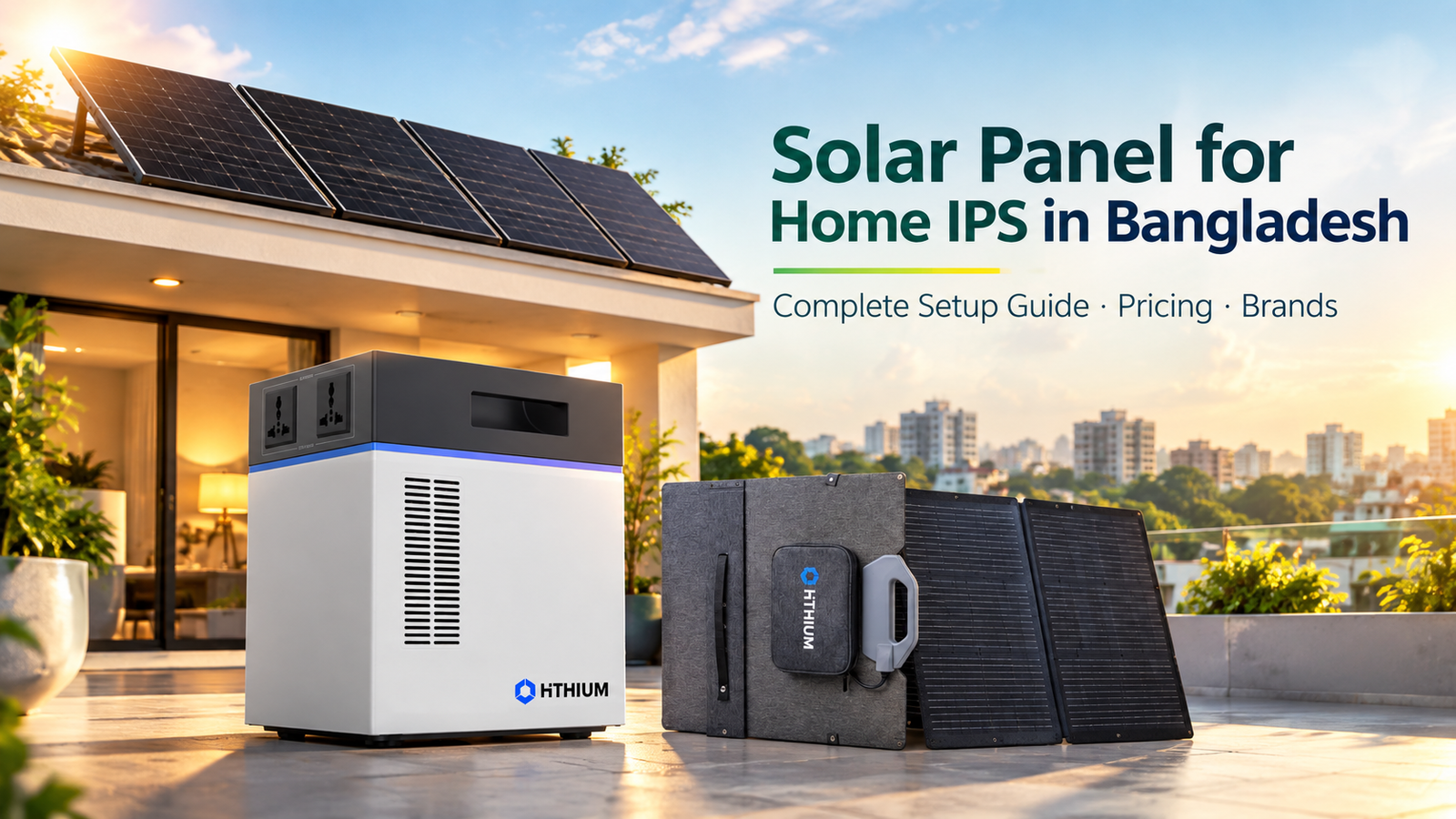
Bangladesh receives an average of 4.5–5.5 peak sun hours per day — one of the best solar resources in South Asia. Yet most Bangladeshi homes still rely on grid electricity or diesel generators during load-shedding. Adding a solar panel for home IPS in Bangladesh changes this equation entirely: your IPS charges from the sun during the day and powers your home at night or during outages — at near-zero running cost.
This complete setup guide covers everything you need to know: how to size your solar panels, which battery type to choose, how to wire the system, what it costs in 2026, and which HiTHIUM models pair best with solar input.
Why Add Solar Panels to Your Home IPS?
A standard home IPS charges from the grid. When load-shedding happens, the IPS runs on its battery — then you wait for grid power to recharge it. In some areas of Dhaka, Chattogram, and rural Bangladesh, load-shedding can last 6–10 hours per day. If your battery is 100Ah and load-shedding lasts 8 hours, you may run out of backup before the power returns.
Solar panels solve this by recharging the battery continuously during daylight hours, independent of grid availability. A properly sized solar IPS system in Bangladesh can provide 8–16 hours of daily backup for a typical home.
- Zero electricity cost for daytime charging
- Continuous recharge even during extended load-shedding
- Lower grid dependency — ideal for village homes and areas with frequent outages
- Environmentally friendly — no fuel, no emissions
- LiFePO4 compatibility — modern lithium batteries work excellently with solar charge controllers
How to Size Solar Panels for Your Home IPS
The most common mistake Bangladeshi homeowners make is buying solar panels that are too small. Here is a simple calculation method used by HiTHIUM’s installation team:
Step 1 — Calculate Your Daily Energy Need (Watt-Hours)
| Appliance | Watts | Hours/Day | Wh/Day |
|---|---|---|---|
| Ceiling Fan (×3) | 75 × 3 = 225W | 10 | 2,250 |
| LED Lights (×6) | 9 × 6 = 54W | 8 | 432 |
| TV (32-inch) | 60W | 5 | 300 |
| Router / Modem | 15W | 16 | 240 |
| Phone Chargers (×2) | 20W | 4 | 80 |
| TOTAL | — | — | 3,302 Wh/day |
Step 2 — Calculate Required Solar Panel Capacity
Bangladesh gets approximately 4.5 peak sun hours per day on average (lower in monsoon: ~3.5 hours; higher in winter: ~5.5 hours). Divide your daily energy need by peak sun hours and add 20% for system losses:
Formula: Required Panel Watts = (Daily Wh ÷ Peak Sun Hours) × 1.2 loss factor
Example: (3,302 ÷ 4.5) × 1.2 = 880W of solar panels
In practice, a medium-sized Bangladeshi home (3 fans, 6 lights, TV, router) needs 800W–1,000W of solar panels. A small flat (2 fans, 4 lights, router) needs 500W–600W.
Step 3 — Size Your Battery Bank
Your battery must store enough energy to run the home through the night (typically 8–10 hours with no solar input). For 3,302 Wh/day and 10 hours of night operation covering roughly 50% of daily consumption:
Night energy need: ~1,650 Wh. With a LiFePO4 battery at 90% usable depth of discharge: 1,650 ÷ 0.9 ≈ 1,833 Wh capacity needed. At 24V system voltage: 1,833 ÷ 24 ≈ 77Ah. Choose 100Ah for comfortable headroom.
Solar Panel + IPS System Components
A complete solar IPS system for a Bangladeshi home requires these four components:
1. Solar Panels
Monocrystalline panels are recommended for Bangladesh. They perform better in high-heat and partial-shade conditions (relevant during monsoon cloud cover) and have longer lifespans (25+ years) than polycrystalline panels. In 2026, monocrystalline panels cost ৳35–৳55 per watt in Dhaka’s IDB Bhaban and New Elephant Road markets.
2. Solar Charge Controller
The charge controller sits between the solar panels and the battery. It prevents overcharging and optimises power extraction. For LiFePO4 batteries, you need an MPPT (Maximum Power Point Tracking) controller with LiFePO4 charge profile support. MPPT controllers are 15–20% more efficient than PWM controllers and are required for panel arrays above 400W. Cost: ৳3,500–৳15,000 depending on current rating (20A–60A).
3. IPS / Inverter with Solar Input
Not all IPS units support solar input. Look for models with a built-in solar charge controller or an external MPPT input terminal. HiTHIUM’s HeroEE series supports solar charging via its charge controller input — making integration straightforward.
4. Battery Bank
For solar IPS systems, LiFePO4 (Lithium Iron Phosphate) batteries are strongly preferred over traditional tubular batteries. Reasons:
- LiFePO4 handles partial state-of-charge (PSOC) cycling well — critical for solar systems where battery may charge and discharge partially multiple times per day
- No memory effect — no performance loss from partial cycles
- 95%+ charge efficiency (tubular: ~80%) — more solar energy stored
- 11,000 charge cycles (tubular: 300–500 cycles)
- No water top-up, no acid fumes — safer for home installation
Solar Panel + IPS Cost in Bangladesh 2026
| System Size | Solar Panels | Battery | MPPT Controller | Total Cost (BDT) | Best For |
|---|---|---|---|---|---|
| Small (400W) | ৳18,000–22,000 | ৳20,000–28,000 | ৳4,000–6,000 | ৳45,000–60,000 | Studio / 1-bedroom flat |
| Medium (800W) | ৳36,000–44,000 | ৳40,000–55,000 | ৳7,000–10,000 | ৳90,000–1,20,000 | 2–3 bedroom apartment |
| Large (1.5kW) | ৳65,000–80,000 | ৳80,000–1,10,000 | ৳12,000–18,000 | ৳1,70,000–2,20,000 | Large home / village house |
| Heavy (3kW) | ৳1,20,000–1,50,000 | ৳1,50,000–2,00,000 | ৳20,000–30,000 | ৳3,00,000–4,00,000 | Business / shop with AC |
Prices as of July 2026. Installation labour: add ৳8,000–৳20,000 depending on roof type and system complexity.
Step-by-Step Solar IPS Installation Guide for Bangladeshi Homes
This is a general guide. Always consult a licensed electrician for wiring work, especially if connecting to your main distribution board.
Step 1 — Choose Panel Mounting Location
Mount panels on the south-facing slope of your roof for maximum sun exposure in Bangladesh. Tilt angle should be 20–25 degrees (matching Bangladesh’s latitude of 20–26°N). Ensure no shading from water tanks, buildings, or trees between 9 AM and 3 PM. Flat rooftops can use adjustable aluminium frames.
Step 2 — Install Solar Panels
Fix the aluminium mounting frame to the roof using anchor bolts. Secure panels in the frame. Connect panels in series (to increase voltage) or parallel (to increase current) depending on your MPPT controller’s input voltage range. Most home MPPT controllers accept 12V–150V DC input.
Step 3 — Wire Panels to MPPT Charge Controller
Run DC cable (minimum 4mm² cross-section for runs up to 10 metres; 6mm² for longer runs) from the panel array to the MPPT charge controller. Use MC4 connectors. Connect positive to positive and negative to negative. The MPPT controller must be installed in a shaded, ventilated location — not in direct sun.
Step 4 — Connect MPPT Controller to Battery
Connect the battery terminals to the MPPT controller’s battery output. For LiFePO4 batteries, set the charge controller profile to LiFePO4 (bulk: 14.6V, float: 13.6V for 12V systems). Do NOT use the default “sealed lead acid” profile — it will undercharge a lithium battery.
Step 5 — Connect IPS/Inverter to Battery
If your IPS has a separate battery terminal (most hybrid inverter IPS units do), connect the battery bank to the IPS input. In simpler systems (standard IPS with external MPPT), the MPPT charges the battery and the IPS inverter draws from the same battery bank. Ensure circuit breakers (DC and AC) are installed on each branch for protection.
Step 6 — Test the System
In daylight, the MPPT controller’s display should show solar input watts, battery charging current, and battery voltage. The IPS should show “solar charging” or the battery indicator should be rising. Test by switching off grid and running loads — the IPS should sustain them from battery charged by solar.
HiTHIUM HeroEE — Recommended for Solar IPS Systems
HiTHIUM’s HeroEE LiFePO4 IPS series is particularly well-suited for solar integration in Bangladesh:
- LiFePO4 chemistry — tolerates the partial charge/discharge cycles that solar charging creates daily
- High charge efficiency (95%+) — more of your solar energy is stored, not wasted as heat
- 11,000+ cycle lifespan — at one charge cycle per day, that’s 25+ years of service life
- Wide operating temperature — performs reliably in Bangladesh’s summer temperatures (38–42°C)
- No maintenance — no water top-up, no acid corrosion, no terminal cleaning needed
- 5-year warranty — significantly longer than tubular batteries (2-year typical)
Browse available HeroEE models and capacity options at the HiTHIUM Bangladesh official shop.
Common Mistakes to Avoid
| Mistake | Why It’s a Problem | What to Do Instead |
|---|---|---|
| Buying undersized panels | Battery never fully charges; poor backup at night | Calculate actual load first, then size panels with 20% buffer |
| Using PWM instead of MPPT | 15–20% energy loss; panels can’t work at optimal voltage | Always use MPPT for arrays above 200W |
| Wrong battery charge profile | Lead-acid profile undercharges LiFePO4; reduces capacity | Set MPPT to LiFePO4 profile explicitly |
| Poor cable sizing | Resistance losses; fire risk with undersized DC cables | Use 4mm² minimum for short DC runs; 6mm² for long ones |
| Panels facing east or west | 50–60% less energy output than south-facing | South-facing at 20–25° tilt; use adjustable frames if needed |
| No circuit breakers | Risk of fire or equipment damage if short circuit occurs | Install DC breaker (solar side) and AC breaker (load side) |
Frequently Asked Questions (FAQ)
How many solar panels do I need for a home IPS in Bangladesh?
For a typical Bangladeshi home with 3 ceiling fans, 6 LED lights, a TV, and a router, you need approximately 600W–800W of solar panels. A studio flat or small apartment needs 300W–500W. The exact number depends on your daily energy consumption and available peak sun hours (4.5 hours average in Bangladesh). Always calculate your load before buying panels.
Can I add solar panels to my existing IPS in Bangladesh?
Yes, in most cases. You need to add an MPPT solar charge controller between the panels and the IPS battery. The MPPT controller charges the battery from solar, and the existing IPS inverter runs your loads as normal. However, if your existing IPS has a built-in charge controller, you need to check whether it supports external MPPT input. HiTHIUM HeroEE models are designed for easy solar integration.
What is the cost of a solar panel IPS system in Bangladesh in 2026?
A complete solar IPS system in Bangladesh costs ৳45,000–৳60,000 for a small (400W) setup suitable for a studio flat, ৳90,000–৳1,20,000 for a medium (800W) home system, and ৳1,70,000–৳2,20,000 for a large (1.5kW) setup. Prices include solar panels, MPPT charge controller, LiFePO4 battery, and basic installation hardware. Labour costs extra (৳8,000–৳20,000).
Which battery is best for solar IPS — LiFePO4 or tubular?
LiFePO4 (lithium iron phosphate) is significantly better for solar IPS systems. It handles the partial charge cycles that solar creates far better than tubular batteries, has 95%+ charge efficiency (vs 80% for tubular), lasts 11,000 cycles (vs 300–500 for tubular), needs no maintenance, and works reliably in Bangladesh’s high temperatures. The higher upfront cost is offset by the much longer lifespan and lower lifetime cost.
Does a solar IPS work during monsoon and cloudy days in Bangladesh?
Yes, but at reduced capacity. During the monsoon season (June–September), Bangladesh gets approximately 3–4 peak sun hours per day instead of the usual 4.5–5.5 hours. The system generates 20–35% less energy on cloudy days. To compensate, size your panels 25–30% larger than minimum if you live in a high-rainfall area. The grid connection on your IPS serves as backup — it charges the battery whenever grid power is available and solar falls short.
How long do solar panels last in Bangladesh’s climate?
Quality monocrystalline solar panels carry 25-year performance warranties and typically last 30+ years in Bangladesh’s climate. The main challenges are salt air in coastal areas (Chattogram, Cox’s Bazar), cyclone damage, and dust accumulation. Clean panels monthly during dry season to maintain output. Use marine-grade aluminium mounting frames in coastal areas. Annual output degradation is typically 0.5–0.7% per year for quality panels.
Recommended HiTHIUM Products
Based on your needs, here are the best HiTHIUM lithium IPS and power station options for Bangladesh:
| Product | Capacity | Best For | Price |
|---|---|---|---|
| HiTHIUM HC200 Solar Panel (200W) | 200W | Solar charging, outdoor use | ৳24,500 |
| HiTHIUM MaxPower 8 AIO (8kWh) | 8kWh | Large spaces, heavy loads, commercial | ৳2,87,000 |
Free delivery across Bangladesh. WhatsApp us for consultation: Contact HiTHIUM
Ready to set up solar panels for your home IPS? HiTHIUM Bangladesh offers LiFePO4 IPS batteries designed for solar integration. Our team can advise on sizing and compatibility. Contact HiTHIUM Bangladesh or visit our online shop to explore available models.

3 thoughts on “Solar Panel for Home IPS in Bangladesh — Complete Setup Guide 2026”