




Blog
How to Test Lithium IPS Battery Health — BMS Diagnostics Guide

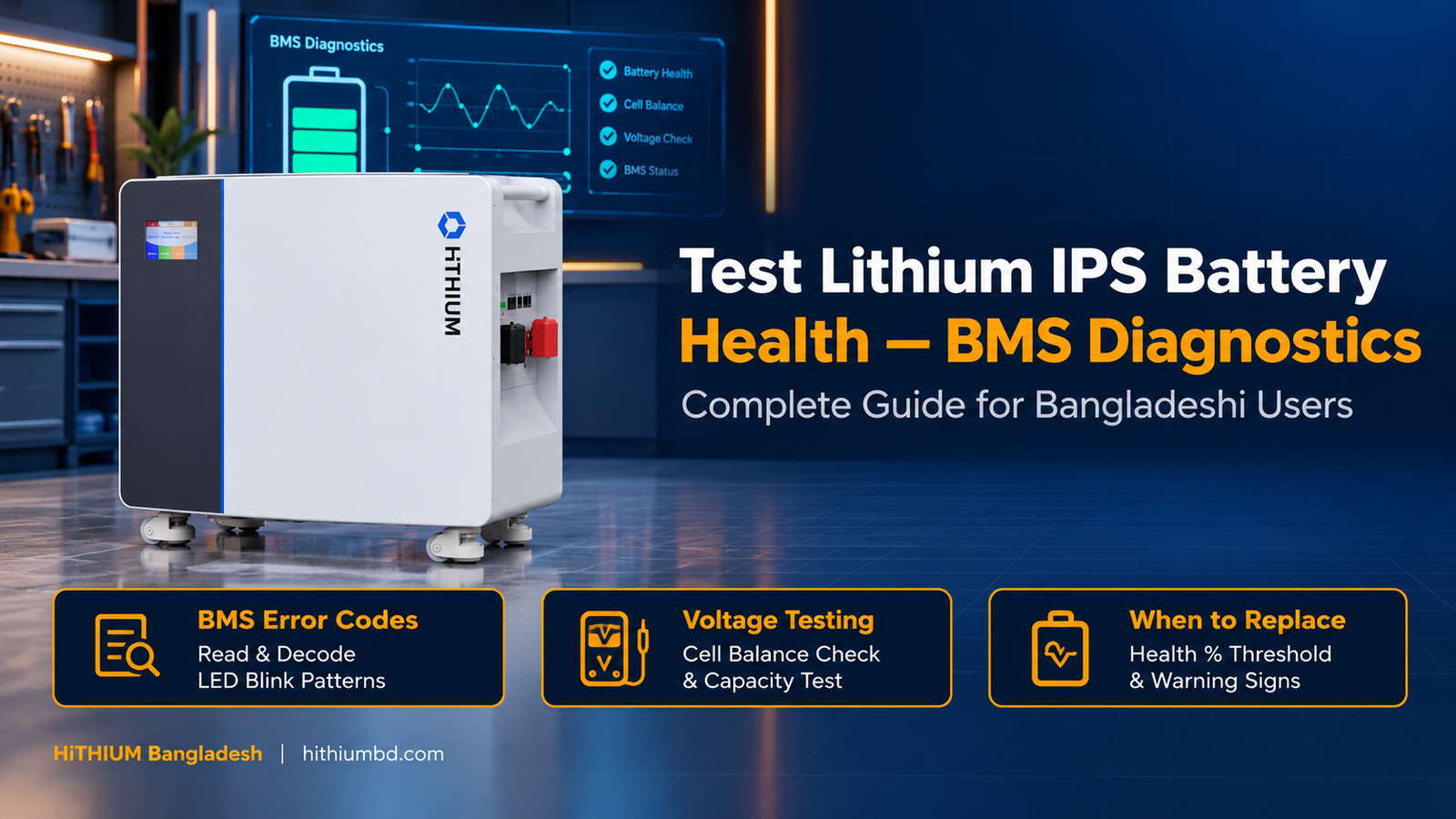
Every lithium IPS in Bangladesh runs on a Battery Management System (BMS) that silently monitors cell voltage, temperature, and charge cycles. Most users never check it — until the IPS fails during a 12-hour load-shedding night. Knowing how to test your lithium IPS battery health can save you from sudden power loss and expensive emergency replacements.
This guide walks you through practical BMS diagnostics you can perform at home, explains the error codes your IPS may be hiding, and tells you exactly when it is time to replace the battery pack. Whether you own a HiTHIUM, Luminous, or Hamko lithium IPS, the testing principles are the same.
What Is a BMS and Why Does It Matter?
The Battery Management System is a small circuit board inside every lithium battery pack. It performs three critical jobs:
- Cell balancing — keeps all cells within 0.05V of each other during charging
- Protection — cuts power if voltage drops below 2.5V per cell or exceeds 4.2V
- Health reporting — tracks charge cycles, temperature history, and internal resistance
In Bangladesh, where grid voltage fluctuates between 150V and 260V daily, the BMS works overtime. A healthy BMS ensures your lithium IPS delivers consistent backup time. A failing BMS means uneven cell charging, reduced capacity, and eventually a battery that cannot hold a charge at all.
5 Ways to Test Lithium IPS Battery Health at Home
1. Check the LED Status Indicator
Every lithium IPS has an LED display or indicator panel on the front. Here is what the common patterns mean:
| LED Pattern | What It Means | Action Needed |
|---|---|---|
| Solid green, all bars | Battery fully charged, healthy | None — normal operation |
| Green, 3 of 4 bars | 75% charge, healthy | Normal — recharge when low |
| Amber/yellow blinking | Low battery or temperature warning | Charge immediately; check room temperature |
| Red solid or fast blink | BMS fault or cell imbalance | Power off, let cool, restart; if persists, service needed |
| All LEDs off | BMS disconnected or deep discharge | May need professional recovery — do NOT force charge |
Pro tip: If the IPS shows green at full charge but drops to empty within 30 minutes of load, the battery has likely lost significant capacity. This is the most common BMS health symptom users notice in Bangladesh.
2. Measure Backup Time Against Rated Capacity
This is the simplest real-world health test. Every lithium IPS comes with a rated backup time at a specific load. Compare actual vs rated:
- New battery: Should deliver 90–100% of rated backup time at the specified load
- After 5,000 cycles: Expect 80–85% of original capacity
- After 11,000 cycles: Expect 70–75% of original capacity
- Below 60%: Battery is nearing end of useful life
How to test: Fully charge the IPS, disconnect from mains, run a consistent load (e.g., 2 ceiling fans + 5 LED lights = ~200W), and time how long the IPS lasts. Compare this with the manufacturer’s rated backup time for that load. If your actual backup is less than 70% of the rated time, the battery cells have degraded significantly.
3. Read BMS Error Codes via the IPS Panel
Many modern lithium IPS units display error codes on an LCD panel or through LED blink sequences. Here are the most common codes seen on HiTHIUM, Luminous, and Hamko units in Bangladesh:
| Error Code | Meaning | Seriousness |
|---|---|---|
| E01 | Over-voltage protection triggered (input > 280V) | Low — caused by grid surge, auto-resolves |
| E02 | Under-voltage protection (input < 140V) | Low — grid too low, auto-resolves when power returns |
| E03 | Over-temperature shutdown | Medium — check ventilation, reduce load |
| E04 | Over-load protection | Medium — reduce connected load immediately |
| E05 | Battery low voltage cutoff | High — charge fully; if repeats quickly, cells may be weak |
| E06 | Cell imbalance detected | High — may need cell balancing or replacement |
| E07 | BMS communication failure | High — BMS board may need replacement |
| E08 | Short circuit protection | Critical — check wiring, do not reconnect until inspected |
If you see E05 or E06 appearing frequently, your battery cells are losing their ability to hold balanced charge. This is the BMS telling you the battery is aging. In Bangladesh’s hot climate (35–42°C summers), cell degradation accelerates by 20–30% compared to temperate climates.
4. Check Cell Voltage Balance with a Multimeter
For technically inclined users, you can open the IPS battery compartment (with power OFF and unplugged) and measure individual cell group voltages. A healthy lithium iron phosphate (LiFePO4) battery pack has 3.2V per cell nominal. Here is the acceptable range:
| Measurement | Healthy | Concerning | Replace |
|---|---|---|---|
| Full charge voltage | 3.55–3.65V per cell | 3.45V or 3.70V | Above 3.75V (overcharge risk) |
| Resting voltage (2hrs after charge) | 3.30–3.40V per cell | 3.20V or 3.45V | Below 3.10V (cell damage) |
| Cell-to-cell difference | Within 0.05V | 0.05–0.10V | Above 0.10V (imbalance) |
Warning: Never measure cells while the IPS is charging or under load. Always wait at least 2 hours after disconnecting from mains. Use a digital multimeter with at least 0.01V resolution. If cell-to-cell voltage difference exceeds 0.10V, the BMS cannot fully balance the pack, and backup time will drop noticeably.
5. Monitor Internal Resistance Trend
Internal resistance (IR) is the most accurate predictor of lithium battery end-of-life. As cells age, their internal resistance increases, causing:
- More heat generation during charge/discharge
- Lower voltage under load (voltage sag)
- Reduced effective capacity
Most home users cannot directly measure IR, but you can observe its effects:
- Voltage sag test: Note the voltage display when the IPS is on mains (no load). Then turn on your full load and watch the voltage drop. A healthy battery shows less than 0.5V drop. If the drop exceeds 1.0V, internal resistance is high.
- Heat test: After 30 minutes of discharging at normal load, carefully touch the battery casing. A healthy LiFePO4 battery should feel barely warm (under 35°C). If it feels hot to touch (above 45°C), IR is elevated and cells are degrading.
Professional service centers in Dhaka can perform a full IR test using specialized battery analyzers. This costs BDT 500–1,500 and gives you exact mAh capacity and IR values for each cell group.
Understanding Your Battery Health Percentage
Some HiTHIUM and newer lithium IPS models display a battery health percentage on the LCD. Here is how to interpret it:
| Health % | Status | Expected Behavior |
|---|---|---|
| 90–100% | Excellent | Full rated backup time, quick recharge |
| 75–89% | Good | Slight capacity loss, normal for 1–2 years use |
| 60–74% | Fair | Noticeable backup time reduction, plan for replacement |
| 40–59% | Poor | Significant capacity loss, replace within 6 months |
| Below 40% | End of life | Replace immediately — unreliable backup |
A LiFePO4 battery typically reaches 80% health after 11,000 cycles. In Bangladesh with daily load-shedding (1–2 cycles per day), this translates to approximately 25 years of useful life. Compare this to tubular lead-acid batteries that typically last only 1–2 years in the same conditions.
When Should You Replace Your Lithium IPS Battery?
Replace the battery pack if any of these conditions are true:
- Backup time has dropped below 60% of the original rated time
- The BMS shows E05 or E06 error codes more than once per week
- Cell-to-cell voltage difference exceeds 0.10V at rest
- The battery feels excessively hot during normal discharge
- The IPS fails to fully charge after 8 hours on mains
- Battery health percentage is below 50%
In Bangladesh, replacement battery packs for common IPS brands cost between BDT 12,000 and BDT 35,000 depending on capacity. A full IPS unit replacement runs BDT 25,000 to BDT 65,000 for lithium models. Factor in the long-term savings — lithium batteries last 3–5x longer than tubular alternatives, making the per-year cost significantly lower.
Preventive Maintenance Tips for Longer Battery Life
Follow these practices to maximize your lithium IPS battery lifespan in Bangladesh’s challenging conditions:
- Keep the IPS in a cool, ventilated area — ambient temperature above 35°C reduces battery life by 20–30%
- Avoid deep discharge below 10% — try to recharge before the battery hits the low-voltage cutoff
- Do not leave the IPS on standby without load for weeks — self-discharge can trigger deep discharge protection
- Clean battery terminals every 6 months — dust and humidity cause corrosion that increases resistance
- Check BMS firmware updates — some manufacturers release updates that improve balancing algorithms
- Use a voltage stabilizer if your area has extreme voltage swings — protects both the IPS and battery from surge damage
Regular maintenance is especially important in Bangladesh where summer temperatures routinely exceed 40°C and humidity levels above 80% create ideal conditions for corrosion and thermal stress on battery components.
How often should I test my lithium IPS battery health?
Test your lithium IPS battery health every 3 to 6 months using the backup time method described above. If you notice any warning signs like reduced backup time or error codes, test immediately. Monthly visual inspection of the LED indicator and battery terminals takes only 5 minutes and can catch problems early.
Can I test lithium IPS battery health without opening the unit?
Yes. The three easiest non-invasive tests are: checking the LED/LCD status display, measuring actual backup time against the rated specification, and monitoring error codes. These tests require no tools beyond a clock or timer and give you a reliable picture of battery condition. Only the multimeter cell voltage test requires opening the battery compartment.
What does E06 cell imbalance error mean on my lithium IPS?
The E06 error means the BMS has detected that individual cell groups in your battery pack have voltage differences greater than the safe threshold (typically 0.10V). This can cause reduced backup time and uneven charging. In mild cases, a full charge-discharge cycle may help the BMS rebalance. If the error persists after 2–3 full cycles, the cells may need professional balancing or the pack may need replacement.
How long does a lithium IPS battery last in Bangladesh?
A quality LiFePO4 battery in Bangladesh typically lasts 25 years or 11,000 cycles, whichever comes first. Bangladesh’s hot climate and frequent load-shedding (1–2 cycles daily) put more stress on batteries compared to temperate countries. Keeping the IPS in a cool, ventilated area can extend battery life by 20–30%.
Is it safe to measure lithium IPS battery voltage at home?
Yes, measuring voltage with a digital multimeter is safe as long as you follow precautions: turn off the IPS and disconnect it from mains power first, wait at least 2 hours for the battery to settle, and only touch the multimeter probes to the designated test points. Never attempt to measure voltage while the IPS is charging or under load, and never short-circuit the battery terminals.
What is the difference between LiFePO4 and lead-acid battery health indicators?
LiFePO4 batteries maintain a very flat voltage curve during discharge — they stay near 3.2V per cell until nearly depleted, then drop sharply. Lead-acid batteries show a gradual voltage decline throughout discharge. This means LiFePO4 backup time remains consistent until the very end, while lead-acid performance degrades gradually. For LiFePO4, the backup time test is more reliable than voltage monitoring for health assessment.
Understanding your lithium IPS battery health is not just about avoiding breakdowns — it is about getting the full value from your investment. A well-maintained LiFePO4 battery delivers reliable backup power for years in Bangladesh’s demanding conditions. Test regularly, watch for warning signs, and replace before the battery becomes unreliable.
Ready to check your battery health or need a replacement? Visit the HiTHIUM shop or contact our team for expert guidance on lithium IPS battery diagnostics and replacement in Bangladesh.
Related reading: Lithium Battery Safety Guide | LiFePO4 Charging Guide | LiFePO4 Battery Lifespan in Bangladesh | How to Extend IPS Battery Life
Recommended HiTHIUM Products
Based on your needs, here are the best HiTHIUM lithium IPS and power station options for Bangladesh:
| Product | Capacity | Best For | Price |
|---|---|---|---|
| HiTHIUM HeroEE Light 1 (500W, 1kWh) | 500W, 1kWh | Small homes, 5 fans + 4lights + router | ৳50,800 |
| HiTHIUM HeroEE 2 (1000W, 2kWh) | 1000W, 2kWh | Medium homes, fridge + fans + TV + lights | ৳78,100 |
Free delivery across Bangladesh. WhatsApp us for consultation: Contact HiTHIUM

One thought on “How to Test Lithium IPS Battery Health — BMS Diagnostics Guide”