




Blog
LiFePO4 Battery Charging Guide — How to Charge Properly in Bangladesh

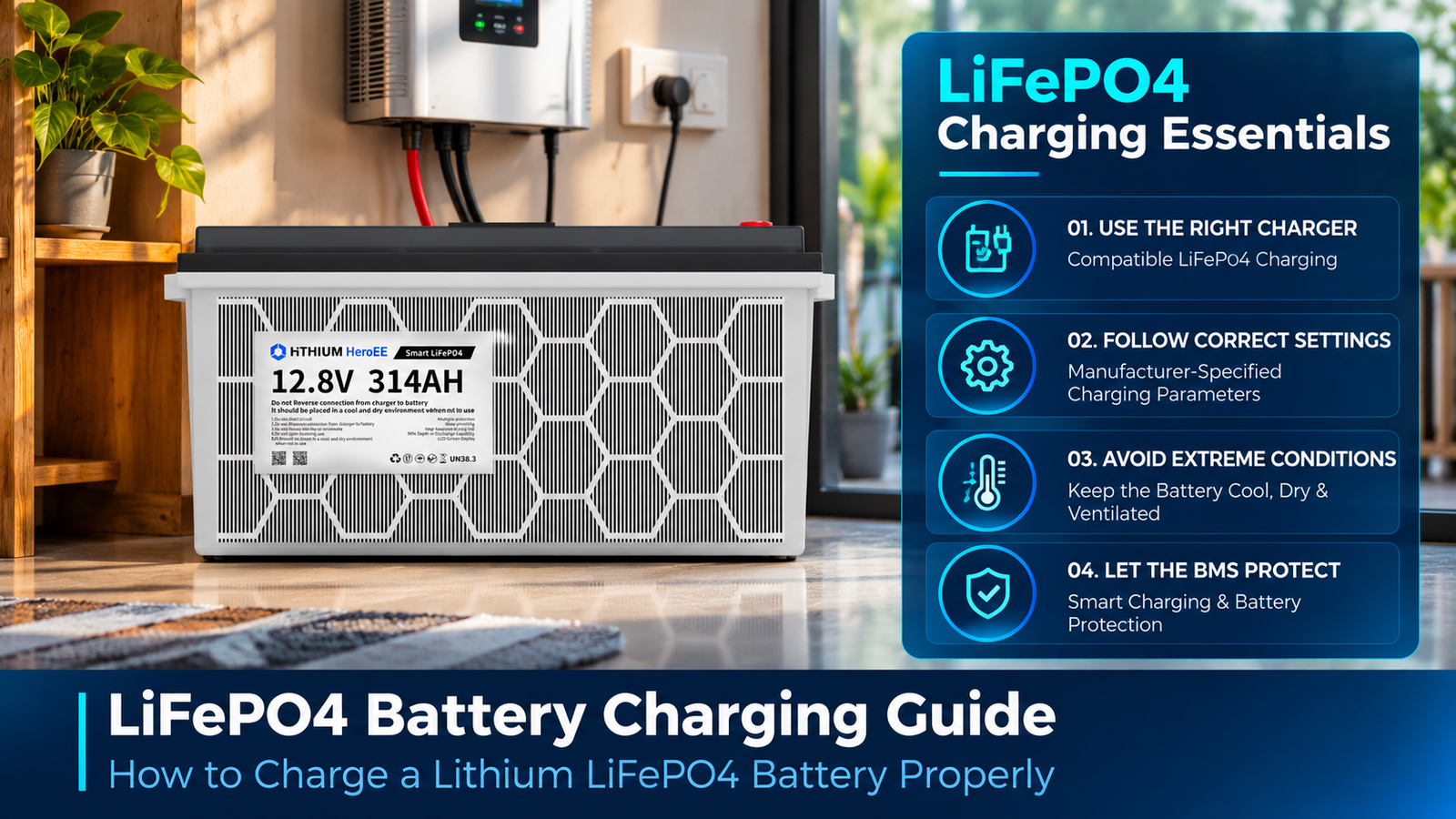
LiFePO4 Battery Charging Guide — How to Charge Properly in Bangladesh
If you own a lithium IPS or solar power system in Bangladesh, you already know the value of LiFePO4 batteries. They last longer, weigh less, and perform better in Dhaka’s heat than traditional tubular batteries. But here is the part many users overlook: how you charge a LiFePO4 battery directly determines how long it lasts. A properly charged LiFePO4 cell can survive 11,000 cycles. An improperly charged one may degrade in under 11,000 cycles. That difference can mean three to five extra years of service — or thousands of taka wasted on premature replacement.
This LiFePO4 battery charging guide covers everything Bangladeshi IPS and solar users need to know: the right voltage, the right charger, the right method, and the mistakes that destroy battery life. Whether you run a HiTHIUM lithium IPS at home in Uttara or a solar setup in Sylhet, these principles apply to every LiFePO4 battery in Bangladesh.
What Makes LiFePO4 Charging Different from Lead-Acid?
Lead-acid batteries (tubular, AGM, gel) have been the standard in Bangladeshi households for decades. Most users learned to charge them by leaving the IPS on continuously — a float-charge approach that works for lead-acid but harms LiFePO4 cells.
The key differences in how LiFePO4 batteries handle charging:
- Charging voltage: LiFePO4 needs 14.4V to 14.6V per 12V battery pack (3.5V to 3.6V per cell). Lead-acid needs 13.8V to 14.4V. The window is narrower and the tolerance is tighter.
- Charge acceptance rate: LiFePO4 accepts charge much faster. A 100Ah LiFePO4 battery can reach 80% state of charge in under two hours with a proper charger. Lead-acid takes 8 to 12 hours for the same capacity.
- No float charge needed: LiFePO4 batteries do not need continuous float charging. Once fully charged, disconnect or let the BMS (Battery Management System) handle standby. Keeping a LiFePO4 battery at full voltage for weeks causes gradual cell imbalance.
- Temperature sensitivity in reverse: Lead-acid batteries lose capacity in cold weather but tolerate overcharging better. LiFePO4 batteries handle cold well but are more sensitive to high-voltage overcharging, especially in Bangladesh’s summer heat when ambient temperatures exceed 40°C.
- BMS protection: Every quality LiFePO4 battery has a built-in BMS that monitors individual cell voltages, temperature, and current. The BMS prevents overcharge, over-discharge, and short circuits — but it is a last resort, not a substitute for proper charging practice.
How to Charge LiFePO4 Battery — Step by Step
Follow these steps to charge your LiFePO4 battery correctly, whether it is part of a lithium IPS system or a standalone solar battery bank.
Step 1: Use a Compatible Charger
Use only a charger designed for LiFePO4 chemistry. A standard lead-acid charger will deliver the wrong voltage profile. In Bangladesh, most lithium IPS brands (HiTHIUM, Luminous lithium models, Hamko lithium) come with a matched charger. If you are buying a separate charger, check these specs:
- Charging voltage: 14.4V–14.6V for a 12V pack (or 28.8V–29.2V for 24V, 57.6V–58.4V for 48V)
- Charging current: Typically 0.2C to 0.5C (for a 100Ah battery, charge at 20A to 50A)
- Cutoff method: CC-CV (Constant Current, Constant Voltage) with automatic cutoff at full charge
Step 2: Check Battery Temperature Before Charging
LiFePO4 batteries should be charged between 0°C and 45°C. In Bangladesh, summer temperatures in Dhaka, Chittagong, and Rajshahi regularly exceed 35°C. If your battery is in direct sunlight or in an unventilated enclosure, check temperature before charging. Most quality LiFePO4 batteries have a built-in temperature sensor that pauses charging if cells exceed safe limits.
Step 3: Connect Charger Before Power
Always connect the charger to the battery terminals first, then plug in the power. This prevents voltage spikes from reaching the battery. When disconnecting, reverse the order — unplug power first, then disconnect the charger.
Step 4: Charge at Recommended Rate
The standard recommended charge rate for LiFePO4 batteries is 0.5C — meaning a 100Ah battery charges at 50A. This gives a full charge in roughly two hours. Some users charge at the slower 0.2C rate (20A for 100Ah) which takes about five hours but generates less heat. In Bangladesh’s warm climate, the slower rate is better for battery longevity, especially for batteries installed in non-air-conditioned rooms.
Step 5: Disconnect When Full
When the BMS or charger indicates full charge, disconnect the battery from the charger. Unlike lead-acid, there is no benefit to leaving a LiFePO4 battery on trickle charge. A quality charger will automatically stop, but if you are using an IPS system with an integrated charger, ensure the system switches to bypass mode once batteries are full.
Best Charger for LiFePO4 Battery in Bangladesh
Choosing the right charger matters as much as the charging method. Here is what Bangladeshi users should look for:
| Feature | What to Look For | Why It Matters in BD |
|---|---|---|
| Chemistry selector | Must have LiFePO4 mode | Lead-acid chargers lack the right voltage profile |
| Voltage range | 14.4V–14.6V per 12V | Wrong voltage kills cells faster |
| Charge current | At least 20A for 100Ah batteries | BD grid outages are short — you need fast charging |
| Input voltage | 220V AC, 50Hz (BD standard) | Must handle BD voltage fluctuations (180V–260V) |
| Built-in BMS compatibility | Works with battery’s own BMS | Double protection prevents any overcharge scenario |
| Temperature compensation | Optional but recommended | Dhaka summers vs. Sylhet winters need different profiles |
If you own a HiTHIUM lithium IPS, the factory-matched charger is already optimized for the battery pack. Using a third-party charger voids the warranty in most cases, so always check with your IPS dealer before switching.
LiFePO4 Charging Voltage and Current Explained
Understanding voltage and current helps you verify that your charger is working correctly. These numbers apply to standard 12V LiFePO4 battery packs (4 cells in series):
- Fully charged voltage: 13.6V–14.4V (measured at battery terminals with no load)
- Charging voltage (during charge): 14.4V–14.6V
- Resting voltage (after charge, no load for 2 hours): 13.2V–13.4V is normal
- Minimum safe voltage: 12.0V (below this, the BMS disconnects to prevent damage)
- Optimal state of charge range: 20%–80% for daily use maximizes cycle life
- Recommended charge current: 0.2C–0.5C (20A–50A for 100Ah battery)
For 24V and 48V systems, multiply these values by 2 or 4 respectively. A 48V LiFePO4 battery in a home IPS system charges at 57.6V–58.4V with a recommended current of 0.2C to 0.5C based on total capacity.
Common LiFePO4 Charging Mistakes to Avoid
Bangladeshi IPS users make several mistakes that shorten battery life. Here are the most common ones and how to avoid them:
Mistake 1: Using a Lead-Acid Charger
The most dangerous mistake. Lead-acid chargers use a different voltage profile — they increase voltage to 14.8V or higher during the absorption phase. This overvoltages LiFePO4 cells, causing the BMS to cut off repeatedly. Over time, the BMS cycling reduces usable capacity.
Mistake 2: Leaving the Battery at 100% Charge for Weeks
If your IPS is always plugged into mains power and the batteries stay at full charge, the cells slowly lose balance. For systems that rarely experience outages, discharge the batteries to 50%–80% at least once a month to keep cells balanced.
Mistake 3: Charging Below 0°C
In northern Bangladesh (Rangpur, Dinajpur), winter temperatures can drop below 5°C. LiFePO4 batteries cannot safely charge below 0°C — lithium plating on the anode permanently damages cells. Quality BMS units block charging in cold conditions, but budget batteries may not.
Mistake 4: Ignoring Battery Health During Peak Summer
Dhaka summers push ambient temperatures above 40°C. Charging generates internal heat. When external heat plus charging heat push cell temperature above 50°C, the BMS should halt charging. If your battery enclosure has no ventilation, the BMS may not have time to react. Install the battery in a shaded, ventilated area.
Mistake 5: Mixing Old and New Battery Packs
If you add a new LiFePO4 battery to an existing bank, the new cells charge and discharge at different rates than the aged cells. This causes the BMS in the weaker battery to work overtime. Always replace all batteries in a bank at the same time.
LiFePO4 Battery Charging Time — How Long Does It Take?
Charging time depends on three factors: battery capacity (Ah), charge current (A), and current state of charge. Here is a practical reference for common sizes used in Bangladeshi homes:
| Battery Capacity | Charge Rate (0.5C) | 0% → 100% | 20% → 80% |
|---|---|---|---|
| 100Ah (12V) | 50A | ~2 hours | ~1.2 hours |
| 200Ah (12V) | 100A | ~2 hours | ~1.2 hours |
| 100Ah (48V system) | 50A | ~2 hours | ~1.2 hours |
At the slower 0.2C rate, multiply these times by approximately 2.5. For most Bangladeshi households experiencing 2 to 4 hours of load shedding per day, a LiFePO4 battery charged at 0.5C reaches sufficient charge between outages without needing overnight charging.
Can I charge a LiFePO4 battery with a solar charge controller in Bangladesh?
Yes. Use an MPPT solar charge controller with a LiFePO4 charging profile. The controller must support 14.4V–14.6V per 12V pack and have temperature compensation. In Bangladesh, where solar irradiance is 4–5 kWh/m²/day, a 300W panel can charge a 100Ah 12V LiFePO4 battery in approximately 5–6 hours of peak sunlight. Ensure the controller’s maximum input voltage exceeds your panel’s open-circuit voltage (Voc).
How often should I charge my LiFePO4 IPS battery in Bangladesh?
Charge your LiFePO4 battery whenever the state of charge drops below 20%. In Bangladesh, with typical load shedding of 2–4 hours daily, most users charge once per day. LiFePO4 batteries tolerate partial charging well — you do not need to wait for a full discharge before recharging. In fact, keeping the battery between 20% and 80% state of charge maximizes total cycle life, potentially reaching 11,000 cycles or more.
Is it safe to charge a LiFePO4 battery during a thunderstorm in Bangladesh?
Charging during thunderstorms carries risks from power surges and lightning strikes. In Bangladesh, where monsoon storms bring frequent power fluctuations, disconnect the charger during severe weather. A quality LiFePO4 battery’s BMS provides some surge protection, but a dedicated surge protector or UPS for the charger itself is recommended for homes in storm-prone areas like Sylhet and Chittagong.
What voltage should my LiFePO4 battery read when fully charged?
A fully charged 12V LiFePO4 battery reads 13.6V to 14.4V at the terminals immediately after charging. After resting for two hours without any load, the voltage settles to approximately 13.2V to 13.4V. If your battery reads above 14.6V, the charger may be delivering excessive voltage — disconnect immediately and check charger settings. If it reads below 13.0V after extended rest, the battery may have a cell balance issue.
Can I use a LiFePO4 battery charger for other lithium battery types?
No. LiFePO4 (lithium iron phosphate) has a different voltage profile than other lithium chemistries like NMC (nickel manganese cobalt) or LMO (lithium manganese oxide). A LiFePO4 charger delivers 3.6V per cell at full charge, while NMC cells need 4.2V. Using the wrong charger type risks undercharging NMC cells or overcharging LiFePO4 cells. Always match charger chemistry to battery chemistry.
Extend Your LiFePO4 Battery Life — The Bottom Line
LiFePO4 batteries are the best investment for Bangladeshi homes and offices running on IPS or solar power. But that investment only pays off when you charge them correctly. To summarize the key points from this LiFePO4 battery charging guide:
- Use a LiFePO4-specific charger with the correct voltage profile
- Charge at 0.2C to 0.5C — slower is gentler on cells in Bangladesh’s heat
- Disconnect when fully charged — do not float charge
- Keep batteries in shaded, ventilated areas, especially in summer
- Maintain 20%–80% state of charge for maximum cycle life
- Avoid charging in extreme cold (below 0°C) or extreme heat (above 45°C)
Ready to upgrade to a LiFePO4 battery system? Browse our full product range or contact our team for a free consultation on the right capacity for your home or office.
Recommended HiTHIUM Products
Based on your needs, here are the best HiTHIUM lithium IPS and power station options for Bangladesh:
| Product | Capacity | Best For | Price |
|---|---|---|---|
| HiTHIUM HeroEE 4 (4kWh) | 4kWh | Medium backup, battery upgrade | ৳74,500 |
| HiTHIUM MaxPower 8 AIO (8kWh) | 8kWh | Large spaces, heavy loads, commercial | ৳2,87,000 |
Free delivery across Bangladesh. WhatsApp us for consultation: Contact HiTHIUM
