




Blog
Lithium Battery Safety — What Bangladeshi Users Must Know

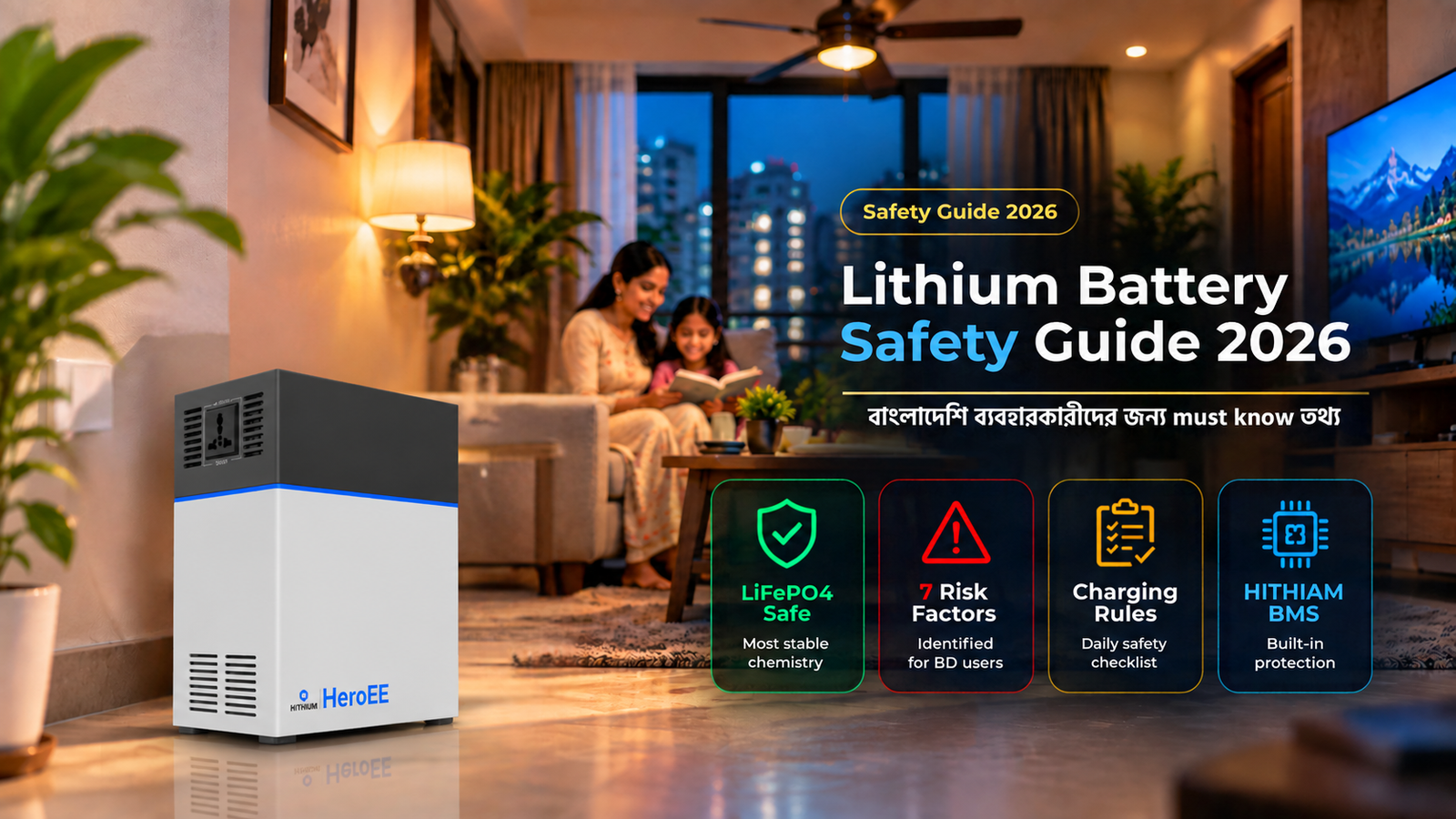
Lithium Battery Safety — What Bangladeshi Users Must Know
Bangladesh’s electricity grid still averages 6-10 hours of load shedding per day in rural areas and 2-4 hours in urban centres during peak summer demand. Lithium IPS systems have become the first-choice solution — but with great power comes real responsibility. Lithium battery safety in Bangladesh is not talked about enough, and improper use can lead to fire, property damage, or even personal injury.
This guide covers everything you need to know: how LiFePO4 chemistry makes your IPS inherently safer than older technologies, what still can go wrong, and exactly what you should and should not do to protect your home and family.
Why Lithium Battery Chemistry Matters for Safety
Not all “lithium” batteries are equal. The two main types used in IPS systems in Bangladesh are:
| Feature | Lithium-Ion (NMC/NCA) | LiFePO4 (Lithium Iron Phosphate) |
|---|---|---|
| Thermal runaway temperature | ~150°C | ~270°C |
| Risk of fire/explosion | Moderate–High if mishandled | Very Low |
| Cycle life | 500–800 cycles | 11,000 cycles |
| Performance in 40°C+ heat | Degrades quickly | Stable, minimal degradation |
| Suitable for BD climate | Marginal | Yes — recommended |
HiTHIUM’s lithium IPS systems use LiFePO4 chemistry exclusively. This is why they are far safer than cheap NMC batteries sold in local markets. If a seller cannot confirm the chemistry type, that is a red flag.
What Is Thermal Runaway?
Thermal runaway is the dangerous chain reaction where heat generates more heat inside the battery, ultimately causing fire or explosion. LiFePO4 chemistry requires more than 270°C to trigger this — a temperature impossible to reach under normal use in Bangladesh, even in a Chittagong corrugated iron roof house in June where room temperatures can hit 45°C. NMC batteries can hit the runaway point at 150°C, which is achievable if the battery is overcharged, short-circuited, or physically damaged.
The 7 Biggest Lithium Battery Safety Risks in Bangladesh
1. Overcharging
Overcharging forces excessive current into a battery cell beyond its maximum voltage threshold. Quality IPS units have a Battery Management System (BMS) that automatically cuts charging at the correct voltage. Danger arises when:
- You bypass the BMS (never do this)
- The BMS itself is faulty (cheap, no-brand IPS units)
- You use a third-party charger not matched to the battery specifications
Rule: Always use the charger supplied with your IPS or one certified by the manufacturer.
2. Deep Discharge
Draining a LiFePO4 battery below its minimum voltage (typically 2.5V per cell) damages the cell structure permanently. Again, the BMS protects against this — but if your IPS has been sitting unused for 4-6 months and the battery voltage has fallen below the BMS recovery threshold, forced charging with an incorrect charger can cause damage.
Rule: If you plan not to use your IPS for more than 2 months (e.g., during a long stay abroad), charge to 50-60% before storage. Check voltage every 2 months and top up if needed.
3. Bangladesh’s Heat — Real Risk Assessment
Dhaka, Rajshahi, and Khulna regularly see temperatures above 40°C between April and September. Charging a lithium battery generates additional heat on top of ambient temperature. The safe operating range for LiFePO4 is -20°C to +60°C during use and 0°C to +45°C during charging.
Practical implications for Bangladeshi users:
- Place your IPS in a ventilated area — not inside a closed cabinet or steel rack in the sun
- Keep at least 15 cm clearance around the IPS unit on all sides
- If the IPS is on a rooftop or in a tin-roof room, ensure airflow or use a small fan
- Do not place the IPS next to a gas stove or other heat source
4. Physical Damage and Flooding
Bangladesh’s 2024 monsoon season saw flooding in 11 districts including Sylhet, Sunamganj, and parts of Dhaka. A flooded lithium battery is a serious hazard:
- Water ingress can cause internal short circuits
- Saltwater (from river flooding) is especially corrosive
- The chemical reaction can generate hydrogen gas
What to do if your IPS is flood-affected:
- Do NOT try to turn it on or charge it
- Disconnect from mains immediately — wear rubber gloves
- Move the unit to an outdoor, ventilated area
- Call your dealer or HiTHIUM Bangladesh for professional inspection
- Do not attempt to open the battery casing yourself
5. Poor Ventilation and Fire Risk
Even the safest LiFePO4 battery can become a fire risk if placed in a completely sealed space with no airflow. During a fault condition, any battery may vent gases. In a sealed room, these gases can accumulate.
Install your IPS in:
- A dedicated battery room or utility area with wall vents
- A garage or storeroom with a window that can be opened
- Never in a bedroom, children’s room, or sealed closet
6. Counterfeit and Low-Quality Batteries
Bangladesh’s electronics markets — particularly Multiplan Centre, Dholaikhal, and Gulshan electronics shops — have seen an influx of counterfeit lithium cells from China that are mislabelled as LiFePO4 but are actually cheaper NMC or even repurposed cells. These batteries skip critical BMS protection features.
How to verify you are buying genuine LiFePO4:
- Ask for the cell manufacturer’s certificate (e.g., CATL, EVE, HiTHIUM cells)
- Check the battery weight — genuine LiFePO4 cells are heavier than cheap alternatives
- Demand a warranty document with the company’s registered Bangladesh address
- Check the cell chemistry label — it must say “LiFePO4” not just “Lithium”
7. Incorrect Wiring and Installation
Incorrect wiring during IPS installation causes more battery failures in Bangladesh than the battery itself. Common mistakes:
- Using undersized cable gauge (e.g., 4mm² cable on a system that needs 10mm²)
- Loose terminal connections that arc and generate heat
- Connecting batteries in series/parallel without proper balancing
- No fuse on the battery positive terminal
See our complete IPS installation guide for the correct cable sizing and wiring procedure.
Safe Charging Practices — A Daily Checklist
For the average Bangladeshi home user, these daily habits will keep your lithium IPS battery safe for its full 10+ year lifespan:
- Never charge during thunderstorms — Disconnect the IPS mains input during heavy storms (April–September season)
- Check for unusual heat — The IPS should be warm, not hot to the touch during charging. If it feels dangerously hot, disconnect and call the dealer
- Keep the area clean — Dust accumulation on the IPS vents reduces cooling. Clean with a dry cloth monthly
- Check indicator lights — Green = healthy, Yellow = low battery, Red = fault. Do not ignore fault indicators
- Do not connect loads while charging at maximum rate if possible — though modern IPS units handle this, it generates more heat
- Annual professional check — Have a certified technician inspect terminal connections and BMS health once a year
LiFePO4 vs Tubular Battery — Safety Comparison
Many Bangladeshi homes are still transitioning from traditional tubular lead-acid batteries. Here is how safety compares:
| Safety Factor | Tubular Lead-Acid | LiFePO4 Lithium |
|---|---|---|
| Hydrogen gas emission | Yes — requires ventilation | No (normal conditions) |
| Acid spill risk | High — contains sulphuric acid | None — sealed unit |
| Overcharge safety | Can boil and crack | BMS cuts at safe voltage |
| Child safety | High risk if improperly stored | Low risk — sealed, no acid |
| Fire risk | Low (but hydrogen can ignite) | Very low (LiFePO4 stable) |
| Flood damage risk | Acid contamination | Short circuit (manageable) |
For a deeper comparison of technology and cost, read our Lithium IPS vs Tubular Battery cost analysis.
FAQ — Lithium Battery Safety Bangladesh
Can lithium IPS batteries explode in Bangladesh’s heat?
Standard lithium-ion batteries can experience thermal runaway above 60°C. However, LiFePO4 batteries — used in quality IPS systems like HiTHIUM — are thermally stable up to 270°C, making them far safer for Bangladesh’s climate where ambient temperatures regularly hit 38-42°C in summer. With proper ventilation, LiFePO4 batteries handle Bangladesh’s heat without risk.
How should I store my lithium IPS battery during Eid holidays?
Charge the battery to 50-60% (not 100%), disconnect the load, and store in a cool, ventilated room away from direct sunlight. A battery stored at 50% charge self-discharges at only 2-3% per month, so it will be perfectly healthy when you return after Eid.
What happens if my lithium IPS battery gets wet during monsoon flooding?
Immediately disconnect the battery from all power sources — do NOT attempt to charge or use it. Move it to a dry, ventilated outdoor location. Do not open the casing. Contact your dealer or HiTHIUM Bangladesh for professional inspection before reusing.
Is it safe to charge the IPS during a thunderstorm in Bangladesh?
No. Voltage spikes from lightning can damage the Battery Management System. Unplug the IPS charger input from the mains socket during thunderstorms — a common event in Bangladesh’s April-September monsoon season. A quality IPS has surge protection, but disconnecting mains input is the safest approach.
How do I know if my lithium battery is swelling or degrading?
Warning signs include: visible bulging of the battery casing, shorter backup times (20%+ capacity loss), unusual heat during charging, faint chemical smell, or repeated BMS low-battery warnings even after a full charge. If you notice any of these signs, stop using the battery immediately and contact your supplier.
Can I use my lithium IPS in a closed room without windows?
This is not recommended for any battery system. While LiFePO4 does not vent gases under normal operation, fault conditions can produce small amounts of gas. Always ensure there is some airflow in the room where your IPS is installed — at minimum, a door gap or wall vent.
HiTHIUM Safety Standards — What We Build In
Every HiTHIUM lithium IPS sold in Bangladesh includes built-in protection layers:
- Multi-layer BMS: Monitors cell voltage, current, and temperature 100 times per second
- Overcharge protection: Cuts at 3.65V per cell (LiFePO4 safe maximum)
- Over-discharge protection: Disconnects load at 2.5V per cell
- Short circuit protection: Trips within milliseconds
- Temperature protection: Shuts down charging above 45°C and discharging above 60°C
- Cell balancing: Equalises voltage across all cells to prevent uneven wear
These features are not optional extras — they are standard in every unit. Cheap no-brand lithium IPS systems often omit 2-3 of these protection layers to cut cost.
What to Do in Case of Emergency
If you smell burning, see smoke, or notice the battery casing is deformed:
- Do NOT use water — water reacts with lithium compounds
- Disconnect the IPS from mains power if safe to do so
- Evacuate the room and close the door
- Call Fire Service: 999 (Bangladesh national emergency)
- If a small fire: use a dry powder or CO₂ fire extinguisher — NOT water
- After the incident, do not attempt to reuse the battery
Ready to Upgrade to a Safe Lithium IPS?
Lithium battery safety in Bangladesh starts with choosing the right technology. LiFePO4 chemistry, a genuine BMS, and a reputable manufacturer eliminate the vast majority of risks that give “lithium” a bad reputation in local markets.
Explore HiTHIUM’s full range of certified LiFePO4 IPS systems — trusted by thousands of homes and offices across Dhaka, Chattogram, Sylhet, and beyond. Our units carry CE, UN38.3, and IEC 62619 safety certifications.
→ Browse HiTHIUM Lithium IPS Models | → View LiFePO4 Battery Options
Have questions about your specific setup? Contact our Dhaka team for a free consultation on the right IPS capacity, installation, and safety configuration for your home or business.
📖 Related Guides — Lithium Battery & IPS
- Best Lithium Battery for IPS in Bangladesh 2026 — LiFePO4 Price, Cycles & Specs
- LiFePO4 Battery Lifespan — How Many Years Will It Last?
- Best Lithium IPS in Bangladesh — Top 5 LiFePO4 Models & Prices 2026
- Intelligent IPS Features Bangladesh — Auto-Switch, App Monitoring, LiFePO4
- 🛒 Buy HiTHIUM HeroEE — Certified Safe LiFePO4 IPS, Official Bangladesh Store
Recommended HiTHIUM Products
Based on your needs, here are the best HiTHIUM lithium IPS and power station options for Bangladesh:
| Product | Capacity | Best For | Price |
|---|---|---|---|
| HiTHIUM HeroEE L12314ES (4kWh) | 4kWh | Medium backup, battery upgrade | ৳74,500 |
| HiTHIUM MaxPower 8 AIO (8kWh) | 8kWh | Large spaces, heavy loads, commercial | ৳2,87,000 |
Free delivery across Bangladesh. WhatsApp us for consultation: Contact HiTHIUM

6 thoughts on “Lithium Battery Safety — What Bangladeshi Users Must Know”