




Blog
Parallel IPS Installation Guide: Connect Two Lithium IPS Units

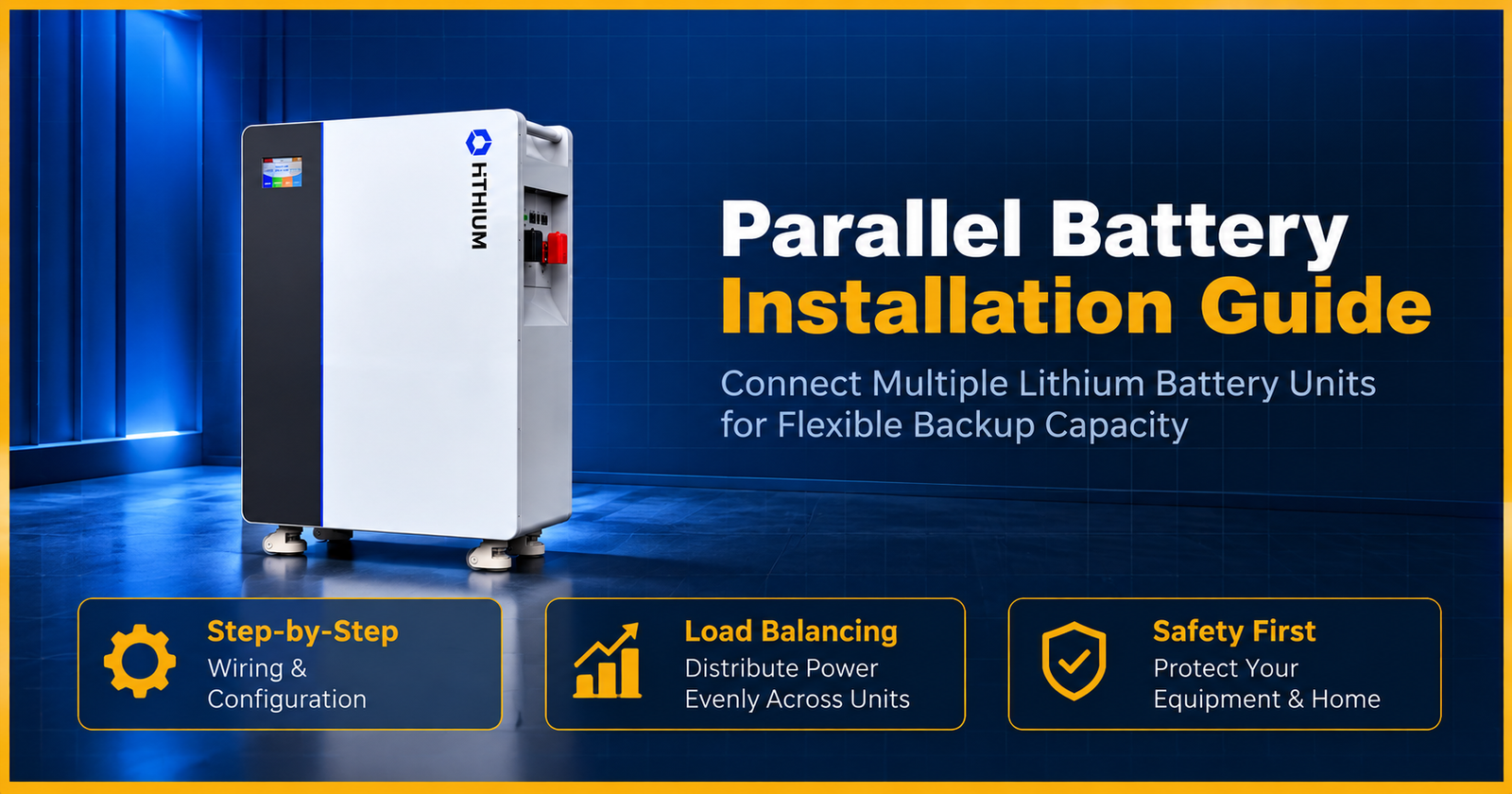
Parallel IPS Installation Guide: How to Connect Two Lithium IPS Units in Bangladesh
Many Bangladeshi homes and businesses face a common problem: a single IPS unit cannot handle all their essential loads during extended load shedding. When your 1500VA IPS trips every time the refrigerator compressor kicks in alongside the fan and lights, the solution is not always buying a bigger unit. Sometimes, connecting two lithium IPS units in parallel gives you the capacity, redundancy, and flexibility you need — at a lower cost than one oversized system.
This guide walks you through everything you need to know about parallel IPS installation in Bangladesh: whether your IPS models support it, how to wire them correctly, what load balancing looks like in practice, and the safety precautions that prevent costly mistakes. Whether you are running a small shop, a home office, or a residential apartment, parallel IPS setups are becoming a practical solution across Dhaka, Chattogram, and beyond.
What Is a Parallel IPS Setup?
A parallel IPS configuration connects two or more independent IPS units so they share the total electrical load. Instead of one unit handling everything, each IPS contributes its capacity to power your home or business. Think of it like two generators running side by side — both feed power into the same circuit, and the combined output is greater than what either unit provides alone.
In a typical Bangladeshi household experiencing 8-12 hours of daily load shedding, a single 1500VA lithium IPS can comfortably run lights, fans, a TV, and a router. But add a refrigerator, a water pump, or a computer, and the single unit quickly reaches its limit. Two 1500VA units working in parallel provide 3000VA of combined capacity — enough to keep essential appliances running through the longest outages.
Can You Connect Any Two IPS Units in Parallel?
Not every IPS supports parallel operation. This is the first and most important thing to understand. Parallel connection requires specific hardware and firmware features that are only available in certain models. Attempting to wire two incompatible IPS units together can damage both units, trip your circuit breaker, or create a fire hazard.
Here are the requirements for a successful parallel IPS installation:
- Parallel-compatible models: The IPS manufacturer must explicitly support parallel operation for the specific model. HiTHIUM lithium IPS units, for example, include parallel-ready models designed for this purpose.
- Matching voltage: Both units must operate at the same output voltage (typically 220V-240V in Bangladesh). Mixing a 110V unit with a 220V unit is dangerous.
- Same battery chemistry: Both units should use the same battery type. Connecting a lithium IPS with a lead-acid or tubular battery IPS causes uneven charging and discharging.
- Similar capacity: While not strictly required, using two units of similar VA rating (e.g., both 1500VA or both 2000VA) ensures balanced load sharing. Mixing a 500VA unit with a 3000VA unit creates uneven stress.
- Parallel communication port: Many parallel-ready IPS models include a communication cable or port that lets the units sync their inverter timing and load distribution.
How to Check if Your IPS Supports Parallel Operation
Check these three things before you attempt any wiring:
- Read the user manual — Look for “parallel,” “parallel operation,” “parallel kit,” or “parallel connection” in the specifications section.
- Check the back panel — Parallel-ready IPS units often have a dedicated port (RJ45, USB, or proprietary connector) labeled “Parallel,” “Link,” or “Communication.”
- Check the model number — Some manufacturers use different model suffixes for parallel-capable versions. Compare your model against the manufacturer’s parallel compatibility list.
If your IPS does not support parallel operation, consider upgrading to a higher-capacity single unit instead. Forcing a non-compatible unit into parallel mode voids the warranty and risks equipment damage.
Step-by-Step: How to Wire Two Lithium IPS Units in Parallel
The following guide assumes you have two parallel-compatible lithium IPS units. Always switch off both units and disconnect from the main power supply before making any wiring changes.
Step 1: Plan Your Load Distribution
Before touching any wires, decide which appliances each IPS unit will power. There are two approaches:
- Equal split: Divide your loads roughly equally between both units. For example, Unit A powers lights and fans on the ground floor, while Unit B powers the refrigerator and upstairs lights.
- Priority split: Assign critical loads (router, computer, medical equipment) to Unit A and general loads (fans, lights) to Unit B.
In most Bangladeshi homes, the equal split works best because it ensures neither unit is overloaded during peak usage hours.
Step 2: Install the Parallel Communication Cable
Connect the communication cable between the two IPS units. This cable synchronizes their inverter output so both units produce AC power at the same frequency and phase. Without this synchronization, the two units can fight each other, causing voltage spikes and potential damage.
Plug one end into the “Parallel Out” port on Unit A and the other end into the “Parallel In” port on Unit B. The cable is usually short (1-2 meters) because the units should be placed close together.
Step 3: Connect the AC Input (Mains)
Both IPS units need AC input from your main power supply. There are two wiring options:
- Separate circuits: Each IPS gets its own circuit breaker from the main distribution board. This is the safer approach because one unit’s input can be isolated for maintenance.
- Shared circuit with individual breakers: Both units connect to the same incoming line but each has its own circuit breaker. This works if your main panel has limited available breakers.
Use appropriate cable sizes: 2.5mm² for units up to 2000VA, 4mm² for units between 2000VA-3000VA. Install a 20A or 32A MCB (Miniature Circuit Breaker) for each unit depending on its VA rating.
Step 4: Connect the AC Output (Loads)
This is the most critical step. Each IPS unit’s output goes to its designated load circuit through a separate distribution board or changeover switch.
Do NOT connect both IPS outputs to the same wire unless the units are designed for direct parallel output sharing. Most residential parallel setups use separate output circuits with individual breakers.
Wire the output of Unit A to the breaker for Circuit A (e.g., ground floor lights and fans). Wire the output of Unit B to the breaker for Circuit B (e.g., refrigerator and upstairs loads). Both circuits connect to your home’s distribution board through separate changeover switches or auto-transfer switches.
Step 5: Battery Connection
Each lithium IPS unit should have its own battery bank. Never connect two IPS units to the same battery bank unless the manufacturer explicitly supports shared-battery parallel operation. Shared battery configurations require specialized battery management that most residential IPS units do not have.
For each unit:
- Connect the lithium battery pack using the manufacturer’s recommended cables and fuses
- Ensure the battery terminals are clean and tight (loose connections cause arcing and heat)
- Verify the BMS (Battery Management System) status indicator shows normal operation
Step 6: Power Up and Test
Follow this startup sequence:
- Switch on the AC mains supply to both units
- Wait for both units to complete their self-test (usually 10-30 seconds)
- Verify both units show “Line” or “Mains” mode on their display
- Switch off the mains to simulate load shedding
- Both units should switch to battery/inverter mode within 10-20 milliseconds
- Check that all connected appliances are running normally
- Use a multimeter at the output of each unit to verify voltage is within 220V-240V
Load Balancing: How Two IPS Units Share Power
When properly configured, a parallel IPS setup automatically balances the load between units. The communication cable ensures both inverters produce synchronized AC output. The load distributes based on each unit’s available capacity.
Here is a real-world load distribution example for a Bangladeshi household with two 1500VA lithium IPS units:
| Appliance | Wattage | Assigned Unit | Running on |
|---|---|---|---|
| LED Lights (6 pcs) | 60W total | Unit A | Battery |
| Ceiling Fans (4 pcs) | 280W total | Unit A | Battery |
| Television (43 inch) | 80W | Unit A | Battery |
| Wi-Fi Router | 15W | Unit A | Battery |
| Refrigerator | 150W (running) / 400W (compressor start) | Unit B | Battery |
| Desktop Computer | 300W | Unit B | Battery |
| Water Pump (0.5 HP) | 375W | Unit B | Battery |
In this example, Unit A handles about 435W and Unit B handles about 825W. During compressor startup, Unit B sees a surge to 1,075W — well within its 1500VA capacity. The combined system draws roughly 1,260W from both battery banks, giving approximately 2-3 hours of backup depending on battery size.
What You Need: Hardware and Materials Checklist
Before starting your parallel IPS installation, gather these materials:
- 2 x parallel-compatible lithium IPS units (same brand recommended, similar VA rating)
- Parallel communication cable (usually included with parallel-ready models)
- 2 x lithium battery packs (one per unit, matched to each IPS model)
- MCB circuit breakers — 20A-32A for each IPS input, 16A-20A for each output circuit
- Changeover switches — 2-pole, rated for your load (32A typical for home use)
- Cable — 2.5mm² to 4mm² copper wire for AC connections
- Cable lugs and terminals — Properly crimped connections prevent loose contact and fire risk
- Multimeter — For verifying voltage and phase during testing
- Wire conduit or trunking — Protect exposed wiring in your home
Safety Precautions for Parallel IPS Installation
Working with electrical equipment carries real risks. Follow these safety rules without exception:
- Disconnect all power before wiring — Turn off both the mains and both IPS units. Verify with a multimeter that no voltage is present before touching any wire.
- Use properly rated cables — Undersized cables overheat and can cause electrical fires. Follow the cable sizing guidelines above.
- Install MCBs on every circuit — Never bypass circuit breakers. Each IPS input and output should have its own MCB.
- Earth/ground both units — Connect the earth terminal of each IPS to your home’s earthing system. This protects against fault currents. See our IPS earthing guide for proper grounding procedures.
- Do not exceed rated capacity — Two 1500VA units provide 3000VA, not infinite capacity. Calculate your total load before installation.
- Hire a qualified electrician — If you are not confident about electrical work, hire a licensed electrician. The cost of professional installation (typically 2,000-5,000 BDT) is far less than the cost of fire damage or equipment failure.
- Keep units ventilated — Lithium IPS units generate heat during operation. Ensure at least 15cm of clearance around each unit for airflow.
Common Mistakes to Avoid
Based on real installation issues reported in Bangladesh, here are the most common parallel IPS mistakes:
| Mistake | Consequence | How to Prevent |
|---|---|---|
| Connecting non-compatible models | Phase mismatch, voltage spikes, unit damage | Only use manufacturer-approved parallel combinations |
| Sharing one battery between two units | Uneven discharge, BMS errors, reduced battery life | Each IPS gets its own battery bank |
| Skipping the communication cable | Units fight each other, tripping and shutdowns | Always install the parallel link cable first |
| Using undersized wiring | Overheating, melted insulation, fire risk | Follow cable sizing chart — minimum 2.5mm² copper |
| Overloading one unit heavily | One unit runs at 100%, the other at 20% | Plan load distribution before installation |
| Ignoring earthing/grounding | Electric shock risk during faults | Connect earth terminals to your home grounding system |
How Much Does Parallel IPS Installation Cost in Bangladesh?
The total cost depends on whether you already own one IPS unit or are buying two new ones. Here is a realistic breakdown for 2026:
| Item | Cost Range (BDT) |
|---|---|
| 1500VA Lithium IPS Unit (each) | 35,000 – 55,000 |
| Lithium Battery Pack (per unit) | 20,000 – 40,000 |
| Parallel Communication Cable | 500 – 2,000 (often included) |
| MCB, Changeover Switch, Wiring | 3,000 – 6,000 |
| Professional Installation | 2,000 – 5,000 |
| Total (two complete units) | 1,20,000 – 2,10,000 |
Compare this to a single 3000VA lithium IPS unit, which typically costs 80,000-1,20,000 BDT. The parallel setup costs more upfront but provides the advantage of redundancy — if one unit fails, the other continues powering your essential loads. For businesses that cannot afford any downtime, this redundancy alone justifies the extra cost.
FAQ: Parallel IPS Installation in Bangladesh
Can I connect two different brand IPS units in parallel?
No, you should not connect IPS units from different brands in parallel. Each brand uses different communication protocols, inverter frequencies, and load-sharing algorithms. Mixing brands causes phase mismatch and voltage instability that can damage both units. Always use the same brand and ideally the same model for parallel operation.
How many IPS units can I connect in parallel?
Most residential parallel-ready IPS systems support 2 to 6 units in parallel. The exact number depends on the manufacturer’s specifications. HiTHIUM lithium IPS units support up to 15 units in parallel, providing a combined capacity of up to 240 kWh for large homes or small commercial installations in Bangladesh.
Will parallel IPS installation void my warranty?
If you connect two manufacturer-approved parallel-compatible units using the official communication cable and follow the installation guide, the warranty remains valid. However, connecting non-compatible models, using third-party cables, or modifying the wiring voids the warranty. Always check your warranty terms before installation.
How long will two parallel lithium IPS units provide backup?
Backup time depends on total load and battery capacity. Two 1500VA lithium IPS units with 100Ah lithium batteries each, running a combined load of 1,200W, provide approximately 2-3 hours of backup. Reducing load to 600W extends backup to 4-5 hours. For longer backup, install higher-capacity lithium battery packs.
Do I need an electrician to install parallel IPS in Bangladesh?
While the wiring is straightforward for someone comfortable with electrical work, we recommend hiring a qualified electrician for parallel IPS installation in Bangladesh. The cost is typically 2,000-5,000 BDT and ensures correct wiring, proper earthing, and safe operation. Improper installation risks electrical fires, equipment damage, and voided warranties.
Can I add a second IPS to my existing setup later?
Yes, if your existing IPS unit is parallel-compatible. Check the model’s specifications or contact the manufacturer. You will need a matching second unit, a parallel communication cable, and additional wiring for the new circuit. If your current IPS does not support parallel operation, you cannot add a second unit to it — you would need to replace both units with parallel-compatible models.
When to Choose Parallel IPS vs. a Single Larger Unit
A parallel IPS setup is not always the best choice. Here is how to decide:
- Choose parallel IPS when: You need redundancy (cannot afford downtime), your total load is 2000-6000VA, you want to expand capacity gradually, or you need separate circuits for different areas of your home or business.
- Choose a single larger unit when: Your budget is tight, your total load is under 3000VA, simplicity is important, or you have limited space for two units and two battery banks.
For most Bangladeshi households, a single 2000VA-3000VA lithium IPS is sufficient. Parallel setups make more sense for larger homes, shops, offices, and small factories where reliability and capacity are critical.
Get Expert Help with Your Parallel IPS Setup
Planning a parallel IPS installation? HiTHIUM Bangladesh offers expert consultation and installation support for lithium IPS systems. Our team can help you choose the right parallel-compatible models, plan your load distribution, and ensure a safe, professional installation.
- Visit our product catalog to explore parallel-ready lithium IPS units
- Read our step-by-step IPS installation guide for single-unit setups
- Learn about IPS capacity planning for small factories if you are setting up a commercial installation
- Understand how to calculate IPS backup time before sizing your system
Contact us today for a free consultation on the best parallel IPS configuration for your needs.
📖 Related Guides — HiTHIUM Bangladesh
Recommended HiTHIUM Products
Based on your needs, here are the best HiTHIUM lithium IPS and power station options for Bangladesh:
| Product | Capacity | Best For | Price |
|---|---|---|---|
| HiTHIUM HeroEE 2 (1000W, 2kWh) | 1000W, 2kWh | Medium homes, fridge + light + fans + TV | ৳78,100 |
| HiTHIUM HeroEE 16 (16kWh) | 16kWh | Large homes, offices, factories | ৳3,36,000 |
Free delivery across Bangladesh. WhatsApp us for consultation: Contact HiTHIUM

2 thoughts on “Parallel IPS Installation Guide: Connect Two Lithium IPS Units”