




Blog
IPS for Hospital and Clinic Backup Power in Bangladesh — Complete 2026 Guide

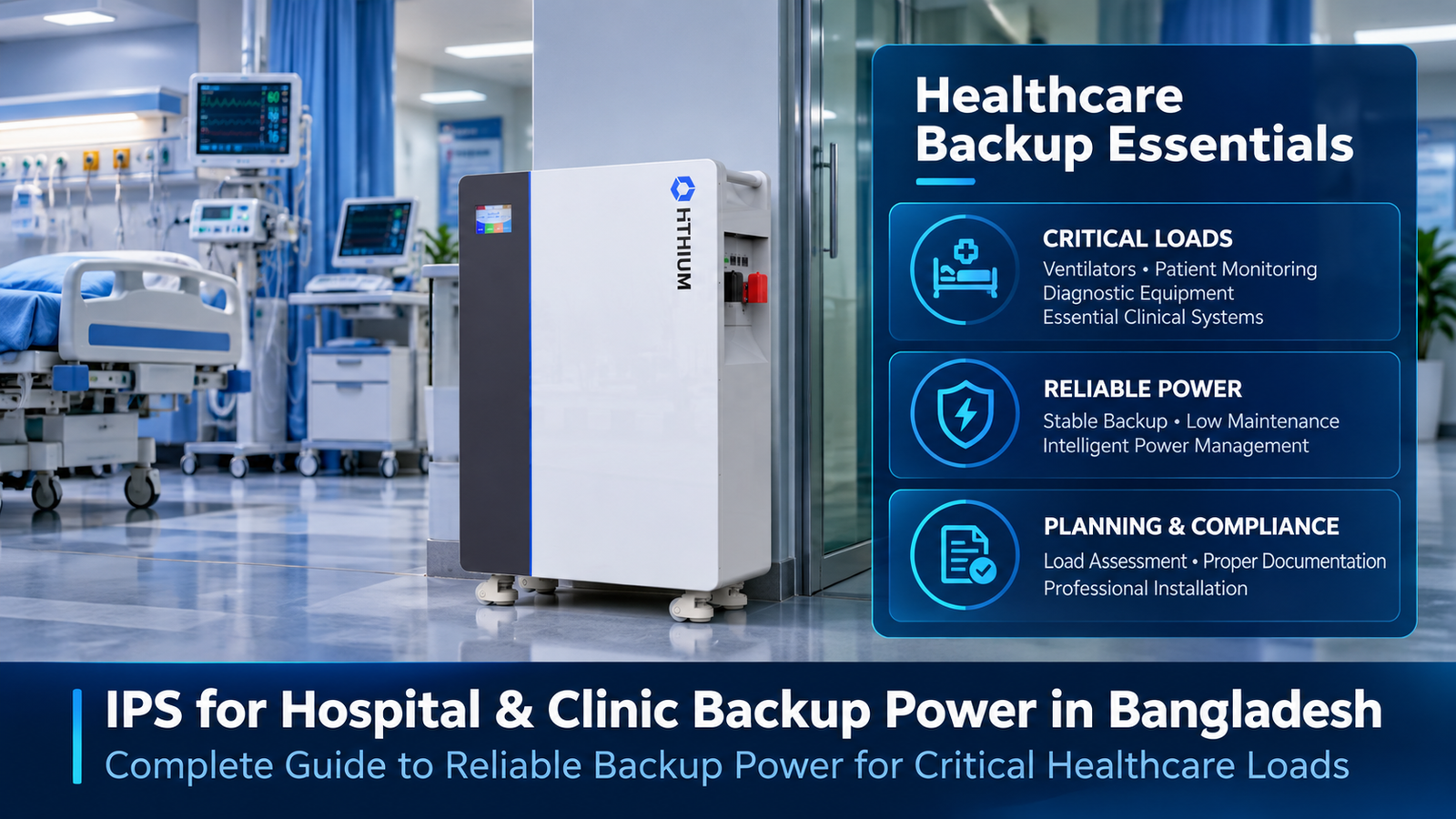
IPS for Hospital and Clinic Backup Power in Bangladesh — Complete 2026 Guide
Power reliability in hospitals and clinics is not a convenience — it is a matter of patient safety. In Bangladesh, where load shedding and grid instability are daily realities, an uninterrupted power supply (IPS) system designed for medical facilities requires a completely different approach compared to residential or standard commercial setups.
This guide covers everything medical facility administrators, procurement officers, and biomedical engineers need to know about selecting, sizing, and maintaining an IPS for hospital and clinic backup power in Bangladesh.
Why Hospital IPS Requirements Are Different
Unlike homes or offices, medical facilities have life-critical loads that cannot tolerate even milliseconds of interruption. A standard IPS designed for fans and lights will fail when connected to:
- Ventilators and anesthesia machines
- Patient monitors and infusion pumps
- Operating theater lighting and suction systems
- Laboratory analyzers and refrigeration for vaccines/medicines
- Imaging equipment (X-ray, ultrasound, CT)
- Nurse call systems and emergency lighting
These devices require pure sine wave output, zero transfer time, and stable voltage/frequency regulation. Any deviation can cause equipment malfunction, data loss, or — in worst cases — patient harm.
Critical Load Classification for Medical Facilities
Before sizing an IPS, classify every load in your facility into three categories:
1. Life-Critical Loads (Zero Tolerance)
Equipment where power loss directly endangers patients. These need online double-conversion UPS with internal batteries (5–15 min runtime) backed by the main IPS. Examples: ventilators, anesthesia machines, heart-lung machines.
2. Essential Clinical Loads (Seconds Tolerance)
Equipment that must stay online but can tolerate a brief (2–5 second) transfer. These run directly on the main IPS. Examples: patient monitors, infusion pumps, surgical lights, lab analyzers.
3. Operational Loads (Minutes Tolerance)
Administrative and comfort loads. Can be on a separate IPS or the same system with lower priority. Examples: office computers, lighting, HVAC (non-critical zones), cafeteria equipment.
How to Calculate IPS Capacity for a Hospital or Clinic
Undersizing is the most common and dangerous mistake. Follow this step-by-step method:
Step 1: List Every Device with Nameplate Data
Create a spreadsheet with columns: Device Name, Quantity, Voltage (V), Amperage (A), Power Factor (PF), Starting Surge Multiplier.
Step 2: Calculate Running Load (kW)
Running kW = Σ (Quantity × Voltage × Amperage × Power Factor) / 1000Step 3: Calculate Starting Surge (kVA)
Medical equipment with motors (compressors, pumps, imaging gantries) draws 3–7× rated current on startup. Use the highest surge multiplier among your devices:
Surge kVA = Max(Device kVA × Surge Multiplier)Step 4: Apply Diversity and Safety Factors
- Diversity Factor: 0.7–0.85 (not all equipment runs simultaneously)
- Future Expansion: Add 20–30%
- Safety Margin: Add 15%
Formula: IPS Rating (kVA) = (Running kW ÷ 0.8) × Diversity × 1.2 × 1.15
Example: 20-Bed Clinic in Dhaka
| Load Category | Running kW | Surge kVA |
|---|---|---|
| Life-Critical (ventilators, monitors) | 8.5 | 12.0 |
| Essential Clinical (lab, imaging, OT) | 15.2 | 28.5 |
| Operational (lights, HVAC, admin) | 12.0 | 18.0 |
| Total | 35.7 | 58.5 |
Applying factors: (35.7 ÷ 0.8) × 0.8 × 1.25 × 1.15 = 51.4 kVA. Round up to 60 kVA online double-conversion IPS with lithium battery bank for 2-hour autonomy on essential loads.
Lithium (LiFePO4) vs Tubular Lead-Acid for Hospital IPS
| Parameter | LiFePO4 (Lithium) | Tubular Lead-Acid |
|---|---|---|
| Cycle Life (70% SOH) | 11,000 cycles | 800–1,200 cycles |
| Depth of Discharge | 80–90% usable | 50% usable |
| Recharge Time | 2–3 hours | 8–12 hours |
| Weight per kWh | ~8.5 kg | ~30 kg |
| Maintenance | Zero | Water topping, terminal cleaning |
| Temperature Tolerance | -20°C to 60°C | 20°C–35°C optimal |
| Cost per Usable kWh (2026 BDT) | ৳ 0 | ৳8,000–11,000 |
| Total Cost of Ownership (10 yr) | Lower | Higher (replacements + maintenance) |
Verdict for hospitals: LiFePO4 is the only rational choice for life-critical and essential clinical loads. The faster recharge means the system is ready for the next outage — critical in Bangladesh where multiple load-shedding events can occur in a single day. Zero maintenance eliminates the risk of neglected battery upkeep causing failure during an emergency.
Bangladesh-Specific Regulatory & Compliance Considerations
DGHS and DGDA Guidelines
The Directorate General of Health Services (DGHS) and Directorate General of Drug Administration (DGDA) require hospitals to maintain backup power for critical areas. While no single standard mandates a specific IPS brand, facilities seeking accreditation must demonstrate:
- Documented load calculations
- Autonomy test records (monthly)
- Battery health monitoring logs
- Changeover time < 10 seconds for essential loads
Bangladesh Fire Service & Civil Defence
Battery rooms must comply with fire safety codes. LiFePO4 batteries (LFP chemistry) are inherently non-flammable and do not emit hydrogen gas — a significant advantage over lead-acid in confined hospital basement battery rooms.
Electrical License Requirements
Installation must be certified by a licensed electrical supervisor (Bangladesh Energy Regulatory Commission). Ensure your vendor provides:
- Single-line diagram (SLD)
- Cable sizing calculations per BDS/IEC standards
- Earthing design (critical for medical equipment leakage currents)
- Commissioning test report
Top IPS Brands for Hospital/Clinic Use in Bangladesh (2026)
- HiTHIUM — Purpose-built lithium IPS, online double-conversion, LiFePO4, local service network, 5 year warranty. Best for 10kWh (expandable) medical installations.
- Luminous (Lithium Series) — Established brand, growing lithium portfolio, wide dealer network.
- Apollo (Medical Grade) — Specialized medical UPS/IPS line with isolation transformers.
- Eaton / APC (Schneider) — Premium international, online double-conversion, high cost but global support.
For clinics under 20 kVA, HiTHIUM lithium IPS offers the best value-to-performance ratio. For hospitals above 50 kVA, consider parallel redundant configuration (N+1) with HiTHIUM or Eaton.
Installation Best Practices for Medical Facilities
1. Dedicated Electrical Room
IPS and battery bank must be in a clean, dry, temperature-controlled room — not a storage closet. Maintain 20–25°C for optimal battery life.
2. Separate Earthing for Medical Equipment
Medical equipment earthing must be independent from the building’s general earthing. Target < 0.5 Ω resistance. This prevents ground loops that disrupt sensitive diagnostics.
3. Automatic Transfer Switch (ATS) with Bypass
Install a make-before-break ATS with manual bypass for maintenance. Test monthly under load.
4. Remote Monitoring & Alerts
Choose an IPS with Modbus/TCP or SNMP monitoring. Integrate with the hospital BMS (Building Management System) or SCADA. Alerts should go to:
- Biomedical engineering team (SMS/email)
- Facility manager
- On-call electrician
5. Battery Health Monitoring
LiFePO4 BMS (Battery Management System) provides cell-level voltage, temperature, and state-of-health data. Log this monthly. Replace modules when capacity drops below 80%.
Maintenance Schedule for Hospital IPS
| Frequency | Task | Responsible |
|---|---|---|
| Daily | Visual check: alarms, temperatures, load % | Biomed tech / Electrician |
| Weekly | Simulate mains failure — verify transfer time & load carry | Electrician |
| Monthly | Full autonomy test (run on battery to 50% DoD), log runtime | Biomed engineer |
| Quarterly | Torque all power connections, clean dust, verify fan operation | Electrician |
| Annually | Load bank test, BMS firmware update, calibration | Vendor / Biomed |
Cost Estimation: Hospital IPS in Bangladesh (2026)
All prices in BDT, indicative for lithium (LiFePO4) online double-conversion systems including battery bank for 2-hour autonomy on essential loads:
- 10 kVA Clinic IPS: ৳12–18 lakh
- 20 kVA Small Hospital: ৳22–32 lakh
- 50 kVA Medium Hospital: ৳50–70 lakh
- 100 kVA Large Hospital: ৳90 lakh – ৳1.3 crore
Installation, cabling, earthing, ATS, and commissioning typically add 15–20% to equipment cost. Always get a detailed quote with itemized breakdown.
Frequently Asked Questions
What size IPS do I need for a 10-bed clinic in Bangladesh?
A typical 10-bed clinic with basic lab and minor OT needs 15–25 kVA online double-conversion lithium IPS. Exact sizing requires a load audit. For a 10-bed clinic with ventilators, monitors, and lab equipment, plan for 20 kVA minimum with 2-hour lithium battery backup.
Is lithium IPS mandatory for hospitals in Bangladesh?
No law mandates lithium specifically, but DGHS accreditation guidelines require reliable, maintainable backup with documented testing. Lithium (LiFePO4) is the only technology that meets zero-maintenance, fast-recharge, and long-life requirements for medical facilities in Bangladesh’s climate and grid conditions.
How long does a lithium IPS battery last in a hospital setting?
LiFePO4 batteries last 8–10 years (11,000 cycles at 80% DoD) in hospital use. With daily cycling (typical in Bangladesh), expect 7–9 years. Replace when capacity drops below 80% of rated capacity.
Can I use a residential IPS for my small clinic?
No. Residential IPS units lack pure sine wave output, zero transfer time, and medical-grade voltage regulation. They also lack the battery capacity for clinical loads. Using a residential IPS for medical equipment voids equipment warranties and risks patient safety.
What certifications should I look for in a medical IPS?
Look for IEC 60601-1 (medical electrical equipment safety), IEC 62040 (UPS standard), and ISO 13485 (medical device quality management) certifications. The vendor should provide a declaration of conformity and local installation certification by a licensed electrical supervisor.
Does HiTHIUM provide installation and commissioning for hospitals?
Yes. HiTHIUM provides end-to-end installation for medical facilities including load audit, single-line diagram, cable sizing, earthing design, ATS configuration, and commissioning with full documentation for DGHS compliance. Contact the team.
Related Reading
Best Lithium IPS in Bangladesh — Complete Buyer’s Guide | How Long Do LiFePO4 Batteries Really Last in Bangladesh? | Lithium Battery Safety — What Bangladeshi Users Must Know | IPS Maintenance Checklist for Bangladeshi Homes | Lithium IPS vs Tubular Battery — Which Saves More?
Need a hospital-grade lithium IPS in Bangladesh? Visit HiTHIUM Shop or contact our team for a free load audit and medical facility IPS consultation.
Recommended HiTHIUM Products
Based on your needs, here are the best HiTHIUM lithium IPS and power station options for Bangladesh:
| Product | Capacity | Best For | Price |
|---|---|---|---|
| HiTHIUM MaxPower 8 AIO (8kWh) | 8kWh | Large spaces, heavy loads, commercial | ৳2,87,000 |
| HiTHIUM HeroEE 16 (16kWh) | 16kWh | Large homes, offices, factories | ৳3,36,000 |
Free delivery across Bangladesh. WhatsApp us for consultation: Contact HiTHIUM
