




Blog
IPS for Garment Factory (RMG) Production Line Backup in Bangladesh — Complete Power Guide 2026

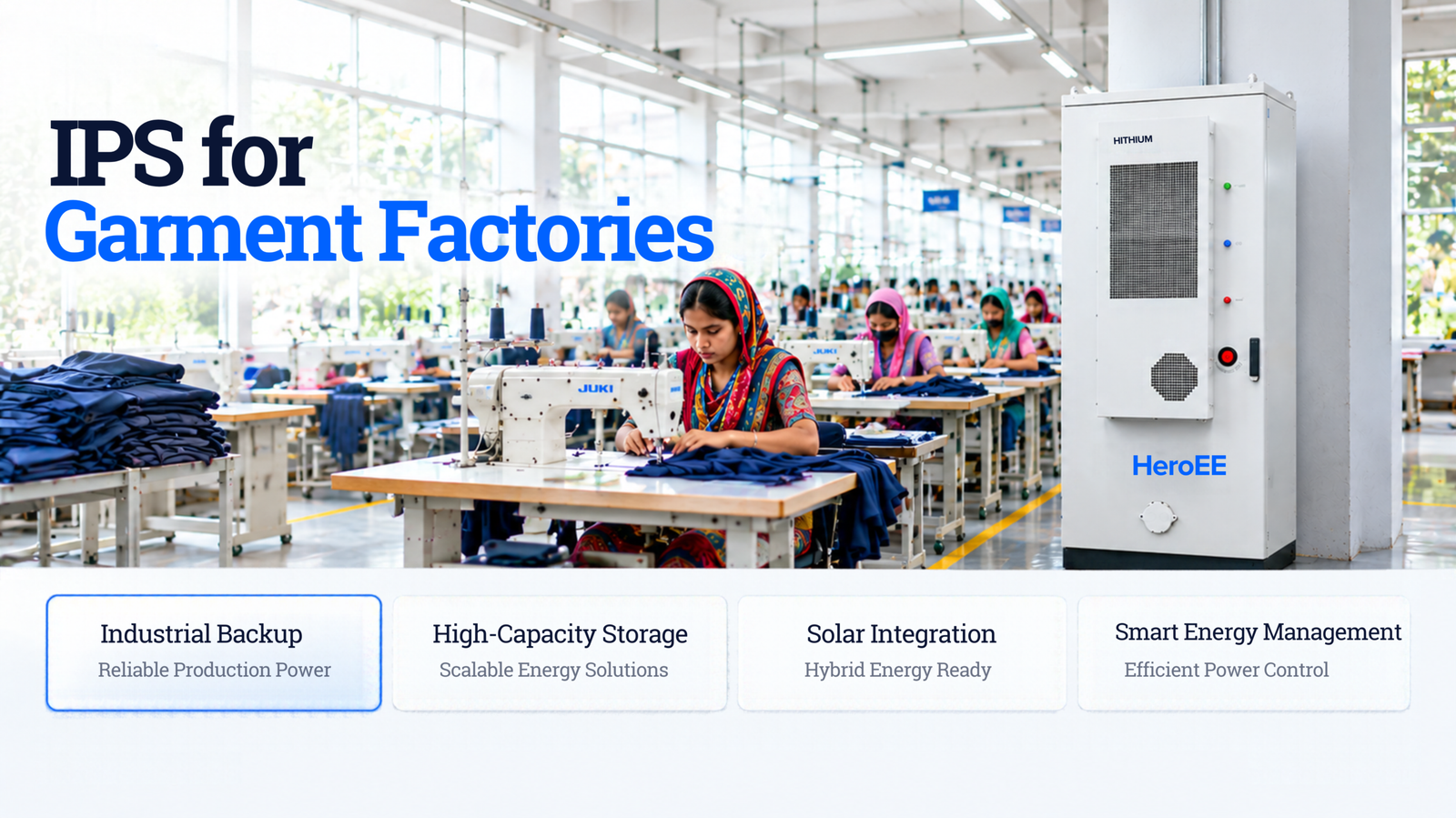
IPS for Garment Factory (RMG) Production Line Backup in Bangladesh — Complete Power Guide 2026
Garment factories in Bangladesh form the backbone of the nation’s economy, contributing over 84% of total export earnings. Yet every year, load-shedding and voltage fluctuations disrupt production lines, damage sensitive sewing machines and cutting equipment, and cost factories millions in lost output. A purpose-built IPS for RMG garment factory is no longer optional — it is the critical infrastructure that keeps production running when the grid fails.
This guide covers everything Bangladeshi garment factory owners and facility managers need to know: how to calculate the right IPS capacity for your production line, which HiTHIUM lithium IPS systems are proven in factory environments, and how to integrate solar for long-term cost savings. All recommendations are based on real factory deployments across Dhaka, Chattogram, and Narayanganj industrial zones.
Why Garment Factories Need Industrial-Grade IPS Backup
A typical medium-sized garment factory in Bangladesh operates between 200 and 500 sewing machines, along with cutting tables, folding stations, lighting systems, HVAC units, and computerised pattern-making equipment. When the power goes down during load-shedding — which can last 4-12 hours daily in many areas — the entire production line stops.
The costs of power failure in a garment factory are severe:
- Direct production loss: Each hour of downtime costs ৳50,000-200,000+ in missed output depending on factory size
- Machine damage: Voltage surges when power returns can fry computerised sewing machine boards (replacement: ৳15,000-40,000 per machine)
- Labor idle time: Workers on the production floor cannot work without power — wages are still paid
- Order delays: Missed delivery deadlines can result in penalties and lost buyer relationships
- Safety compliance: Dark factories violate fire safety and building regulations enforced by the Bangladesh Accord
A dedicated IPS system with pure sine wave output and instant transfer time (<10ms) protects your equipment and maintains critical production functions during outages.
Calculating IPS Capacity for Your Garment Factory
Sizing an IPS for an RMG factory requires a detailed load audit. Here is a typical breakdown for a 300-machine factory:
| Equipment Category | Quantity | Watts Each | Total (W) | Priority |
|---|---|---|---|---|
| Computerised Sewing Machines | 300 | 90W | 27,000W | CRITICAL |
| Folding & Packing Machines | 20 | 200W | 4,000W | HIGH |
| Industrial LED Lighting | 150 | 40W | 6,000W | HIGH |
| Cutting Machines (electric) | 10 | 500W | 5,000W | CRITICAL |
| Office Computers & Servers | 30 | 100W | 3,000W | MEDIUM |
| Ceiling Fans (production floor) | 50 | 70W | 3,500W | MEDIUM |
| Peak Running Load | 48,500W | — | ||
| Recommended IPS Capacity (with 20% surge margin) | ~50-60 kVA | — | ||
For a full production line backup, factories typically need 30-60 kVA IPS systems with 40-80 kWh of LiFePO4 battery capacity. For partial backup (critical machines only), a 10-20 kVA system with 10-20 kWh battery can keep sewing machines, cutting equipment, and emergency lighting running.
Best HiTHIUM IPS Solutions for Garment Factories
HiTHIUM offers a range of industrial-grade lithium IPS systems proven in Bangladeshi factory environments. Here are the models we recommend based on factory size and power requirements:
1. HiTHIUM MaxPower 8 AIO — Best for Small-to-Medium Factories
The HiTHIUM MaxPower 8 AIO is our most popular choice for small and medium garment factories that need to keep 100-200 machines running during load-shedding. With 8kWh of LiFePO4 capacity and a 5000W output, it handles critical production loads including sewing machines, cutting equipment, and lighting.
Key specifications:
- Battery: LiFePO4 — 8,038.4Wh (8kWh) / 25.6V
- Inverter output: 5,000W p, <10ms transfer time
- All-in-one design: battery + inverter + MPPT solar charge controller
- Solar-ready: direct connection for up to 9kW solar array
- LCD display with real-time load, battery %, and runtime estimates
- Warranty: 5 years
2. HiTHIUM HeroEE 16 — Best for Large Factories
For factories with 300+ machines that need extended backup, the HiTHIUM HeroEE 16 delivers 16kWh of industrial-grade LiFePO4 capacity and a 10,000W output. This system can power an entire production floor section including all sewing machines, cutting equipment, and HVAC for 4-8 hours during outages.
Key specifications:
- Battery: LiFePO4 — 16,000Wh (16kWh) / 51.2V
- Inverter output: up to 10,000W (11kW)
- Industrial-rated: designed for 24/7 factory operation
- Modular expansion: add additional battery packs as needed
- BMS protection: cell balancing, overcharge, over-discharge, temperature
- Warranty: 5 years / 11,000+ cycles
3. HiTHIUM HeroEE 4 — Best for Modular Factory Setups
The HiTHIUM HeroEE 4 provides 4kWh of modular LiFePO4 capacity with a 3000W inverter output. Its modular design allows factories to start with a smaller system and expand capacity as production grows — ideal for factories that want to phase their IPS investment.
Key specifications:
- Battery: LiFePO4 — 4,019Wh (4kWh) / 12.8V
- Inverter output: 3,000W pure sine wave
- Modular design: stack multiple units for increased capacity
- Compact footprint: fits in tight factory spaces
- WiFi monitoring: track factory energy usage remotely
- Warranty: 5 years
LiFePO4 vs Diesel Generator for RMG Factories — Cost Comparison
Many garment factories in Bangladesh currently rely on diesel generators for backup power. While generators provide high power output, the total cost of ownership over 5 years significantly favours a lithium IPS system for partial or full production line backup:
| Factor | Diesel Generator (10kVA) | HiTHIUM LiFePO4 IPS (8kWh) |
|---|---|---|
| Upfront cost | ৳1,20,000 – ৳1,80,000 | ৳4,80,000 – ৳6,00,000 |
| Daily fuel cost (4hr backup) | ৳800 – ৳1,200 | ৳0 (battery + solar) |
| Annual fuel cost | ৳3,00,000 – ৳4,50,000 | ৳0 |
| Maintenance (annual) | ৳25,000 – ৳50,000 | ৳0 |
| Noise level | 75-85 dB (disrupts workers) | <30 dB (silent operation) |
| emissions | CO₂, NOₓ, particulate matter | Zero emissions |
| 5-year total cost | ৳18,00,000 – ৳25,00,000+ | ৳4,80,000 – ₹6,00,000 |
| 5-year savings with IPS | ৳12,00,000 – ৳19,00,000 | |
For a factory running a 10kVA generator for 4 hours daily, the HiTHIUM IPS system pays for itself within 18-24 months through fuel savings alone — and then provides nearly free backup power for the remaining 5+ years of battery life.
Larger garment plants that want to cover several production lines should also look at a battery energy storage system in Bangladesh, which expands in modules but needs a proper load and sizing study first.
Factory IPS Installation Best Practices
Installing an IPS system in a garment factory environment requires careful planning. Follow these guidelines for maximum reliability:
1. Load Zoning Strategy
Divide your factory into power zones based on criticality:
- Zone 1 (Critical): Sewing machines on the main production line, cutting machines, quality control stations — these MUST have uninterrupted power
- Zone 2 (High): Folding/packing area, emergency lighting, server room, office AC
- Zone 3 (Medium): General floor lighting, ceiling fans, cafeteria equipment
Size your IPS system to cover Zone 1 first, then expand to Zone 2 as capacity allows.
2. Electrical Infrastructure Requirements
- Use 3-phase distribution for factories above 20 kVA total load
- Install separate MCCBs (Molded Case Circuit Breakers) for each IPS zone
- Ensure proper earthing/grounding — factory floors often have poor grounding that can damage sensitive electronics
- Use heavy-gauge copper cable (minimum 6 sq mm for high-current circuits)
- Install surge protection devices (SPDs) at the main distribution board to protect against voltage spikes when the grid returns
3. Solar Integration for Maximum Savings
Pairing your HiTHIUM IPS with a 5-10 kW solar panel array dramatically reduces your operational costs. During Bangladesh’s peak sunshine months (March-May), a 5kW solar system can generate 20-25 kWh per day — enough to fully recharge an 8kWh IPS system multiple times and run production during daylight hours without any grid power.
4. Monitoring and Maintenance
All HiTHIUM factory IPS systems include WiFi monitoring capabilities. Factory managers can:
- Monitor real-time power consumption across production zones from their phone
- Receive alerts when battery levels drop below 20%
- Track daily energy usage patterns to identify optimization opportunities
- Schedule preventive maintenance through the HiTHIUM service network
Frequently Asked Questions (FAQ)
Q1: What size IPS do I need for a 300-machine garment factory?
A 300-machine factory typically needs a 50-60 kVA IPS system with 40-80 kWh of LiFePO4 battery capacity. For full production line backup, this means 4-8x HiTHIUM MaxPower 8 AIO units connected in parallel. For partial backup (critical machines only), 1-2 MaxPower 8 units covering 100-150 machines may suffice.
Q2: Can a HiTHIUM IPS run computerised sewing machines safely?
Yes. HiTHIUM IPS systems deliver true pure sine wave output with less than 3% Total Harmonic Distortion (THD) — well within the tolerance of all computerised sewing machine brands (Juki, Pegasus, Siruba, Brother). The <10ms transfer time ensures zero disruption to machine operation during power switches.
Q3: How long does a LiFePO4 IPS last in a factory environment?
HiTHIUM LiFePO4 batteries are rated for 11,000 cycles at 80% depth of discharge. In a factory running 1 cycle per day (charge during day, discharge during load-shedding), this translates to 25+ years of service. The built-in BMS (Battery Management System) protects against overheating, overcharge, and deep discharge — critical in Bangladesh’s hot factory environments.
Q4: Is it better to use a diesel generator or a lithium IPS for my factory?
For partial backup (critical machines only, 4-8 hours), a lithium IPS is significantly more cost-effective — saving ৳12-19 lakhs over 5 years versus a generator. For full factory backup (50+ kVA for 12+ hours), a hybrid approach works best: IPS for smooth-critical loads + generator for high-surge equipment. Many factories use both: IPS handles the transition period while the generator warms up.
Q5: Can I add solar panels to my HiTHIUM factory IPS system?
Yes. All HiTHIUM MaxPower and HeroEE units have built-in MPPT solar charge controllers. A 5-10 kW solar array can be connected directly, providing free daytime charging and extending your backup runtime by 40-60%. In Bangladesh, solar integration typically achieves payback within 2-3 years through reduced diesel consumption.
Q6: How much does a HiTHIUM industrial IPS system cost for a garment factory?
Pricing depends on factory size and backup requirements:
• Small factory (50-100 machines, partial backup): ৳4,80,000 – ৳8,00,000
• Medium factory (100-300 machines, mixed backup): ৳12,00,000 – ৳20,00,000
• Large factory (300+ machines, full backup): ৳25,00,000 – ৳50,00,000+
HiTHIUM offers EMI options through partner banks and free site surveys for factories above 100 machines.
Q7: Where can I buy a HiTHIUM IPS for my garment factory in Bangladesh?
Contact HiTHIUM Bangladesh directly at +880-1788-686788 or visit hithiumbd.com/shop/. HiTHIUM provides free factory site surveys, custom engineering designs, and installation support across all industrial zones in Bangladesh including Dhaka, Chattogram, Narayanganj, Gazipur, and Turag.
Conclusion: Power Your Factory with Confidence
As a garment factory owner in Bangladesh, you know that every minute of production downtime costs money. A HiTHIUM lithium IPS system eliminates the uncertainty of load-shedding, protects your expensive machinery from voltage damage, and — when paired with solar — dramatically reduces your energy costs year after year.
Whether you need to backup 50 machines or 500, HiTHIUM has a scalable lithium IPS solution engineered for the demands of Bangladeshi industrial environments. Visit hithiumbd.com/shop/ to explore our full range, or contact our team for a free factory power audit and custom quote.
HiTHIUM Bangladesh — industrial-grade lithium IPS and energy storage solutions for Bangladesh’s manufacturing sector since 2019. Showroom: House 42, Road 11, Block F, Banani, Dhaka 1213. Phone: +880-1788-686788. Email: info@hithiumbd.com

One thought on “IPS for Garment Factory (RMG) Production Line Backup in Bangladesh — Complete Power Guide 2026”