




Blog
Portable Power Station for Camping in Bangladesh 2026

A portable power station for camping in Bangladesh runs your lights, fans, phones, routers and mini fridges when the grid stops — or when you are three hours from the nearest plug.
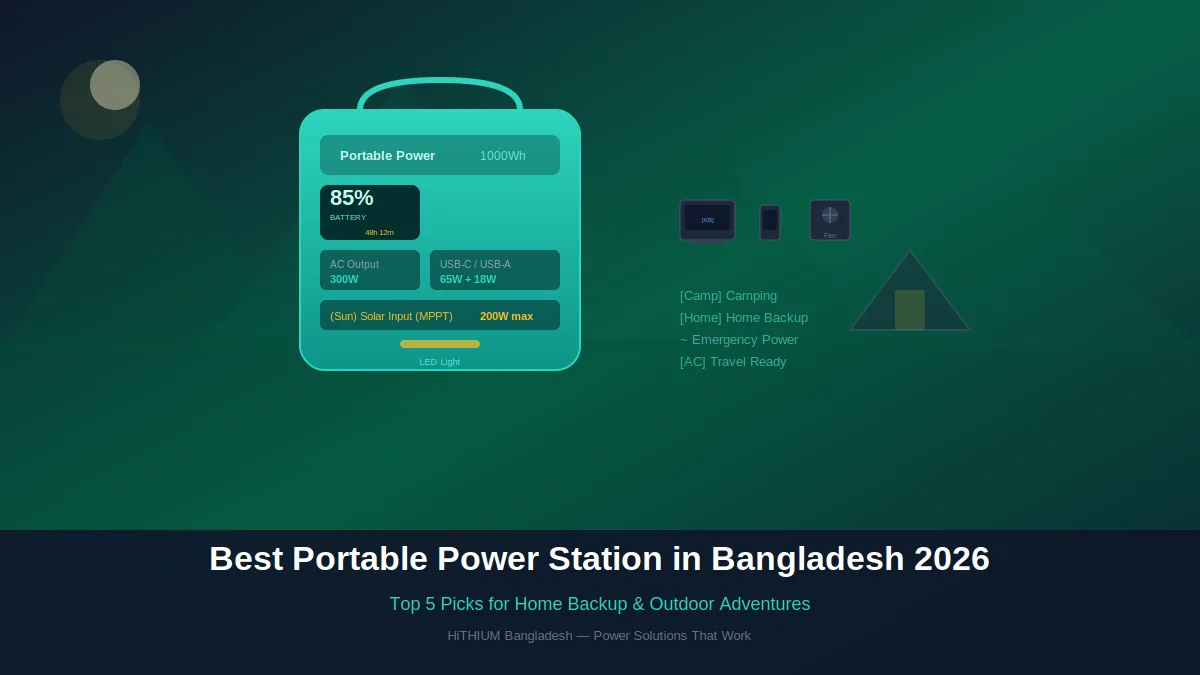
This 2026 buying guide explains capacity, output, LiFePO4 vs lead-acid cells, solar charging in the field, sizing formulas for a two-night trip, safety rules for hot and humid conditions, and realistic prices in BDT so you can pick the right unit before the next holiday.
What Is a Portable Power Station?
A portable power station is a rechargeable battery pack with a built-in inverter and charge controller. It stores energy (measured in watt-hours, Wh) and delivers it as AC and DC power (measured in watts, W). Unlike a generator there is no fuel, no exhaust and almost no noise — which makes it usable inside a tent, a fishing hut or a car at night. Unlike a home IPS it is not wired into your house; you carry it, plug things in, and recharge it from a wall socket, a car socket or a solar panel.
Why Bangladeshi Campers Need One in 2026
- Load-shedding still hits chalets, resorts and rural homestays. Many holiday spots outside Dhaka run on weak grids or generators that switch off overnight.
- Popular destinations are off-grid. Cox’s Bazar beach camps, Sundarbans tours, Sajek, Nilachal, Tamabil and the riverine areas around Padma rarely guarantee stable power.
- Device load has grown. A modern camping kit includes a phone per person, a camera or gimbal, a drone, a portable fan, LED lanterns and sometimes a laptop — all of which need charging daily.
- Carrying a generator is impractical. Fuel, smoke and 15–20 kg of machine do not fit a family car boot; a 1–2 kg power station does.
Key Specs That Actually Matter
| Spec | What It Means | Minimum for Camping 2026 |
|---|---|---|
| Capacity | Total stored energy, in Wh | 500 Wh for a weekend; 1,000 Wh for 3+ nights |
| AC output | Continuous watts the inverter can supply | 600 W for gadgets; 1,000–2,000 W if running a fan or kettle |
| Battery chemistry | Cell type and cycle life | LiFePO4 — 2,000–3,000+ cycles vs 500–800 for lead-acid |
| Solar input | Max solar watts accepted | 100–200 W so a folded panel can refill a day |
| Recharge time | Wall charge 0–100% | Under 2 hours for fast-charging models |
| Weight | Portability | Under 7 kg for a 500–1,000 Wh unit |
| UPS / pass-through | Can it charge and discharge at once | Useful if you also run a router at home |
For a deeper explanation of each number, read our complete guide to power stations in Bangladesh.
How to Size Your Camping Power Station
Run this three-step formula before you buy:
- List each device’s wattage (phone charger ≈ 20 W, LED lantern ≈ 5 W, portable fan ≈ 25 W, laptop ≈ 60 W, car-style mini fridge ≈ 45 W average).
- Multiply by hours of use per day. A 25 W fan running 8 hours = 200 Wh per day.
- Add the total for your trip and divide by 0.85 — inverters and batteries lose roughly 15% to heat and conversion.
Example: two nights with a fan (200 Wh/day), two phone charges (80 Wh/day), a lantern (40 Wh/day), a camera and drone (120 Wh/day) = 440 Wh/day × 2 ÷ 0.85 ≈ 1,035 Wh. That points to a 1,000 Wh-class unit. For a light one-night kit (phones, lantern, small fan) a 500 Wh unit is enough.
| Trip Type | Typical Load | Recommended Capacity |
|---|---|---|
| One night, couple | Phones, lantern, small fan | 300–500 Wh |
| Weekend, family of 4 | Fan, lights, phones, camera | 700–1,000 Wh |
| 3–5 nights, group | Above + fridge, router, laptop | 1,000–2,000 Wh |
| Camp with power tools / events | High-draw equipment | 2,000 Wh+ or parallel units |
A quicker cross-check is our best portable power stations in Bangladesh 2026 roundup, which groups units by capacity class.
LiFePO4 vs Lead-Acid: Which Battery for Camping?
Buy LiFePO4 unless the budget is truly fixed. It delivers 2,000–3,000 full cycles before dropping to 80% capacity, holds its charge for months of storage, survives Bangladesh’s heat far better than lead-acid, and weighs roughly half as much for the same usable energy. Lead-acid and AGM units are cheaper upfront but lose 30–50% of their rated capacity in practice, cannot be discharged deeply without damage, and need replacement every 1–2 seasons.
The full economics are covered in our LiFePO4 lifespan in Bangladesh analysis and the lithium vs tubular battery comparison.
Charging with Solar in the Field
Solar is what makes a power station genuinely useful at a campsite. Practical rules for Bangladesh:
- Panel should be 100–200 W to refill a 500–1,000 Wh unit during one clear day (roughly 4–6 peak sun hours).
- Foldable panels beat rigid ones for travel — packable, light, and set up on a beach or rooftop in minutes.
- Angle toward the sun, not flat. Even a 30° tilt raises yield noticeably in the winter months.
- Keep panels clear of salt spray and dust — wipe with a dry cloth; output drops fast on a dirty surface.
- Recharge during the day, run loads at night. Charging and discharging simultaneously wastes efficiency.
Panel sizing maths is explained step by step in how to calculate solar panel wattage for charging, and a ready-made solar pairing appears in our solar power station guide for 2026.
Camping Use Cases: What You Can Realistically Run
| Device | Watts | Runtime from 1,000 Wh |
|---|---|---|
| LED camping lantern | 5 W | ≈ 170 hours |
| Portable DC fan | 25 W | ≈ 34 hours |
| Phone (full charges) | 15 Wh each | ≈ 55 charges |
| Laptop | 60 W | ≈ 14 hours |
| Wi-Fi router | 10 W | ≈ 85 hours |
| Mini fridge | 45 W avg | ≈ 19 hours |
| Camera battery charges | 12 Wh each | ≈ 70 charges |
Two things campers consistently underestimate: fan runtime (the single biggest draw on a Bangladeshi summer trip) and inverter idle draw — switch the AC outlet off when you only need USB, and you will save 5–10% of the pack.
Safety Rules for Hot, Humid and Coastal Conditions
- Store the unit out of direct sun and above the floor if you are near water; never under a wet tarpaulin.
- Do not charge to 100% for long-term storage — 50–60% is the healthy storage level.
- Keep 20 cm of clearance around vents; do not stack towels or bags on the unit.
- Use the included charger only — third-party adapters are the most common cause of cell damage.
- Check the terminals and ports for sand or salt after every coastal trip.
- Never open the casing. Servicing and warranty work go through the dealer — see lithium battery warranty and service in Bangladesh.
Our lithium battery safety guide for Bangladeshi users covers fire risk, ventilation and transport rules in detail.
Price Guide: What a Portable Power Station Costs in Bangladesh (2026)
| Capacity Class | Best For | Indicative Price (BDT) |
|---|---|---|
| 300–500 Wh | Overnight trips, lights and phones | 18,000–35,000 |
| 600–1,000 Wh | Family weekends, fans, camera, laptop | 38,000–75,000 |
| 1,100–2,000 Wh | Extended trips, fridge, router, events | 80,000–160,000 |
| Solar panel add-on (100–200 W) | Field recharging | 12,000–30,000 |
Prices shift with imported cell costs and the dollar rate, so treat these as planning figures. Live numbers are tracked in our portable power station price list for Bangladesh and the mini power station price guide. Also read portable power station vs wall-mounted IPS if you are deciding between a camping unit and a home backup unit.
Quick Buying Checklist
- Capacity sized to your trip using the ÷0.85 formula above
- LiFePO4 cells with 2,000+ cycle rating
- AC output at least 2× the highest single device you will run
- 100 W+ solar input and a foldable panel option
- Weight you are willing to carry from the car to the campsite
- Local warranty, service centre and spare adapter availability
- Real reviews or a load test video — see our HiTHIUM HeroEE portable review for what to test
Frequently Asked Questions
How big a portable power station do I need for camping in Bangladesh?
For a one-night couple’s trip, 300–500 Wh is enough. A family weekend with a fan, lights, phones and a camera needs 700–1,000 Wh. Trips of three nights or more, especially with a fridge or router, need 1,000 Wh or more.
Can a portable power station run a fan all night?
Yes. A 25 W DC fan running 8 hours uses about 200 Wh — a 500 Wh unit will run it for roughly two nights, and a 1,000 Wh unit for about three and a half nights, allowing for inverter losses.
How long does it take to recharge with a solar panel?
With a 100–200 W foldable panel in clear conditions, expect 4–6 hours of direct sun to refill a 500–1,000 Wh unit. Cloudy or rainy weather can double that time, so plan to charge during the day and conserve at night.
Is it safe to use a power station inside a tent?
It is safe if the unit has no fan noise issues and is kept dry, upright and away from sleeping bags. Use USB or DC for lighting where possible, keep ventilation clear, and never charge it under a damp covering.
What is the difference between a portable power station and a generator?
A generator burns petrol or diesel and must run outdoors because of noise and exhaust. A portable power station is silent, emission-free and can be used indoors, but its runtime is limited by battery capacity — which is why solar recharging matters on longer trips.
Where to Buy in Bangladesh
Portable power stations, foldable solar panels and lithium IPS units are available through HiTHIUM Bangladesh dealers nationwide, with warranty and after-sales service handled locally. Check current stock and pricing before your trip, and ask the dealer to power-test the unit in front of you — a healthy pack should hold its rated output under load without the voltage dropping.
Bottom line: for camping in Bangladesh in 2026, buy a LiFePO4 portable power station sized 1.2× your daily watt-hour estimate, pair it with a 100–200 W foldable solar panel, and you will have silent, rechargeable power for lights, fans and devices wherever the road ends.

One thought on “Portable Power Station for Camping in Bangladesh 2026”