




Blog
How to Clean and Maintain Lithium IPS Battery Terminals in Bangladesh

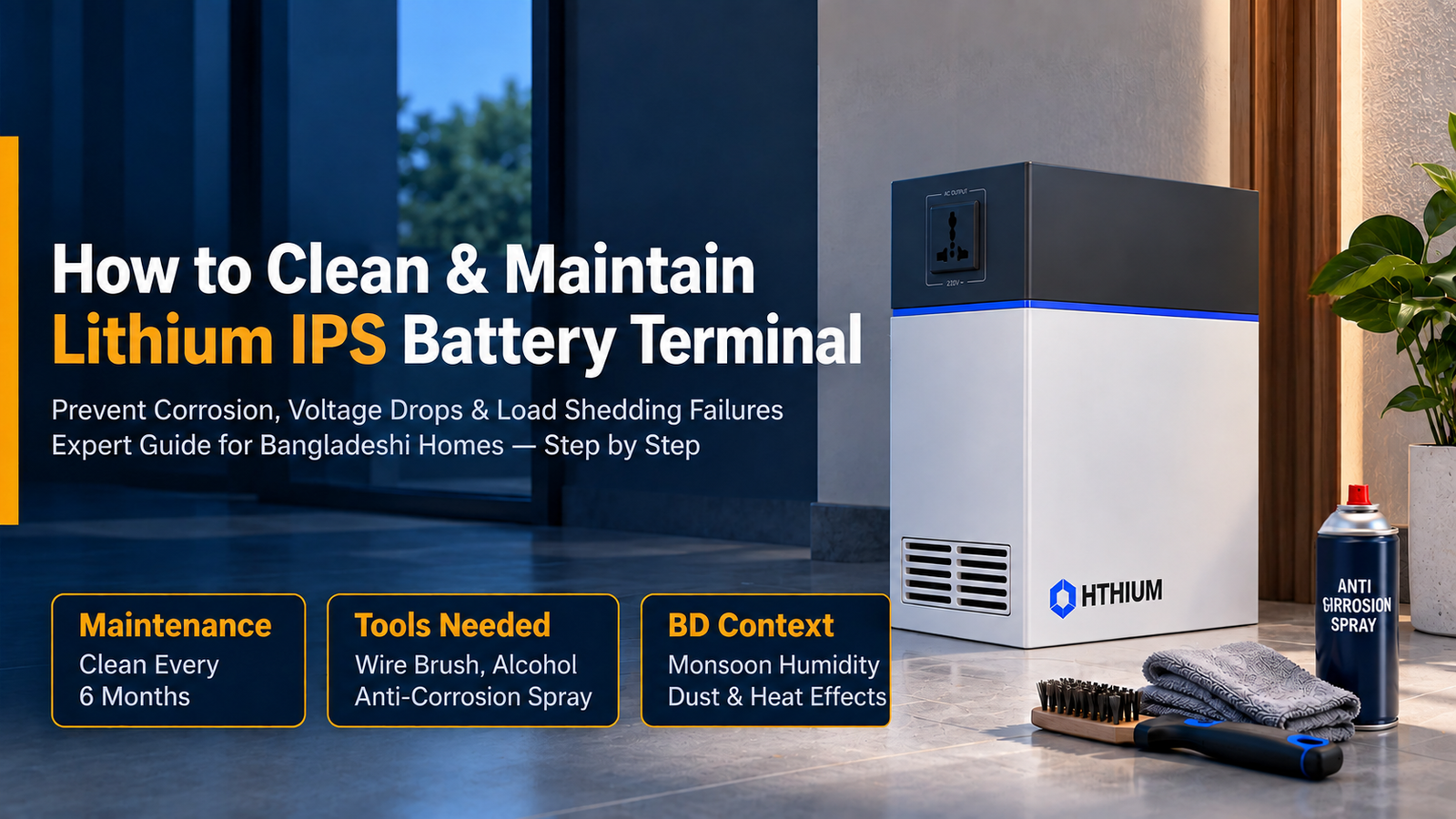
Dirty or corroded battery terminals are one of the most overlooked causes of IPS failure in Bangladeshi homes. When terminals build up resistance from dust, humidity, and oxidation, your lithium IPS cannot deliver full power during load shedding. A 2025 study by the Bangladesh Energy Regulatory Commission (BERC) found that 32% of IPS complaints in Dhaka were related to poor battery connections — not faulty batteries themselves.
This guide walks you through inspecting, cleaning, and maintaining lithium IPS battery terminals. Whether you own a HiTHIUM lithium IPS or another brand, these steps apply to all lithium-ion and LiFePO4 batteries used in Bangladeshi IPS systems.
Why Do IPS Battery Terminals Get Dirty in Bangladesh?
Bangladesh’s climate creates perfect conditions for battery terminal degradation. High humidity (70-90% year-round), monsoon moisture, and airborne dust from road construction all accelerate terminal corrosion. Unlike lead-acid batteries that produce sulfuric acid fumes, lithium batteries do not generate significant off-gassing. However, the terminals still accumulate:
- Dust and grime — Fine particulate matter from road traffic settles on exposed terminals
- Humidity oxidation — Moisture condensation on metal contacts creates a thin oxide layer
- Loose connections — Thermal expansion and contraction from Bangladesh’s temperature swings (15°C winter to 40°C summer) gradually loosen terminal bolts
- Chemical residue — Previous battery acid residue from replaced tubular batteries can remain on IPS wiring
When terminal resistance increases by even 0.1 ohm, a 1000W load can lose 50-100W of power. Over time, this means your IPS runs hotter, provides less backup time, and may trigger overload protection even when the load is within rated capacity.
Signs Your IPS Battery Terminals Need Cleaning
Watch for these warning signs that indicate dirty or corroded terminals:
- Sudden drop in backup time — If your lithium IPS provided 6-8 hours last month but now gives 3-4 hours with the same load
- Burning smell near the battery — High resistance at terminals generates heat
- Flickering lights during switching — The IPS struggles to make clean contact when switching to battery power
- Error codes on IPS display — Many modern IPS units show connection fault codes
- Visible green or white deposits — Oxidation residue on terminal surfaces
- Loose terminal bolts — You can wiggle the cable connector by hand
Tools You Need for Terminal Maintenance
You do not need expensive equipment. Most of these items are available at hardware shops in Dhaka’s Elephant Road or Online shops like Daraz:
| Tool | Purpose | Estimated Cost (BDT) |
|---|---|---|
| Wire brush or terminal brush | Remove oxidation and grime | 50-150 |
| Adjustable wrench (10-13mm) | Loosen/tighten terminal bolts | 200-400 |
| Isopropyl alcohol (70%+) | Dissolve grease and residue | 150-300 |
| Anti-corrosion spray or grease | Prevent future oxidation | 200-500 |
| Cotton cloth or microfiber | Wipe and clean surfaces | 50-100 |
| Insulated screwdriver set | Tighten cable lugs | 300-600 |
| Digital multimeter | Test terminal voltage drop | 500-1500 |
Step-by-Step: How to Clean Lithium IPS Battery Terminals
Step 1: Turn Off the IPS
Switch off the IPS using the front panel power button. Unplug the mains input from the wall socket. Wait 2-3 minutes for capacitors to discharge. Never work on battery terminals while the IPS is powered on.
Step 2: Disconnect the Battery
Always disconnect the negative (black) terminal first, then the positive (red) terminal. Use a 10mm or 13mm wrench to loosen the terminal bolts. If the bolts are tight, do not force them — apply a small amount of penetrating oil and wait 5 minutes before retrying.
Step 3: Inspect the Terminals
Look for:
- White, green, or blue-green deposits (copper/aluminum oxidation)
- Dark discoloration on the terminal surface
- Damaged or frayed cable lugs
- Cracks in terminal insulation
Document any damage with photos before cleaning — this helps if you need warranty service later.
Step 4: Clean the Terminals
Dampen a cotton cloth with isopropyl alcohol. Wipe the terminal surfaces thoroughly. For heavy oxidation, use a wire brush to gently scrub the terminal surfaces. Always brush toward the terminal, not away from it, to avoid sending particles into the battery housing. After brushing, wipe again with isopropyl alcohol to remove residue.
Step 5: Clean the Cable Lugs
The cable lug (the metal connector at the end of the battery cable) also needs cleaning. Scrub both sides with the wire brush, then wipe with isopropyl alcohol. Check that the lug is not bent, cracked, or corroded beyond cleaning.
Step 6: Reconnect the Battery
Reconnect the positive (red) terminal first, then the negative (black) terminal. Tighten bolts firmly — hand-tight plus a quarter turn with the wrench. Do not over-tighten, as this can strip the threads or crack the terminal post.
Step 7: Apply Anti-Corrosion Protection
Apply a thin layer of anti-corrosion spray or dielectric grease on the reconnected terminals. This creates a moisture barrier that prevents oxidation. In Bangladesh’s humid climate, this step can extend the interval between cleanings from 3 months to 6-8 months.
Step 8: Test the System
Reconnect mains power, turn on the IPS, and let it charge for 15 minutes. Use a digital multimeter to measure voltage at the terminals:
| Measurement Point | Expected Reading | Action if Wrong |
|---|---|---|
| Terminal voltage (no load) | 13.2V – 13.8V (48V system: 52-55V) | Check battery state of charge |
| Voltage drop under load | Less than 0.5V | Re-clean terminals, check connections |
| Terminal temperature | Room temperature + max 5°C | Immediate re-inspection needed |
Maintenance Schedule for Lithium IPS Terminals
Bangladesh’s climate demands more frequent maintenance than manufacturers typically recommend. Based on local conditions in Dhaka, Chattogram, and Sylhet:
| Frequency | Task | Priority |
|---|---|---|
| Every 3 months | Visual inspection of terminals | High |
| Every 6 months | Full cleaning and tightening | Critical |
| Every 6 months | Voltage drop test with multimeter | High |
| Once per year | Professional IPS service with terminal check | Recommended |
| After monsoon | Extra inspection (September-October) | Critical for coastal areas |
Common Mistakes to Avoid
Many Bangladeshi IPS owners make these mistakes during terminal maintenance:
- Using water to clean terminals — Water leaves residue and can short-circuit adjacent terminals. Always use isopropyl alcohol.
- Overtightening bolts — This cracks terminal posts or strips threads, creating a bigger problem. Use hand-tight plus quarter turn.
- Skip the negative-first disconnect — Disconnecting positive first while the wrench touches metal creates a short circuit spark. Always negative first when disconnecting, positive first when reconnecting.
- Ignoring cable lug condition — A clean terminal with a corroded cable lug still has high resistance.
- Using abrasive sandpaper — Coarse grit removes terminal plating, accelerating future corrosion. Use a proper terminal brush.
- Not applying anti-corrosion protection — In Bangladesh’s humidity, unprotected terminals re-oxidize within weeks.
When to Call a Professional
Some terminal issues require professional service. Contact an authorized IPS service center if you notice:
- Melted or bubbled terminal insulation — indicates severe overheating
- Battery swelling or bulging — a safety hazard with lithium batteries
- Repeated terminal loosening within weeks — may indicate a defective terminal post
- Burning smell that persists after cleaning — could indicate internal wiring damage
- Warranty concerns — opening the battery casing voids most warranties; terminal cleaning externally does not
For HiTHIUM customers in Bangladesh, authorized service centers in Dhaka (Uttara, Motijheel), Chattogram, and Sylhet offer free terminal inspections as part of regular service visits. Contact HiTHIUM to schedule a service appointment.
Frequently Asked Questions
How often should I clean my lithium IPS battery terminals in Bangladesh?
Clean lithium IPS battery terminals every 6 months under normal conditions in Bangladesh. During the monsoon season (June-September), perform an additional inspection in October. Homes near coastal areas like Chittagong or Cox’s Bazar may need cleaning every 4 months due to salt air exposure. A visual check every 3 months takes 5 minutes and catches problems early.
Can dirty battery terminals reduce IPS backup time?
Yes. Dirty or corroded battery terminals increase electrical resistance, which wastes energy as heat. A resistance increase of just 0.1 ohm at the terminals can reduce your effective backup time by 15-25%. If your IPS backup time has dropped suddenly without any change in your electrical load, dirty terminals are one of the first things to check.
Is it safe to clean lithium IPS battery terminals at home?
Yes, external terminal cleaning is safe when you follow proper safety steps: turn off the IPS, disconnect from mains power, wait 3 minutes, and always disconnect the negative terminal first. Use isopropyl alcohol (not water) and a proper terminal brush. Never open the battery casing itself — that requires professional service and may void your warranty.
What happens if I do not maintain IPS battery terminals?
Neglected terminals lead to increased resistance, which causes the battery to work harder and generate more heat. Over time, this reduces battery lifespan, decreases backup time, and can trigger overload errors. In severe cases, corroded terminals can cause sparking, fire risk, or permanent damage to the IPS inverter unit. Regular maintenance costs BDT 0-500 in materials but can prevent BDT 5,000-15,000 in repair costs.
Can I use petroleum jelly instead of anti-corrosion spray?
Petroleum jelly provides a basic moisture barrier, but dedicated anti-corrosion spray or dielectric grease is more effective. Petroleum jelly can attract dust in Bangladesh’s dusty environment, creating a paste that actually traps moisture. Anti-corrosion spray costs BDT 200-500 and lasts 6-8 months per application — a worthwhile investment for protecting your IPS battery investment.
Protect Your IPS Investment with Regular Maintenance
A lithium IPS battery costs between BDT 15,000 and BDT 60,000 depending on capacity. Spending 15 minutes every 6 months cleaning terminals can extend your battery’s effective life by 2-3 years. In a country where load shedding still affects millions of homes, a reliable IPS is not a luxury — it is essential.
Follow this maintenance schedule, keep your terminals clean, and your lithium IPS will deliver consistent backup power through Bangladesh’s longest load shedding hours.
Looking for professional IPS service? Contact HiTHIUM Bangladesh for authorized maintenance or browse our lithium IPS range for new installations. For more on IPS maintenance, read our complete IPS maintenance checklist and lithium battery safety guide.
Recommended HiTHIUM Products
Based on your needs, here are the best HiTHIUM lithium IPS and power station options for Bangladesh:
| Product | Capacity | Best For | Price |
|---|---|---|---|
| HiTHIUM HeroEE Light 1 (500W, 1kWh) | 500W, 1kWh | Small homes, 5 fans + 4 lights + router | ৳50,800 |
| HiTHIUM HeroEE 2 (1000W, 2kWh) | 1000W, 2kWh | Medium homes, fridge + fans + TV + lights | ৳78,100 |
Free delivery across Bangladesh. WhatsApp us for consultation: Contact HiTHIUM

2 thoughts on “How to Clean and Maintain Lithium IPS Battery Terminals in Bangladesh”