




Blog
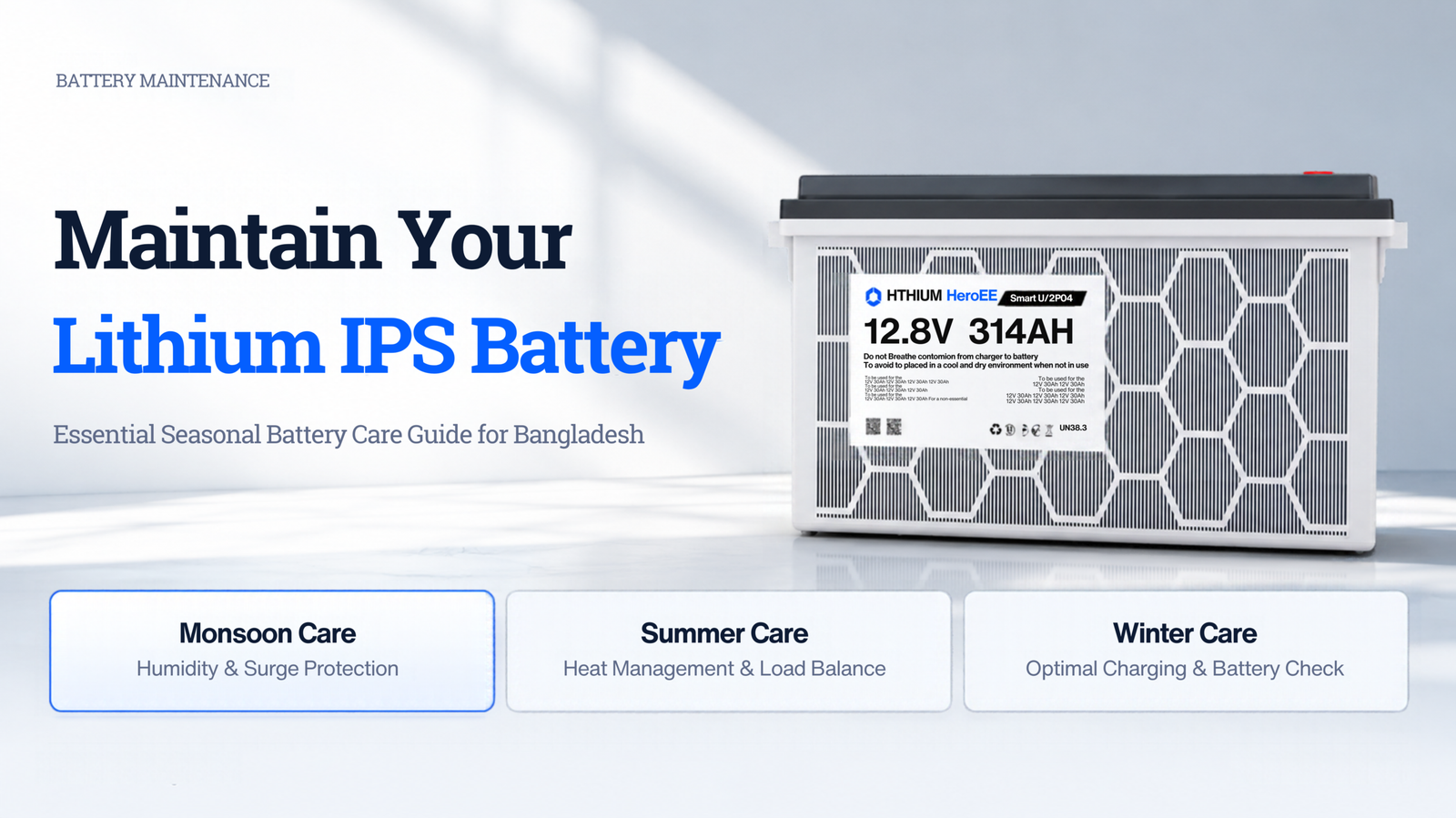
How to Maintain Lithium IPS Battery in Bangladesh — Monsoon, Summer & Winter Care Tips

How to Maintain Lithium IPS Battery in Bangladesh — Monsoon, Summer & Winter Care Tips
Power cuts are a daily reality in Bangladesh. Whether you live in Dhaka, Chittagong, or a rural village, an IPS (Inverter Power Supply) system is your lifeline. But owning a lithium IPS battery is only half the battle — keeping it healthy across Bangladesh’s extreme seasons is what determines whether it lasts 3 years or 8+ years.
This guide covers everything Bangladeshi IPS owners need to know about maintaining their lithium iron phosphate (LiFePO₄) batteries through monsoon humidity, summer heat, and winter cold. We’ll show you practical, actionable steps that take less than 10 minutes per month.
Why Seasonal Maintenance Matters for Lithium IPS in Bangladesh
Bangladesh has three distinct seasons that each stress your IPS battery differently:
- Monsoon (June–September): High humidity, frequent power surges, and waterlogging risks
- Summer (March–May): Peak temperatures of 35–42°C, maximum load from fans and ACs, longest backup demands
- Winter (November–January): Cooler temperatures that actually benefit battery chemistry, but users often neglect maintenance during this calm period
A LiFePO₄ battery like the HiTHIUM HeroEE Light 1 is rated for 11,000 cycles, but that lifespan assumes proper maintenance. Skip seasonal care and you could lose 30–50% of your battery’s potential life.
Essential Monthly Maintenance Checklist
Regardless of season, every lithium IPS owner in Bangladesh should perform these five checks monthly:
1. Visual Inspection for Damage
Check the battery casing for cracks, swelling, or discoloration. Look at all terminals and cables for corrosion (white or green powder). Any bulging case means immediate replacement — do not attempt to repair a swollen lithium battery.
2. Terminal Cleaning
Clean battery terminals with a dry cloth or soft brush. If you see corrosion, use a small amount of white vinegar on a cotton bud, then wipe clean and dry thoroughly. Apply a thin layer of petroleum jelly or grease to prevent future corrosion. For detailed steps, see our IPS Battery Terminal Maintenance Guide.
3. Connection Tightness Check
Loose connections cause voltage drops and heat buildup. Tighten all terminal bolts with the correct wrench size. Do not over-tighten — strip marks on the bolt indicate you’ve gone too far.
4. LCD/Display Reading
Modern lithium IPS units like the HiTHIUM HeroEE 2 show real-time data on their LCD screens. Note the battery percentage, input/output voltage, and load percentage. If voltage drops below 48V on a 48V system, investigate immediately.
5. Ventilation Clearance
Ensure at least 30cm of clear space around the IPS unit. Blockage causes heat buildup, which accelerates battery degradation. Keep the area around your IPS free of stored items, especially during summer.
Monsoon Season Maintenance (June–September)
Bangladesh’s monsoon brings two major threats to lithium IPS batteries: humidity-induced corrosion and electrical surges from lightning or grid fluctuations.
Humidity Protection
- Install your IPS in a dry, elevated location — never on the floor of a ground-floor room prone to waterlogging
- Place silica gel packets or moisture-absorbing pads inside the IPS enclosure if it has a removable panel
- Check for condensation inside the unit after heavy rain days
- Ensure the installation room has cross-ventilation to reduce ambient humidity
Surge Protection
- Verify your IPS has built-in surge protection (all HiTHIUM models do)
- If your area experiences frequent lightning, consider adding an external surge protector between the grid input and IPS
- After severe thunderstorms, check the IPS display for any fault codes and inspect cables for damage
Post-Monsoon Deep Clean
After the monsoon ends, perform a thorough inspection: check all cables for rodent damage (mice love chewing wires in damp conditions), inspect the battery case for moisture ingress, and test the backup time against stated specifications.
Summer Season Maintenance (March–May)
Summer is the most demanding season for IPS batteries. Load-shedding stretches longer, fans and coolers run continuously, and ambient temperatures inside utility rooms can exceed 45°C.
Heat Management
- Critical rule: LiFePO₄ batteries degrade fastest above 45°C. If your installation room exceeds this, install a small exhaust fan or relocate the unit
- Never place the IPS near heat-generating equipment like geysers, deep freezers, or cooking stoves
- Keep the IPS away from direct sunlight — even through windows
- During extreme heat waves, consider running the IPS on a slightly lower charge threshold to reduce internal heating during charging cycles
Load Management
During summer, Bangladesh households typically run 4–6 ceiling fans, 1–2 table fans, LED lights, and sometimes a small AC or cooler. Calculate your total load:
| Appliance | wattage | Typical Hours/Day | Daily Wh |
|---|---|---|---|
| Ceiling fan (40W) × 5 | 200W | 12 hours | 2,400 Wh |
| LED lights (9W) × 8 | 72W | 6 hours | 432 Wh |
| Television (60W) | 60W | 4 hours | 240 Wh |
| Mobile charging (10W) × 3 | 30W | 3 hours | 90 Wh |
| Total | 362W average | — | ~3,162 Wh/day |
For a household needing ~3,200 Wh daily backup, a HiTHIUM MaxPower 8 AIO (8kWh capacity) provides comfortable margin even on hot days when battery efficiency drops slightly.
Charging Optimization in Heat
- Enable “temperature compensation” on your IPS if available — it reduces charging voltage when hot to prevent overheating
- Avoid charging to 100% during peak summer afternoons; 90–95% is sufficient and reduces thermal stress
- If using solar charging, ensure the MPPT controller has temperature compensation built in
Winter Season Maintenance (November–January)
Winter is actually the best season for lithium battery health — cooler temperatures slow chemical degradation and extend cycle life. However, Bangladeshi winters bring unique challenges.
The Cold Warning
While LiFePO₄ batteries handle cold better than lead-acid, they should never be charged below 0°C. In Bangladesh, indoor temperatures rarely drop below 10°C, so this is rarely a concern — but if your IPS is installed in an unheated rooftop area or open veranda, move it indoors during cold snaps.
Winter Charging Tips
- Cooler temperatures mean the battery accepts charge more efficiently — you may notice faster recharge times after power cuts
- Winter evenings are longer; ensure your IPS charges fully before nightfall when loads increase
- Check battery water levels (not applicable for lithium, but verify no condensation inside the unit)
Pre-Winter Inspection
Before winter sets in, verify:
- All cables are intact — rodents active in autumn may have nibbled wiring
- The IPS display shows correct voltage readings across the full charge range
- Backup time matches expectations for your load profile
- Emergency lighting and critical circuits still switch correctly
Annual Deep Maintenance: What to Check Once a Year
Once per year, perform these deeper checks that go beyond monthly routine:
- Capacity test: Fully charge the battery, disconnect grid, and run a known load (e.g., 4 fans + lights) while timing how long it lasts. Compare against the manufacturer’s stated backup time. A drop of more than 20% indicates the battery may need replacement.
- Internal resistance check: If your IPS has a BMS (Battery Management System) with WiFi monitoring like the MaxPower 8 AIO, review the impedance trends in the app. Rising internal resistance signals aging.
- Firmware update: Check with HiTHIUM for any BMS firmware updates that improve charge algorithms or add protection features.
- Cable insulation inspection: Disconnect and inspect all DC and AC cables for brittleness, cracking, or discoloration — signs of UV or heat damage.
- Mounting hardware: Tighten all wall brackets, floor stands, and vibration dampeners. A falling IPS unit causes serious damage.
Common Mistakes Bangladeshi IPS Owners Make
| Mistake | Consequence | Fix |
|---|---|---|
| Leaving IPS on 100% charge for weeks during Ausa/Puja | Accelerated capacity fade | Keep at 80–90% if not in use for 2+ weeks |
| Using the IPS as a storage cupboard | Blocked ventilation, overheating | Clear 30cm around all sides |
| Mixing old and new batteries in parallel | Uneven current sharing, premature failure | Replace all batteries in a string simultaneously |
| Ignoring error codes on the LCD | Minor faults become catastrophic failures | Check manual immediately; contact support |
| Using cheap generic cables instead of specified gauge | Voltage drop, heating, fire risk | Use manufacturer-specified cable sizes |
| Installing in a sealed metal cabinet with no vents | Thermal runaway risk in summer | Ensure cross-ventilation or install exhaust fan |
When to Replace Your Lithium IPS Battery
Even with perfect maintenance, lithium IPS batteries degrade. Here’s how to know when it’s time to replace:
- Backup time dropped below 50% of original specification
- The BMS reports cell imbalance that cannot be corrected by balance charging
- Swelling or physical damage to any cell module
- Charging time exceeds 12 hours for a full charge (indicates high internal resistance)
- The warranty period has expired and repair costs exceed 50% of a new unit
For Bangladeshi homeowners ready to upgrade, HiTHIUM’s full product range includes solutions from 1kWh portable units to 16kWh commercial systems.
FAQ: Lithium IPS Battery Maintenance in Bangladesh
How often should I maintain my lithium IPS battery in Bangladesh?
Perform basic checks (terminal cleaning, visual inspection, connection tightness) once per month. Do a deep capacity test and full inspection once per year, ideally before the monsoon season begins in May.
Can I leave my lithium IPS battery at 100% charge all the time?
While LiFePO₄ batteries handle full charges better than lead-acid, keeping them at 100% for extended periods (weeks) accelerates calendar aging. For daily use, 90–95% is the sweet spot. Only charge to 100% when you need maximum backup time.
Is it safe to use my IPS battery during heavy monsoon rain?
Yes, provided the unit is installed indoors in a dry location. Never install an IPS in a basement or ground-floor room prone to waterlogging. If water enters the unit, disconnect power immediately and do not attempt to restart until a technician inspects it.
What is the best lithium IPS battery for a typical Bangladeshi home?
For most 3–4 room homes, a 1–2kWh unit like the HeroEE Light 1 or HeroEE 2 handles fans, lights, and TVs. Larger homes or those running a small AC should consider the MaxPower 8 AIO (8kWh) with solar integration.
How do I know if my IPS battery needs replacement?
Key signs: backup time has dropped below half its original rating, the battery takes abnormally long to charge, you see physical swelling, or the BMS displays persistent error codes. A yearly capacity test is the best proactive check.
Should I remove my IPS battery during long absences?
If you’re away for more than 2 weeks, charge the battery to 60–80% and power off the IPS completely. Check the charge level every 4–6 weeks and top up if it drops below 50%. Storing at full charge or deep discharge both shorten battery lifespan.
Ready to Upgrade Your IPS System?
Maintenance keeps your current IPS running for years, but upgrading to a newer, more efficient lithium system can cut your electricity bills and eliminate generator dependency entirely. HiTHIUM offers free IPS load assessment — tell us your home or business requirements and we’ll recommend the right capacity.
Visit our contact page or call us to schedule a consultation. We deliver and install across Dhaka, Chittagong, Sylhet, and all major cities in Bangladesh.
