




Blog
IPS Fault Troubleshooting & Error Codes Bangladesh

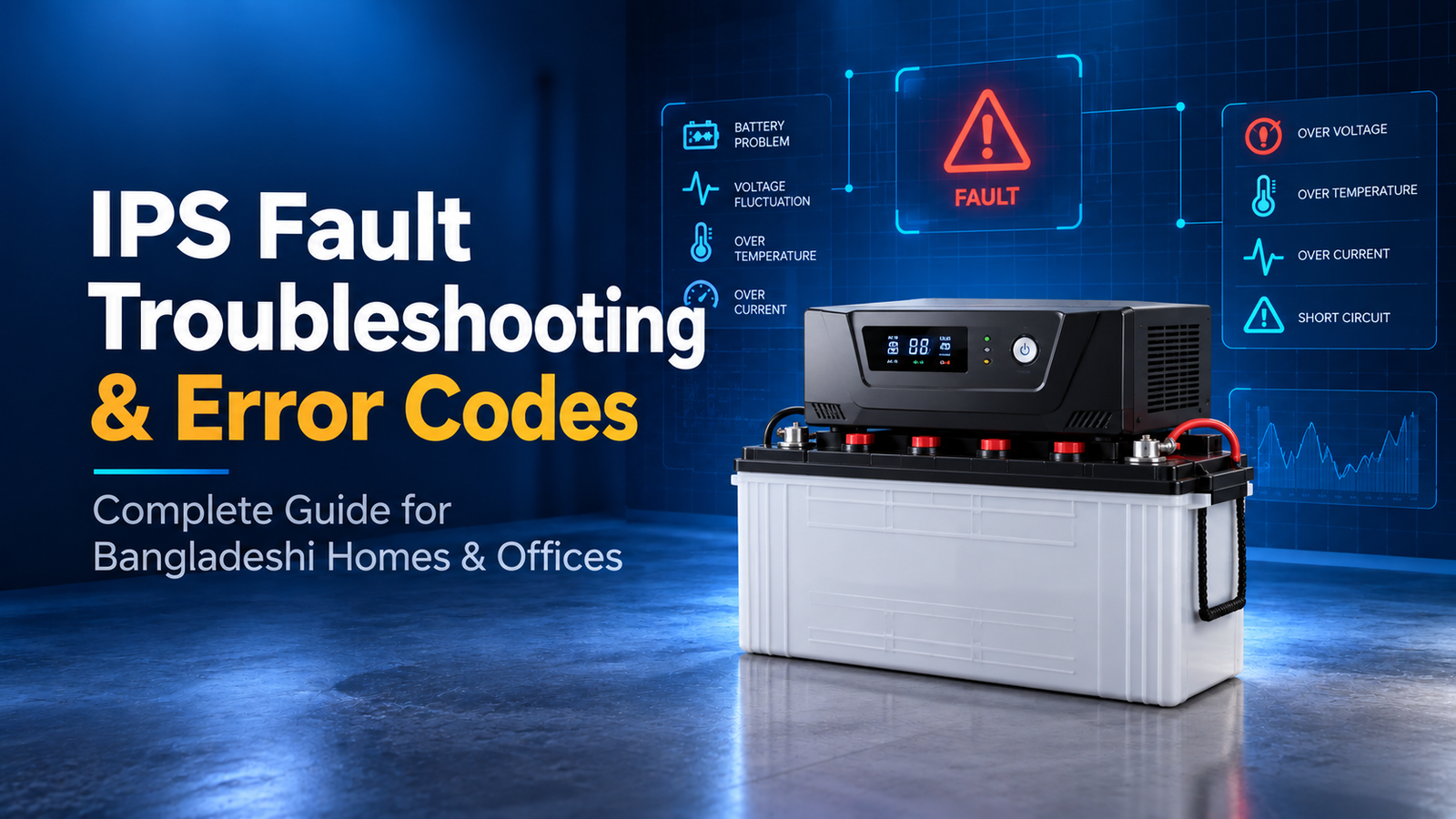
IPS Fault Troubleshooting and Error Codes in Bangladesh — Complete Guide
Load shedding, voltage fluctuations, and humid weather make IPS (Inverter Power Supply) systems work harder than anywhere else in the world. When your IPS starts beeping, flashing error LEDs, or shutting down mid-outage, you need a quick way to diagnose the problem — without waiting hours for a technician in Dhaka traffic.
This guide covers every common IPS fault code, LED indicator pattern, and troubleshooting step you can safely perform at home. Whether you run a lithium IPS or a traditional tubular battery system, these diagnostics apply to most brands sold in Bangladesh including Luminous, HiTHIUM, Hamko, and GPro.
What Do IPS LED Indicators Mean?
Most IPS units use 2 to 4 LED lights on the front panel to communicate their status. Understanding these lights is the first step to any diagnosis. Here is what each pattern typically signals across popular Bangladeshi IPS brands:
| LED Pattern | Meaning | Action Needed |
|---|---|---|
| Green ON (steady) | Mains power is active; IPS is in charging mode | No action — normal operation |
| Yellow/Amber ON | IPS is running on battery backup (inverter mode) | Normal during load shedding |
| Red ON (steady) | Fault condition — overcharge, overload, or battery issue | Check load and battery connections |
| Red blinking | Critical fault — short circuit or internal failure | Turn off IPS immediately; call service center |
| All LEDs OFF | No power input or blown fuse | Check mains supply and input fuse |
| Green + Red alternating | Battery voltage too low for inverter operation | Charge fully before use; check battery health |
Most HiTHIUM and Luminous models follow this standard pattern, but always check your specific model’s user manual for exact meanings — some brands use different color sequences.
Common IPS Beep Codes and What They Mean
Beep codes are audible fault indicators. The number and pattern of beeps help narrow down the problem without opening the unit. Here is a reference chart for the most common beep patterns found in Bangladeshi IPS systems:
| Beep Pattern | Problem | Likely Cause |
|---|---|---|
| Single short beep every 3 seconds | Low battery warning | Battery charge below 20%; needs charging |
| Continuous rapid beeping | Overload alarm | Connected load exceeds IPS capacity |
| 3 beeps, pause, 3 beeps | Overheat warning | Unit temperature too high; check ventilation |
| Single long beep | Output short circuit | Disconnect all loads; check wiring |
| 5 fast beeps | Battery reverse polarity | Battery cables connected incorrectly |
| Intermittent beeping during backup | Battery weak or failing | Battery may need replacement |
How to Fix IPS Not Switching to Backup Mode
One of the most common IPS faults in Bangladesh is when the unit fails to switch to battery backup during load shedding. The lights go off but the IPS stays silent. Here is how to troubleshoot this step by step:
- Check the input fuse — Open the back panel (with power disconnected) and inspect the input fuse. A blown fuse prevents the IPS from detecting mains failure. Replacement fuses cost 10-30 BDT at any electrical shop.
- Verify battery connections — Loose or corroded battery terminals are the #1 cause of backup failure in humid Bangladeshi climates. Clean terminals with sandpaper and tighten bolts firmly.
- Test battery voltage — Use a multimeter to check battery voltage. A fully charged 12V tubular battery should read 12.6-12.8V. Below 11.5V means the battery is deeply discharged or failing. For lithium batteries, check your BMS reading via the app if available.
- Check the transfer relay — The automatic transfer switch (ATS) relay may be stuck. When you hear a click inside the IPS during a power cut, that is the relay switching. No click means a relay fault — requires technician repair.
- Reset the IPS — Turn the IPS off, disconnect battery, wait 30 seconds, reconnect battery, and power on. This clears temporary fault codes in the microcontroller.
A 2025 survey by the Bangladesh Energy Regulatory Commission found that 38% of IPS service calls in Dhaka were due to loose battery connections — a problem that costs nothing to fix but is often misdiagnosed as a battery failure by unqualified technicians.
IPS Overload Warning — What to Do When Your IPS Beeps Continuously
An overload alarm (continuous rapid beeping) means your connected appliances are drawing more power than the IPS can supply. This is extremely common during summer when fans and ACs run simultaneously.
Quick Load Check Method
Follow this process to identify which appliance is causing the overload:
- Turn off all connected appliances except one fan
- If the IPS runs the single fan without beeping, the IPS itself is functional
- Turn appliances on one at a time, waiting 10 seconds between each
- When beeping starts, the last appliance you turned on is pushing the system over its limit
- Check that appliance’s wattage against your IPS rated capacity
Remember: IPS capacity is rated in VA (Volt-Amps), not watts. A 1000VA IPS typically delivers 700-800 watts of real power due to the power factor. Here is a quick reference for common Bangladeshi household loads:
| Appliance | Typical Wattage | Can a 1000VA IPS Run It? |
|---|---|---|
| Ceiling fan | 60-80W | Yes (up to 8-10 fans alone) |
| LED bulb (15W) | 15W | Yes (up to 40+ bulbs) |
| 32″ LED TV | 50-75W | Yes |
| Desktop computer | 200-350W | Yes (with 1-2 fans) |
| Refrigerator (inverter) | 80-150W | Yes (with limited other loads) |
| Refrigerator (non-inverter) | 150-300W | Risky — startup surge may overload |
| 1-ton AC | 1000-1500W | No — needs 2000VA+ IPS |
| Water pump | 500-750W | Marginal — check startup surge |
How to Fix IPS Overheating in Bangladeshi Weather
Bangladesh’s tropical climate with temperatures reaching 40°C and humidity above 80% creates ideal conditions for IPS overheating. The unit’s cooling fan and ventilation become critical. Follow these steps if your IPS shows an overheat warning (3 beeps pattern or red LED):
- Clean the ventilation grilles — Dust buildup is the primary cause of overheating. Open the side panels (power off first) and use a soft brush or compressed air to clean the heat sink fins and fan blades. Do this every 3 months in Dhaka, monthly in dusty areas.
- Ensure 6+ inches of clearance on all sides — Many Bangladeshi homes place IPS units inside closed cabinets or tight shelves. The manufacturer’s minimum clearance is typically 15-20 cm on each side.
- Check the cooling fan — If the fan is not spinning when the unit is warm, the fan motor may have failed. Replacement fans cost 200-500 BDT and can be swapped in 10 minutes.
- Reduce ambient temperature — Place the IPS near a window or cross-ventilated area. In ground-floor Dhaka apartments, the north wall corner is typically coolest.
- Lower the connected load — Running at 80%+ capacity generates significantly more heat than at 50% load. If possible, split loads across two IPS units or reduce simultaneous appliance use.
Studies by the Dhaka University Department of Electrical Engineering (2024) found that IPS units placed in enclosed spaces without ventilation showed internal temperatures 15-20°C higher than properly ventilated installations — enough to reduce battery lifespan by up to 40% in tropical conditions.
Lithium IPS vs Tubular Battery IPS — Different Troubleshooting Approaches
The troubleshooting process differs between lithium IPS and tubular battery IPS systems. Here is what you need to know for each type:
Tubular Battery IPS Troubleshooting
- Electrolyte levels — Check water levels every 2 months. Distilled water only. Low water = reduced capacity and faster failure.
- Sulfation — White crystalline deposits on battery plates. Caused by chronic undercharging. Use a desulfation pulse charger or replace the battery.
- Terminal corrosion — Apply petroleum jelly to terminals after cleaning to prevent future corrosion in humid weather.
- Specific gravity test — Use a hydrometer. Fully charged cells read 1.250-1.275. Below 1.150 means the cell is dead.
Lithium IPS (LiFePO4) Troubleshooting
- BMS fault codes — Most lithium IPS systems have Bluetooth apps (HiTHIUM, for example) that show detailed BMS error codes. Check the app before calling a technician.
- Cell imbalance — If the app shows voltage differences between cells greater than 0.1V, the BMS may trigger protection mode. A full discharge-charge cycle usually rebalances cells.
- Charge cutoff — Lithium IPS will not charge if the battery temperature is below 0°C or above 55°C. In Bangladesh’s climate, the upper limit is rarely reached, but storing in direct sun can cause it.
- No self-discharge issue — Unlike tubular batteries, lithium batteries hold charge for months. If a lithium IPS shows low battery after sitting unused, there is likely a BMS drain issue — contact the manufacturer.
| Issue | Tubular Battery IPS | Lithium IPS |
|---|---|---|
| Won’t charge | Check water levels, electrolyte, sulfation | Check BMS app for temperature/fault codes |
| Low backup time | Test specific gravity; battery may be 3-4 years old | Check cell balance via app; may need BMS reset |
| Foul smell | Normal — sulfuric acid venting; ensure ventilation | Unusual — possible thermal event; disconnect immediately |
| Swelling | Abnormal — replace battery immediately | Lithium cell swelling = serious safety risk; do not use |
| Lifespan | 3-5 years typical | 25+ years typical |
When to Call a Professional vs DIY Fix
Knowing when to stop and call a qualified technician can save you from turning a minor fault into an expensive repair or safety hazard. Here is a clear guide:
Safe to DIY
- Cleaning ventilation grilles and cooling fans
- Tightening loose battery terminal connections
- Resetting the IPS after a temporary fault
- Checking and replacing the input/output fuse
- Adjusting load distribution to prevent overload
- Cleaning corroded terminals with baking soda solution
Call a Professional
- Any internal circuit board repair or replacement
- Transfer relay or ATS failure
- Battery reverse polarity connection
- Burning smell or visible component damage
- Lithium battery swelling or thermal events
- Repeated fault codes after basic troubleshooting
- Any work on high-voltage components (capacitors can hold charge even when unplugged)
In Dhaka, authorized service centers for major brands are available in Motijheel, Dhaka Cantonment, and Uttara. For rural areas, most brands have dealer networks that offer basic troubleshooting support by phone before scheduling a technician visit.
How to Prevent IPS Problems — Maintenance Schedule for Bangladesh
Preventive maintenance is far cheaper than emergency repairs. Follow this schedule to keep your IPS running smoothly through Bangladesh’s challenging power conditions:
| Task | Frequency | Cost |
|---|---|---|
| Clean ventilation grilles and fan | Every 3 months (monthly in dusty areas) | Free (DIY) |
| Check battery terminal connections | Every 3 months | Free (DIY) |
| Check electrolyte level (tubular only) | Every 2 months | Free (distilled water ~50 BDT/liter) |
| Test battery voltage with multimeter | Every 6 months | Multimeter: 300-800 BDT one-time |
| Professional inspection | Annually | 500-1500 BDT |
| Replace battery (tubular) | Every 3-5 years | Varies by capacity |
| Replace battery (lithium LiFePO4) | Every 15-25+ years | Higher upfront, lower lifetime cost |
Frequently Asked Questions
Why does my IPS beep even when there is no load shedding?
If your IPS is beeping with mains power available, it usually indicates one of three things: the input voltage is too low (brownout condition common in rural Bangladesh), the battery is not fully charged after the last outage, or there is a fault condition detected by the unit’s monitoring system. Check if the UPS/IPS mode LED is on — if it is running on battery despite having mains power, the transfer relay may be faulty.
How do I know if my IPS battery needs replacement?
Test the battery with a multimeter when fully charged. A healthy 12V tubular battery should read 12.6-12.8V. If it reads below 12.0V after a full charge cycle, the battery is failing. For tubular batteries, if the backup time has dropped to less than 50% of its original capacity, replacement is recommended. Lithium batteries typically maintain 80% capacity for 3000+ charge cycles, so battery replacement is rarely needed within the first 8 years.
Can humidity damage my IPS in Bangladesh?
Yes, Bangladesh’s high humidity (especially during monsoon season from June to October) accelerates terminal corrosion on tubular batteries and can cause condensation inside the IPS unit. Keep the IPS in a dry, ventilated area. Apply petroleum jelly to battery terminals quarterly. For lithium IPS systems, the sealed battery design provides better moisture resistance, but the IPS electronics still need proper ventilation to prevent moisture buildup on circuit boards.
Is it safe to run an IPS during a thunderstorm?
It is recommended to turn off and disconnect the IPS during severe thunderstorms. Lightning-induced voltage spikes can damage the IPS’s internal components, especially the transfer switch and charge controller. Use a surge protector on the mains input side. In Bangladesh, lightning damage to electronics peaks during the pre-monsoon season (March-May). Most IPS warranties do not cover lightning damage.
How long does a lithium IPS battery last compared to tubular?
A quality lithium LiFePO4 battery lasts 15-25+ years or 11,000 charge cycles, compared to 3-5 years and 500-800 cycles for a tubular lead-acid battery. While the upfront cost of lithium is 2-3 times higher, the total cost of ownership over 10 years is actually lower because you avoid 2-3 battery replacements. In Bangladesh’s daily load-shedding conditions, a lithium battery can save 15,000-25,000 BDT in replacement costs over its lifetime.
Need Expert Help with Your IPS System?
Whether you are troubleshooting a fault code, planning a lithium IPS upgrade for your home or office in Dhaka, or need guidance on choosing the right capacity — contact HiTHIUM Bangladesh for professional support. Our team provides on-site diagnosis, battery testing, and IPS installation services across Bangladesh.
For pricing and product details, visit our online shop or call us directly. We carry lithium IPS systems, LiFePO4 batteries, and all major accessories to keep your power backup running reliably through every load shedding season.
Related reading: How to Extend IPS Battery Life | Lithium IPS vs Tubular Battery | IPS Installation Guide
Recommended HiTHIUM Products
Based on your needs, here are the best HiTHIUM lithium IPS and power station options for Bangladesh:
| Product | Capacity | Best For | Price |
|---|---|---|---|
| HiTHIUM HeroEE 2 (1000W, 2kWh) | 1000W, 2kWh | Medium homes, + fans + TV | ৳78,100 |
| HiTHIUM HeroEE 16 (16kWh) | 16kWh | Large homes, offices, factories | ৳3,36,000 |
Free delivery across Bangladesh. WhatsApp us for consultation: Contact HiTHIUM

One thought on “IPS Fault Troubleshooting & Error Codes Bangladesh”