




Blog
IPS for Water Treatment Plants & RO Systems in Bangladesh: Complete Backup Power Guide 2026

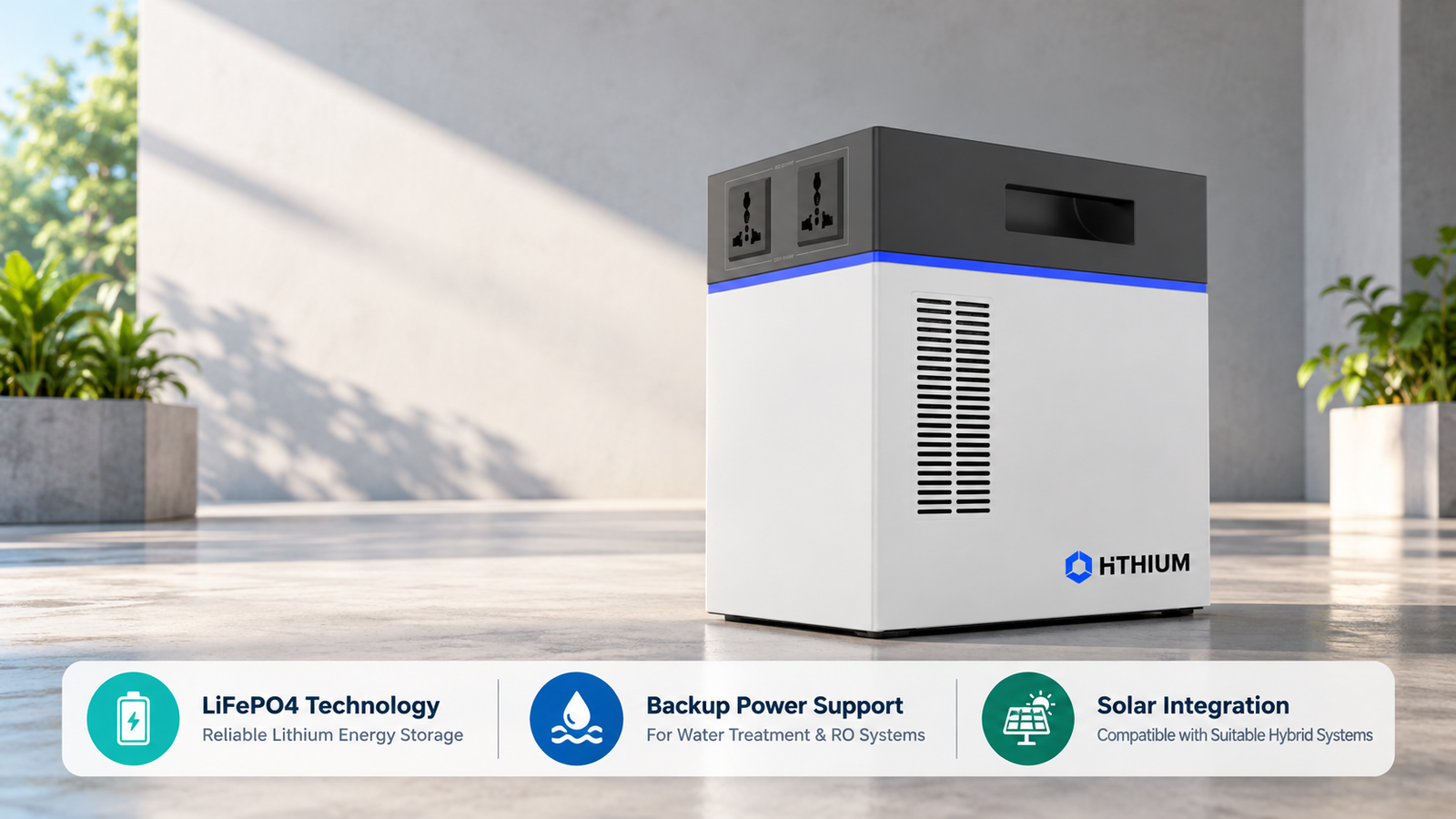
Water treatment plants and reverse osmosis (RO) systems in Bangladesh cannot afford to stop. When the grid fails during load-shedding, a stalled high-pressure RO pump means no clean water for a hospital ward, a food factory, a residential complex, or a rural community supply. A properly sized IPS for water treatment plant operations keeps pumps, dosing units, and control panels running through every outage — protecting both your equipment and your water supply.
This guide explains exactly how to select an IPS for RO plants and water treatment systems in Bangladesh: how to calculate the real load, why lithium (LiFePO4) is the right chemistry for pump duty, and which HiTHIUM models match small, medium, and large installations. Every specification below is taken directly from the HiTHIUM product pages — no guesswork.
Why an IPS for Water Treatment Plants Matters in Bangladesh
An IPS for water treatment plant use is different from a home backup. Water systems run motors — booster pumps, high-pressure RO pumps, dosing pumps, and UV sterilizers — that draw a large starting surge and then run continuously. In Bangladesh, where load-shedding can last several hours in summer, an undersized or lead-acid backup simply cannot keep these motors alive.
The consequences of a power gap in a water plant are serious. RO membranes can develop biofouling if flow stops for long periods. Chlorine dosing interruptions risk contamination. And repeated hard restarts damage pump motors. A lithium IPS with a pure sine wave inverter and fast switchover keeps the process stable and protects your capital equipment.
What Loads Does a Water Treatment IPS Need to Support?
A typical small-to-medium RO plant in Bangladesh runs these loads at the same time:
- High-pressure RO pump — 0.75 kW to 5.5 kW (1 HP to 7.5 HP), the largest load with a heavy starting surge
- Raw water / booster pump — 0.5 kW to 2.2 kW
- Dosing pumps (antiscalant, chlorine) — 50 W to 200 W each
- UV sterilizer — 40 W to 150 W
- Control panel, PLC, sensors — 100 W to 300 W
Because motors draw 2–3 times their rated wattage at startup, your inverter must handle the peak surge, not just the running load. This is why inverter rating (in kW) matters as much as battery capacity (in kWh).
How to Size an IPS for an RO System (Step by Step)
Sizing an IPS for water treatment plant backup follows the same logic as our IPS backup time calculator guide, but with extra attention to motor surge. Follow these steps:
- List every load in watts. Add up the running wattage of all pumps and electronics that must run together.
- Add a surge margin. Multiply the largest motor’s rated wattage by 3 and add it to the rest. This gives the peak the inverter must survive.
- Match the inverter kW rating. Choose an IPS whose continuous inverter rating (kW) exceeds your running load, and whose surge rating covers the peak.
- Choose battery capacity (kWh) for runtime. Multiply your running load (kW) by the hours of backup you need. Add 20% headroom so you never deep-discharge below the safe LiFePO4 range.
Worked example: A community RO plant with a 2.2 kW high-pressure pump, a 0.75 kW booster pump, and 400 W of dosing/control draws about 3.35 kW running. Surge (2.2 kW × 3 + rest) is roughly 7.75 kW. For 2 hours of backup you need about 3.35 kW × 2 = 6.7 kWh, plus headroom — so an 8 kWh lithium system with a 5 kW inverter is the right class.
Why LiFePO4 (Lithium) Is the Right Choice for Water Plants
Tubular and flat-plate lead-acid batteries struggle with the deep, repeated cycling that continuous pump backup demands. They lose capacity fast, need topping up with distilled water, and vent gas in enclosed pump rooms. LiFePO4 lithium solves all of this:
- 11,000+ charge cycles — 20–25+ years of service life versus 2–4 years for tubular batteries
- Deep discharge safe — use up to 90–95% of capacity without damage
- Maintenance-free and sealed — no water topping, no acid fumes in the pump room
- Stable voltage under load — pumps get clean power even as the battery drains
- Built-in BMS protection — guards against overload, over-temperature, and short circuit
For a plant that runs every day, the lower lifetime cost of lithium far outweighs the higher upfront price. This is the same logic that makes lithium the standard in IPS capacity planning for small factories.
Best HiTHIUM IPS Models for Water Treatment & RO Systems
HiTHIUM offers LiFePO4 systems that map directly onto small, medium, and large water plant needs. Here are the exact specifications from the product pages.
HiTHIUM MaxPower 8 AIO — 5kW Inverter for Small & Medium RO Plants
The HiTHIUM MaxPower 8 AIO is an all-in-one unit combining a 314Ah LiFePO4 battery, a 5kW inverter, and 9kW MPPT solar charging in one cabinet. Its 5kW continuous inverter comfortably runs a small-to-medium RO plant (up to ~3.5 kW running load) while surviving pump start surges. It is our top recommendation for most community and commercial RO systems.
HiTHIUM HeroEE 16 — 16kWh for Large Plants & Long Runtime
For larger installations that need extended runtime, the HiTHIUM HeroEE 16 delivers 16kWh of storage with up to 10kW pure sine wave output (inverter-dependent), dual solar/AC charging, and built-in UPS functionality. This is the choice for plants running multiple pumps or requiring 4+ hours of autonomy.
HiTHIUM MaxPower 8 (ESS) — Scalable Battery Bank
The HiTHIUM MaxPower 8 Residential ESS is an 8kWh LiFePO4 energy storage system that is scalable up to 64kWh. For a growing water utility that plans to expand capacity, this modular approach lets you start at 8kWh and add battery modules as demand rises.
HiTHIUM HeroEE 2 — 2kWh for Small Point-of-Use RO Units
Small shop or clinic RO units with a single low-power pump can be backed up by the HiTHIUM HeroEE 2, a 2kWh portable station delivering 1000W pure sine wave output with 11,000+ cycles. It suits dosing pumps, UV units, and control electronics during short outages.
Product Specifications Comparison
| Model | Battery Capacity | Inverter / Output | Solar (MPPT) | Cycle Life | Best For |
|---|---|---|---|---|---|
| MaxPower 8 AIO | 314Ah LiFePO4 (~8kWh) | 5kW inverter | 9kW MPPT | 11,000+ | Small–medium RO plants |
| HeroEE 16 | 16kWh LiFePO4 | Up to 10kW pure sine (inverter-dependent) | Dual solar/AC | 11,000+ | Large plants, long runtime |
| MaxPower 8 (ESS) | 8kWh, scalable to 64kWh | Inverter-dependent | Yes | 11,000+ | Expandable utility banks |
| HeroEE 2 | 2kWh LiFePO4 | 1000W pure sine wave | Solar + AC | 11,000+ | Point-of-use / clinic RO |
All specifications above are taken directly from the official HiTHIUM product pages. Browse the full range on the HiTHIUM shop.
Installation & Usage Tips for Water Treatment Plants
- Wire the largest pump on a dedicated circuit so its surge does not trip smaller loads.
- Use a pure sine wave inverter only. Modified sine wave power overheats pump motors and damages VFDs and PLCs. All HiTHIUM models above are pure sine wave.
- Install in a ventilated, dry area away from chlorine fumes and water spray. LiFePO4 is sealed, but electronics still need airflow.
- Add solar charging where possible. The MPPT-equipped MaxPower units let a water plant cut grid costs and extend backup indefinitely on sunny days.
- Set the low-voltage cutoff conservatively to protect the pump from brownout damage as the battery nears empty.
- Stagger pump starts. If two motors start together, sequence them a few seconds apart to reduce the combined surge on the inverter.
Frequently Asked Questions
What size IPS do I need for a small RO plant in Bangladesh?
Add up the running wattage of your high-pressure pump, booster pump, dosing pumps, and control panel, then choose an inverter rated above that continuous load with surge headroom for motor startup. Most small-to-medium RO plants (up to ~3.5 kW running) are well served by an 8kWh lithium system with a 5kW inverter such as the HiTHIUM MaxPower 8 AIO. Size battery capacity (kWh) to your required backup hours plus 20% headroom.
Can a lithium IPS run a high-pressure RO pump?
Yes. A LiFePO4 IPS with a pure sine wave inverter can run high-pressure RO pumps as long as the inverter’s continuous kW rating exceeds the pump’s running wattage and its surge rating covers the 2–3x startup spike. HiTHIUM’s pure sine wave output protects the motor and keeps flow stable. For pumps above 3 kW running load, choose the HeroEE 16 or a MaxPower unit sized to the surge.
Why is LiFePO4 better than tubular batteries for water plants?
Water treatment backup means daily deep cycling, which wears out tubular lead-acid batteries in 2–4 years. LiFePO4 delivers 11,000+ cycles (20–25+ years), allows 90–95% depth of discharge, needs no water topping, produces no acid fumes in the pump room, and holds stable voltage under load. Over the life of a plant, lithium costs far less per usable kWh.
How long can an IPS keep an RO system running during load-shedding?
Runtime equals usable battery capacity divided by your running load. For example, an 8kWh lithium system running a 3.35 kW plant load gives roughly 2 hours of backup with safe headroom. A 16kWh HeroEE 16 doubles that. Adding MPPT solar charging can extend runtime indefinitely during daylight hours.
Do I need a pure sine wave inverter for a water treatment IPS?
Yes, absolutely. Pump motors, VFDs, PLCs, and UV ballasts require clean pure sine wave power. Modified sine wave inverters cause motor overheating, audible humming, reduced efficiency, and premature failure of sensitive control electronics. Every HiTHIUM IPS model delivers pure sine wave output, making them safe for water treatment equipment.
Can I add solar to my water treatment IPS?
Yes. HiTHIUM MaxPower models include high-power MPPT solar charging — the MaxPower 8 AIO offers 9kW MPPT. Adding solar panels lets a water plant recharge during the day, run pumps on free solar energy, and dramatically extend backup autonomy. This is ideal for rural and off-grid water supply schemes across Bangladesh.
Get Expert Help Sizing Your Water Treatment IPS
Choosing the right IPS for water treatment plant or RO system depends on your exact pump loads and runtime needs. The HiTHIUM team can calculate your requirement and recommend the correct LiFePO4 model. Contact HiTHIUM Bangladesh for a free consultation, or browse all lithium backup systems on the HiTHIUM shop. Protect your water supply with reliable, maintenance-free lithium power built for continuous duty.
