



Blog
IPS vs Solar Home System Bangladesh — Which Is Better for 2026?

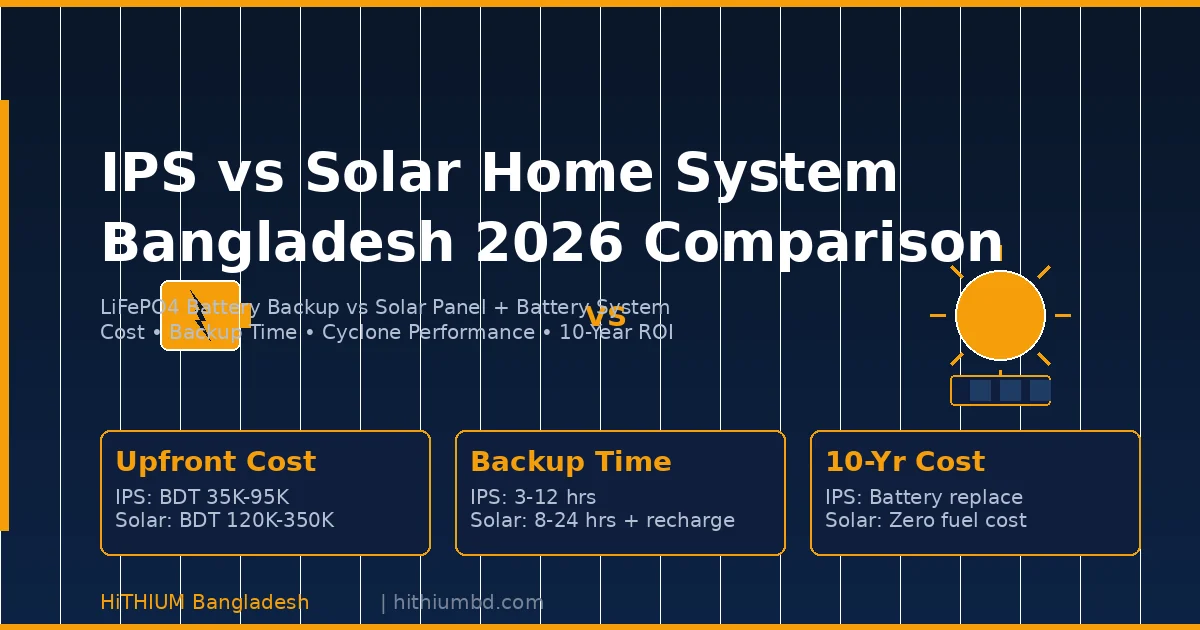
Choosing between an IPS (Instant Power Supply) and a solar home system is one of the most important backup power decisions for Bangladeshi homeowners in 2026. Both provide electricity when the grid fails, but they work on fundamentally different principles, have vastly different costs, and suit different lifestyles.
This comprehensive guide compares IPS and solar home systems across every metric that matters in Bangladesh: upfront cost, running cost, backup duration, maintenance, space requirements, and real-world performance during load shedding and cyclone seasons.
Quick Comparison: IPS vs Solar Home System
| Factor | IPS (Lithium/LiFePO4) | Solar Home System |
|---|---|---|
| Upfront Cost (Typical 3-5kW) | ৳1.2L – ৳3.5L | ৳4L – ৳12L+ |
| Running Cost (Monthly) | ৳0 (grid charging) | ৳0 (sun is free) |
| Backup Duration | 2–8 hours (battery limited) | 4–12+ hours (sun + battery) |
| Grid Dependency | Yes — needs grid to charge | No — charges from sun |
| Space Required | Compact (wall mount) | Rooftop panels (100+ sq ft) |
| Maintenance | Near-zero (LiFePO4) | Panel cleaning, battery checks |
| Cyclone/Storm Performance | Excellent (indoor unit) | Panels at risk in high winds |
| Payback Period | N/A (pure backup) | 4–7 years (bill savings) |
| Best For | Apartments, urban homes, renters | Owned homes with roof access, off-grid |
How IPS Works in Bangladesh
An IPS (often called an inverter or UPS in local markets) stores grid electricity in a battery and converts it to AC power during outages. Modern lithium IPS units use LiFePO4 (Lithium Iron Phosphate) batteries — the same chemistry used in electric vehicles — offering 11,000 cycles, zero maintenance, and 10+ year lifespan.
Types of IPS Available in Bangladesh
- Tubular Battery IPS: Traditional lead-acid, 1,500–2,000 cycles, requires water topping, 3–5 year life. Lower upfront cost (৳80k–৳1.5L for 1500VA).
- Lithium/LiFePO4 IPS: 11,000 cycles, zero maintenance, wall-mountable, 10+ year life. Higher upfront (৳1.5L–৳3.5L) but cheaper per year.
- Hybrid Solar IPS: Accepts solar panel input + grid charging. Best of both worlds if you have roof space.
Typical Load Support (3kVA Lithium IPS Example)
| Appliance | Watts | Runtime (3kWh Battery) |
|---|---|---|
| LED Lights (6×10W) | 60W | 50 hours |
| Ceiling Fans (3×75W) | 225W | 13 hours |
| TV + Router | 120W | 25 hours |
| Refrigerator (200W) | 200W | 15 hours |
| Total Typical Load | ~600W | 5 hours |
Real Bangladesh context: During the 2024–2025 load shedding season, urban Dhaka saw 2–4 hours daily outages. A 3kWh lithium IPS covers a typical apartment’s essential load for the entire outage. Rural areas with 6–8 hour outages need larger batteries (5–10kWh) or solar hybrid.
How Solar Home Systems Work in Bangladesh
A solar home system (SHS) generates electricity from rooftop panels, stores it in batteries, and powers your home directly. Unlike IPS, it does not need the grid to charge — sunlight does the job.
Components of a Bangladeshi SHS
- Solar Panels: 500W–3kW typical for homes. Mono PERC panels (21%+ efficiency) now standard. Price: ৳45–55/Wp.
- Charge Controller (MPPT): Optimizes panel output. 60A–100A for home systems.
- Battery Bank: Traditionally tubular lead-acid (150Ah–200Ah × 2–4). Lithium LiFePO4 gaining share (5kWh–20kWh).
- Hybrid Inverter: Converts DC to AC, manages solar/grid/battery priority. 3kVA–5kVA common.
- Mounting Structure: GI frame, cyclone-rated for coastal Bangladesh.
Solar Production in Bangladesh Climate
| Season | Peak Sun Hours/Day | 3kW System Output |
|---|---|---|
| Summer (Mar–May) | 5.5–6.5 hrs | 16–19 kWh/day |
| Monsoon (Jun–Sep) | 3.0–4.0 hrs | 9–12 kWh/day |
| Winter (Nov–Feb) | 4.5–5.5 hrs | 13–16 kWh/day |
Key insight: Even in monsoon, a 3kW system produces 9–12 kWh — enough for essential loads if battery is sized right. The challenge is multi-day cloudy periods where battery depth of discharge matters.
Cost Breakdown: Real 2026 Bangladesh Prices
Option A: 3kVA Lithium IPS (Grid-Charged Only)
- 3kVA Hybrid Inverter (Growatt/Deye/Must): ৳85,000
- 5kWh LiFePO4 Battery (48V 100Ah): ৳1,65,000
- Installation & wiring: ৳25,000
- Total: ~৳2.75 Lakh
Option B: 3kW Solar Home System (Hybrid)
- 3kW Mono PERC Panels (6×550W): ৳8,25,000
- 3kVA Hybrid Inverter (MPPT built-in): ৳95,000
- 10kWh LiFePO4 Battery (48V 200Ah): ৳3,10,000
- Mounting structure (cyclone-rated): ৳60,000
- Installation, permits, net metering paperwork: ৳80,000
- Total: ~৳13.7 Lakh
Option C: 3kW Solar + Existing Grid IPS (Retrofit)
If you already have a lithium IPS, adding solar panels + MPPT controller:
- 2kW Panels + MPPT + wiring: ~৳4.5 Lakh
- Converts your IPS to hybrid solar charging
- Good middle ground for existing IPS owners
Running Cost Comparison (10-Year View)
| Cost Item | Lithium IPS (5kWh) | Solar Home System (10kWh) |
|---|---|---|
| Upfront Capital | ৳2.75L | ৳13.7L |
| Grid Electricity Cost (10 yrs) | ৳1.8L (charging) | ৳0.6L (top-up only) |
| Battery Replacement (yr 10) | ৳1.2L (80% capacity) | ৳2.4L (80% capacity) |
| Panel Cleaning/Year | ৳0 | ৳6,000 |
| Inverter Replacement (yr 12) | ৳0.9L | ৳0.9L |
| 10-Year Total | ৳6.65L | ৳18.5L |
| Per Year Avg | ৳66,500 | ৳1.85L |
But solar pays back via bill savings: A 3kW system offsets ~360 kWh/month × ৳11/kWh (avg residential slab) = ৳3,960/month savings. Annual savings ~৳47,500. Payback: 13.7L / 47.5k ≈ 2.9 years if net metering works perfectly. Real-world with net metering delays: 4–5 years.
Space & Installation Reality in Bangladesh
IPS: Fits Anywhere
- Wall-mounted unit: 450×300×180mm (typical 3kVA)
- Battery: same enclosure or separate slim cabinet
- Zero roof access needed — perfect for apartments, rented homes
- Installation: 2–4 hours, electrician only
Solar Home System: Needs Roof Rights
- 3kW = 6 panels × 2.3m² each = ~14m² (150 sq ft) unshaded roof
- Must face south (within 30°), tilt 20–25° for Dhaka latitude
- Structural load: 15–20 kg/m² — most RCC roofs OK, tin sheds need reinforcement
- Owner permission mandatory — renters cannot install without landlord agreement
- Installation: 2–3 days, certified solar technician + electrician
- Net metering application: BPDB/DESCO/DPDC — 30–90 days approval
Performance During Bangladesh Extremes
Load Shedding (Daily 2–6 hours)
- IPS: Flawless. Battery sized for outage duration. Instant switch (<10ms).
- Solar: Also flawless if battery charged. Monsoon clouds reduce charging — need larger battery buffer.
Cyclone / Severe Storm (3–7 day outages)
- IPS: Works until battery depletes. Then dead until grid returns. No recharge without grid.
- Solar: Panels at risk from flying debris, high winds (cyclone-rated mounts survive 250km/h). If panels survive, generates power during daylight even with grid down for weeks. Winner for extended outages.
Extreme Heat (April–May, 38–42°C)
- IPS (LiFePO4): Operates 0–45°C. Indoor placement avoids heat.
- Solar Panels: Lose 0.35%/°C above 25°C. At 45°C cell temp, ~7% output drop. Still produces well.
- Battery Heat: LiFePO4 handles heat better than lead-acid. Ventilation needed for both.
Decision Framework: Which Should You Choose?
Choose Lithium IPS If:
- You live in an apartment or rented house
- No roof access or landlord won’t allow panels
- Outages are typically 2–6 hours (urban load shedding)
- Budget is ৳2–3.5 Lakh
- You want zero maintenance, 10+ year life
- Primary need: reliable backup for essentials (lights, fans, TV, router, fridge)
Choose Solar Home System If:
- You own a house with 150+ sq ft unshaded south-facing roof
- You plan to stay 5+ years (payback period)
- Monthly electricity bill > ৳4,000 (worth offsetting)
- Rural/semi-urban area with frequent/long outages
- Want energy independence and bill reduction
- Can invest ৳10L+ upfront or access green financing
Choose Hybrid (Solar + IPS) If:
- You have roof space but want grid backup too
- Already own a lithium IPS — add panels + MPPT controller
- Net metering approved — sell excess to grid
- Best of both worlds: solar by day, grid charge by night, battery backup always
Real Bangladesh Case Studies (2025–2026)
Case 1: Dhaka Apartment (Gulshan, 1800 sq ft)
Owner: Family of 4, bill ৳6,500/month. Chose: 3kVA LiFePO4 IPS (5kWh). Cost: ৳2.8L. Result: Covers 4-hour daily load shedding perfectly. Zero maintenance. No roof access for solar.
Case 2: Gazipur Villa (Owned, 3200 sq ft)
Owner: Family of 5, bill ৳12,000/month. Chose: 5kW Solar + 15kWh LiFePO4 Hybrid. Cost: ৳22L. Result: Bill dropped to ৳1,800/month (net metering). 4.2 year payback projected. Survived Cyclone Remal 2024 with 3-day grid outage — solar + battery ran everything.
Case 3: Rangpur Rural Home (Off-grid tendency)
Owner: Small business + home, bill ৳3,500 but 6–8 hr daily outages. Chose: 3kW Solar + 10kWh Battery (no net metering). Cost: ৳14L. Result: Energy independent. Runs water pump, freezer, lights, fans all day. Grid only for cloudy monsoon weeks.
Frequently Asked Questions
Can I add solar panels to my existing IPS later?
Yes, if you have a hybrid inverter (most modern lithium IPS units do). You need an MPPT charge controller (৳15k–25k) and panels. Total retrofit: ৳3–5 Lakh for 2–3kW. Non-hybrid inverters cannot accept solar input — check your model.
Does solar work during load shedding at night?
Only if you have battery storage. Panels produce zero at night. The battery (charged during day) powers your home. No battery = no night backup from solar alone.
Is net metering available everywhere in Bangladesh?
BPDB, DESCO, DPDC, WZPDCL, NESCO all have net metering policies. Application takes 30–90 days. Rural PBS areas may not offer it yet. Check with your local distribution company before investing.
Which battery lasts longer: Tubular or LiFePO4?
LiFePO4: 11,000 cycles (10–15 years). Tubular lead-acid: 1,200–1,800 cycles (3–5 years with water topping). LiFePO4 costs 2.5× more upfront but 3× less per year.
Can I run an AC on solar home system?
Yes, but you need large system. 1.5 ton inverter AC = 1.2–1.5kW running. Needs 5kW+ solar + 15kWh+ battery for 4–6 hour runtime. Cost: ৳25L+. Most Bangladeshi homes run AC on grid, use solar/IPS for other loads.
What happens to solar panels in a cyclone?
Cyclone-rated mounting (250km/h wind load) + tempered glass panels survive most storms. 2024 Cyclone Remal: properly installed systems in Khulna/Satkhira had zero panel loss. Cheap mounts fail — invest in GI structure with J-bolts, not clamp-only.
Is lithium IPS safe for home use?
LiFePO4 is the safest lithium chemistry — no thermal runaway, no fire risk, no toxic gas. Used in EVs and home storage worldwide. Certified to IEC 62619 / UL 1973. Safer than lead-acid (no acid spills, no hydrogen gas).
How much roof space for 3kW solar?
~14–15 sq meters (150–160 sq ft) unshaded, south-facing. 6×550W panels at 2.3m² each. Add 10% spacing for maintenance access.
Final Verdict: IPS vs Solar for Bangladesh 2026
For 80% of urban Bangladeshi households (apartments, rented homes, budget ৳3L): Lithium IPS is the clear winner. It solves the immediate problem — load shedding backup — at 1/5th the cost of solar, with zero structural requirements and zero maintenance.
For homeowners with roof rights, high bills (৳5k+), and 5+ year horizon: Solar home system pays for itself in 4–5 years via bill savings, then generates free electricity for another 15–20 years. Add battery for backup, and you get energy security IPS alone cannot provide during extended grid failures.
The smart middle path: Start with a hybrid lithium IPS (grid + solar ready). Add panels when budget allows. This spreads investment, gives immediate backup, and lets you scale solar capacity over time.
Next Step: Calculate your actual load. List every appliance you need during outages, sum the watts, multiply by hours of backup needed. That kWh number determines your battery size — whether IPS or solar. Use our backup time calculator guide to size it right.
Need help choosing? Contact HiTHIUM Bangladesh for a free load assessment and product recommendation. Visit our showroom in Dhaka to see lithium IPS and solar hybrid systems live.
Recommended HiTHIUM Products
Based on your needs, here are the best HiTHIUM lithium IPS and power station options for Bangladesh:
| Product | Capacity | Best For | Price |
|---|---|---|---|
| HiTHIUM HeroEE 4 (4kWh) | 4kWh | Medium backup, battery upgrade | ৳74,500 |
| HiTHIUM MaxPower 8 AIO (8kWh) | 8kWh | Large spaces, heavy loads, commercial | ৳2,87,000 |
Free delivery across Bangladesh. WhatsApp us for consultation: Contact HiTHIUM
