




Blog
Battery Energy Storage System in Bangladesh: A Practical Guide for Commercial and Industrial Buyers

Last updated: October 2026
Bangladeshi factories, commercial buildings, hotels, hospitals and solar developers are evaluating battery energy storage at an accelerating pace. This guide explains what a battery energy storage system (BESS) actually includes, how to size one, what drives the cost in Bangladesh, and what to check before you request a quotation — with verified HiTHIUM product specifications where they are relevant.
What you will learn:
- How a BESS works, and how it differs from a conventional IPS or UPS
- Which Bangladeshi business scenarios make storage economically sensible — and which do not
- How to calculate the kW and kWh your facility actually needs
- What system cost depends on, with current published prices in BDT
- A practical checklist for choosing a BESS supplier in Bangladesh
What Is a Battery Energy Storage System (BESS)?
A battery energy storage system stores electrical energy — from the grid, from solar panels, or from a generator — in rechargeable battery modules, and releases it on demand. In commercial and industrial settings it typically consists of five parts:
| Component | What it does |
|---|---|
| Battery modules or racks | Store the energy, usually in LiFePO₄ (lithium iron phosphate) cells in modern systems |
| Battery Management System (BMS) | Monitors cell voltage, temperature and state of charge; protects against over-charge, over-discharge, short circuit and thermal events |
| Power Conversion System (PCS) / inverter | Converts DC from the battery into the AC your equipment uses, and manages charging |
| Energy Management System (EMS) | Decides when to charge and discharge — for backup, solar self-consumption, or load shifting |
| Thermal management and protection | Cooling (fan or liquid), enclosure rating (e.g. IP), fire safety and electrical protection |
The operating cycle is simple: the system charges when energy is available and cheap or abundant, stores it in the battery cells, and discharges when the grid fails, when your load peaks, or when solar production has stopped. Some HiTHIUM products integrate the inverter and battery in one cabinet; others are battery-only packs that connect to an external inverter.
Two numbers define almost every system:
- Power (kW): how much equipment the system can run at the same moment.
- Energy (kWh): how long it can keep running. Backup time ≈ usable kWh ÷ load in kW.
A system sized for a 40 kW load with only 20 kWh of storage will switch off after half an hour. A 5 kW system with 80 kWh will run light loads all night. Both numbers must be right.
BESS vs UPS vs IPS vs generator — quick view
| Conventional IPS | Industrial UPS | Diesel generator | Battery energy storage system | |
|---|---|---|---|---|
| Typical role | Home/small-office backup | Seconds-to-minutes protection for critical IT loads | Long-duration backup power | Backup + solar integration + energy management |
| Transfer time | Milliseconds (on-line/double conversion) or brief switch-over | Near-zero | Seconds (start-up) | Depends on the PCS and configuration; confirm the changeover time on the datasheet |
| Fuel needed | No | No | Yes (diesel/petrol) | No |
| Runtime ceiling | Limited by battery bank | Very short by design | Limited only by fuel supply | Limited by installed kWh; modularly expandable |
| Solar integration | Possible with extra equipment | Not typical | Not possible | Designed in (hybrid/MPCS with PV input) |
| Running noise | Silent | Silent | High | Silent |
For a deeper comparison of backup technologies, see our guides on industrial UPS vs IPS in Bangladesh and lithium IPS vs generator.
Why Businesses in Bangladesh Are Evaluating Battery Storage
Several practical pressures push Bangladeshi commercial and industrial buyers toward storage in 2026:
1. Power continuity. Grid supply to industrial areas can still be interrupted, and many facilities run diesel generators as insurance. A BESS bridges outages silently, within milliseconds, with no fuel handling on site.
2. Solar energy utilisation. Bangladesh has strong solar irradiance and a large base of rooftop PV. Without storage, most daytime solar generation is consumed on site or exported; with storage, a factory can move daytime generation into evening shifts and prayer-time breaks.
3. Generator cost and emissions. Diesel has a running cost, a maintenance schedule, storage and handling rules, and noise. For facilities where generators currently run for a few hours a day, a battery alternative changes the cost structure — our lithium IPS vs generator comparison walks through the numbers for smaller systems.
4. Operational resilience. Hospitals, hotels, cold-chain operators, data and telecom sites and process industries lose money or product during outages. Storage sized for the critical load (not the whole site) is often the cheapest resilience investment.
5. Load management. Where a facility is on a time-of-use tariff or carries demand charges, storage can shave peaks and shift energy to cheaper hours. This only works when the tariff structure, load profile and battery cycle economics are modelled together — it is not automatic savings.
When a battery system may not be the right answer
Honest sizing matters more than sales language:
- If you need many hours of autonomy every day at high power (tens of kW for 8+ hours), a generator or grid upgrade may be cheaper per kWh delivered.
- If your critical load is highly inductive (large motors, compressors, chillers), you must size the PCS for startup currents — sometimes doubling the inverter requirement.
- If the site has no engineering capacity for commissioning and maintenance, a large system becomes a liability; start smaller.
- If your real problem is chronic grid instability at tens or hundreds of kW, a project-scale BESS needs a dedicated feasibility study, not a catalogue purchase.
Typical Applications in Bangladesh
| Application | Common storage need | Notes |
|---|---|---|
| Garments / textile factories | Sewing lines, knitting, finishing, lighting and IT loads during outages | Load prioritisation is essential — production lines are staged, not single loads (RMG backup guide) |
| Small and medium manufacturing | Motors, pumps, control systems, lighting | Startup currents dominate sizing (factory capacity planning) |
| Commercial buildings & offices | Lifts, AC, lighting, IT | Three-phase buildings need three-phase PCS (single vs three-phase guide) |
| Hotels & guest houses | Room power, reception, kitchens, lifts | Solar + storage reduces generator dependency (hotel backup guide) |
| Hospitals & clinics | Critical equipment, lighting, HVAC for sensitive areas | Must be combined with UPS for zero-transfer-time loads |
| Solar EPC / developer projects | PV self-consumption, mini-grids, peak shaving | Storage allows evening energy from daytime generation |
Required capacity depends on your load profile, backup duration, discharge limits, inverter capability and operating conditions — never on floor area or headcount alone.
How to Size an Industrial Battery Storage System
Sizing is a four-step calculation. Worked example throughout: a facility with a 10 kW critical load that must survive a 2-hour outage.
Step 1 — Define the critical load (kW). Not the whole site: the equipment that must run. Measure or estimate total wattage of the prioritised loads. Example: 10 kW.
Step 2 — Define the backup duration (hours). Longest realistic outage you want to cover, or the shift segment you want to power. Example: 2 hours.
Step 3 — Calculate required energy (kWh).
Required energy (kWh) = critical load (kW) × backup hours × 1 ÷ (usable depth of discharge × system efficiency)
With a LiFePO₄ battery at 90% usable depth of discharge and roughly 90% overall conversion efficiency:
10 kW × 2 h ÷ (0.90 × 0.90) ≈ 24.7 kWh of nominal battery capacity
Step 4 — Check the inverter/PCS rating. The PCS must carry the critical load continuously and handle motor startup surges. A 10 kW continuous load with motors typically wants a PCS rated around 1.5–2× for startup.
Step 5 — Design for expansion. Modular systems let you add kWh later as loads or solar capacity grow, instead of over-buying on day one.
For the full formula with home-scale worked examples, see the IPS backup time calculator guide.
Key Specifications Buyers Should Compare
When you collect quotations from any supplier, compare these line by line:
| Specification | Why it matters | What to look for |
|---|---|---|
| Cell chemistry | Safety, cycle life, behaviour in heat | LiFePO₄ is the mainstream choice for stationary storage in Bangladesh’s climate |
| Cycle life & conditions | Real lifespan, not marketing cycles | HiTHIUM publishes 11,000 cycles @ 100% DoD, 25°C, 0.5P, at 70% state of health — always check the test conditions |
| Usable capacity / DoD | How much of the nominal kWh you can actually use | Deep DoD ratings matter more than headline capacity |
| Scalability | Future expansion in parallel | e.g. 16 units in parallel on HiTHIUM MaxPower 8 ESS (128 kWh) |
| IP rating | Indoor vs outdoor placement | IP20/IP30 = indoor, protected enclosure only; IP67 = weather-sealed |
| BMS protections | Safety and warranty validity | Over-charge, over-discharge, over-temperature, short-circuit at minimum |
| Inverter/PCS compatibility | Whether it works with your existing gear | Hybrid capability, PV input range, three-phase options |
| Warranty & service terms | Your actual protection | Written cycle/year terms, local service response, spare-part availability |
| Certifications & documentation | Bankability and compliance | Datasheets, test reports, local references you can verify |
Battery Energy Storage System Price in Bangladesh
There is no single “BESS price in Bangladesh” — system cost depends on capacity, chemistry, inverter, installation, protection and integration. It helps to separate battery-only pricing from a complete installed system.
Current published HiTHIUM prices (battery and all-in-one products)
Verified from the live HiTHIUM Bangladesh store on 13 October 2026:
| Product | Capacity | Type | Listed price (BDT) | Approx. BDT per nominal kWh |
|---|---|---|---|---|
| HeroEE 4 (L12314ES) | 4.02 kWh | Battery pack, IP67 | ৳74,500 | ~৳18,500 |
| MaxPower 8 ESS | 8.04 kWh | Battery pack (inverter separate) | ৳236,000 | ~৳29,400 |
| MaxPower 8 AIO | 8.04 kWh | All-in-one with 5 kW inverter | ৳287,000 | ~৳35,700 |
| HeroEE 16 | 16 kWh | Battery pack (inverter separate) | ৳336,000 | ~৳21,000 |
Per-kWh figures are simple arithmetic from the listed price divided by nominal kWh, calculated for comparison only. They are not a quotation, and prices change — always confirm on the product page or in writing.
What is not included in a battery price
For a complete commercial or industrial installation, budget additionally for:
- Inverter/PCS (unless you buy an all-in-one unit) sized to your load
- Installation: cabling, busbars, breakers, earthing, protection devices
- Integration with existing switchgear, solar PV charge controllers or hybrid inverters
- Civil works and enclosure if outdoor installation or a dedicated room is required
- Commissioning, testing and operator training
- Annual maintenance and eventual battery replacement planning
Projects above roughly 100 kWh, or anything connected to a three-phase distribution board with process loads, should be quoted after a site assessment rather than from a catalogue. For current battery-only price ranges, our lithium battery price guide lists published BDT figures, and the solar + LiFePO₄ system cost analysis covers complete home-scale packages.
BESS Supplier in Bangladesh: What Buyers Should Check
The Bangladesh market includes global brands with local partners, EPC contractors and trading houses. Before you sign, check:
- Documented specifications. Can they produce a datasheet with test conditions — cycle life at a stated DoD, temperature and SOH, not just a headline number?
- System compatibility. Will the battery work with your existing inverter, or do they supply the PCS too? Who owns warranty if the combination fails?
- Installation and commissioning capability. Ask who does the wiring, protection design and commissioning — and their experience with systems of your size.
- Warranty terms in writing. Cycle count and years, capacity-retention threshold, what voids it.
- Local technical support. Response time in Bangladesh, engineer availability, service location.
- Spare parts and after-sales. Are BMS boards, modules and fans stocked locally?
- Verifiable references. Ask for installations you can visit or call — with client permission.
- Quotation transparency. Line items for battery, PCS, installation, protection, commissioning and freight. A single bundled number is a warning sign.
Questions worth asking in every BESS quotation
- What is the usable capacity at 90% DoD, and at what temperature?
- What is the guaranteed capacity retention at end of warranty?
- What are the PCS continuous and surge ratings?
- Is the system expandable in parallel, and what is the maximum configuration?
- What monitoring is included (app, web, Modbus/SCADA)?
- What happens if one module fails — does the string stop?
- What are the commissioning and training deliverables?
HiTHIUM Energy Storage Options in Bangladesh
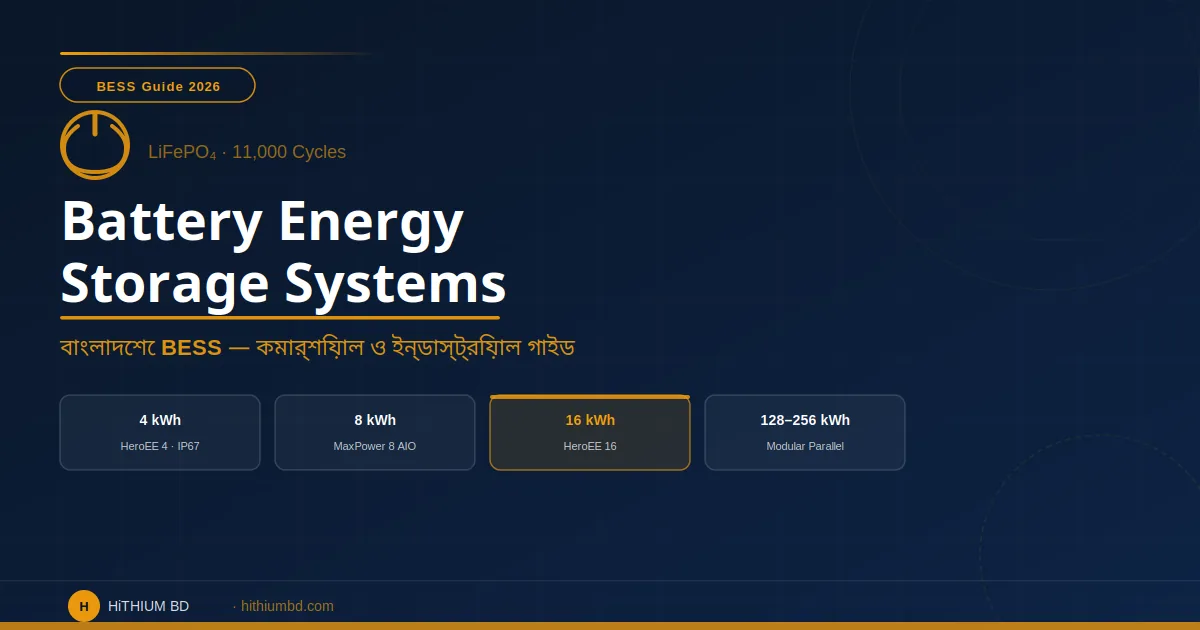
HiTHIUM Bangladesh offers a modular LiFePO₄ product line built around Grade-A cells. The manufacturer, established in 2019, operates dedicated R&D centres and a large engineering team focused on storage cells and system integration. All products listed below use LiFePO₄ chemistry with a published cycle life of 11,000 cycles (test conditions stated on each datasheet).
| Product | Capacity | What it is | Scalability | Best suited for |
|---|---|---|---|---|
| HeroEE 4 (L12314ES) | 4.02 kWh | Sealed battery pack (IP67) | Pair with a suitable inverter | Small offices, shops, modular installations |
| MaxPower 8 ESS | 8.04 kWh | Battery pack, 314 Ah cells, IP30 | Up to 16 units in parallel → 128 kWh | Growing businesses wanting modular expansion |
| MaxPower 8 AIO | 8.04 kWh | All-in-one: battery + 5 kW inverter + 9 kW MPPT solar input | Single-unit all-in-one | Small factories, solar-ready commercial sites |
| HeroEE 16 | 16 kWh | High-capacity battery pack | Up to 16 units in parallel → 256 kWh | Larger homes, offices, commercial backup |
The full range sits in the Energy Storage System category.
Scope and limitations — stated plainly:
- The products above are modular commercial and light-industrial systems. The MaxPower 8 ESS line scales to 128 kWh and the HeroEE 16 line to 256 kWh in parallel configuration.
- Utility-scale and multi-hundred-kWh projects (containerised systems, grid support, mini-grids at village scale) require a separate technical assessment and are not covered by catalogue pricing.
- Not every product suits every application: the IP30 units (MaxPower 8 ESS, HeroEE 16) are specified for protected indoor installation; the IP67 HeroEE 4 is weather-sealed. Placement must follow the datasheet.
Frequently Asked Questions
What is a battery energy storage system?
A BESS stores electricity in rechargeable battery modules and releases it through an inverter when you need it — during outages, at peak tariff hours, or after solar production ends. A commercial system combines battery modules, a battery management system, a power conversion system and energy management controls.
Is BESS available in Bangladesh?
Yes. Battery energy storage is offered by several local suppliers, EPC contractors and international brands with Bangladeshi partners, and the government maintains a public database of BESS projects and products. Domestic product availability ranges from home-scale lithium IPS to containerised grid-scale projects.
How do I find a BESS supplier in Bangladesh?
Start from documented specifications, not marketing claims: request datasheets, warranty terms in writing, references you can verify, and a line-item quotation covering battery, inverter, installation and commissioning. The checklist in this guide covers the eight points worth verifying before signing.
What affects the cost of industrial battery storage?
Four things dominate: usable battery capacity (kWh), power rating (kW/PCS), installation and integration scope, and the service/warranty package. Battery chemistry and cell grade sit behind all of these. A battery-only price tells you little about the installed system cost.
How much battery capacity does a factory need?
Calculate the wattage of the loads that must keep running, multiply by the backup duration you want, then divide by the usable depth of discharge and system efficiency. A 10 kW critical load backed up for 2 hours needs roughly 25 kWh of nominal LiFePO₄ capacity — see the sizing section above for the full calculation.
Can a BESS work with solar panels?
Yes — this is one of its main commercial uses. A hybrid inverter or PCS with MPPT input charges the battery from PV during the day and discharges at night. HiTHIUM’s MaxPower 8 AIO accepts up to 9 kW of PV input in a single cabinet. Sizing PV to match battery capacity depends on your daytime load and sunshine season; our solar panel wattage guide explains the calculation.
What is the difference between BESS and a conventional IPS?
An IPS is a backup power supply built around a battery bank and inverter, sized for household or small-office loads. A BESS is the same principle applied at commercial scale, with managed charge/discharge, modular expansion, monitoring and typically solar integration. The lines blur: HiTHIUM’s HeroEE range is often used as a lithium IPS at home scale and as modular storage at light-commercial scale.
How long can an industrial battery storage system provide backup?
Backup time = usable kWh ÷ load in kW. A 128 kWh MaxPower 8 ESS configuration (16 units in parallel) with an 80% usable depth of discharge has about 102 kWh usable — roughly 10 hours at a 10 kW load, or 5 hours at 20 kW, before conversion losses. Always size the PCS to the load, not just the battery.
What should I check before requesting a quotation?
Write down: your critical load in kW, the backup duration in hours, whether you want solar charging, whether your supply is single-phase or three-phase, and where the system will be installed (indoor/outdoor). With those five answers, any competent supplier can quote accurately — and you can compare offers like for like.
Plan Your Storage Project with HiTHIUM Bangladesh
Storage economics depend on your load profile, your backup requirements and your solar plans — not on a generic price list. If you can share your critical load, desired backup hours and site details, the HiTHIUM Bangladesh team can assess system sizing and provide a line-item quotation.
Specifications in this article are taken from published HiTHIUM Bangladesh product pages as of October 2026. Prices and specifications change — confirm on the product page or in your written quotation. Larger industrial and utility-scale projects require a separate technical assessment.

7 thoughts on “Battery Energy Storage System in Bangladesh: A Practical Guide for Commercial and Industrial Buyers”