




Blog
Single-Phase vs Three-Phase IPS for Commercial Buildings in Bangladesh

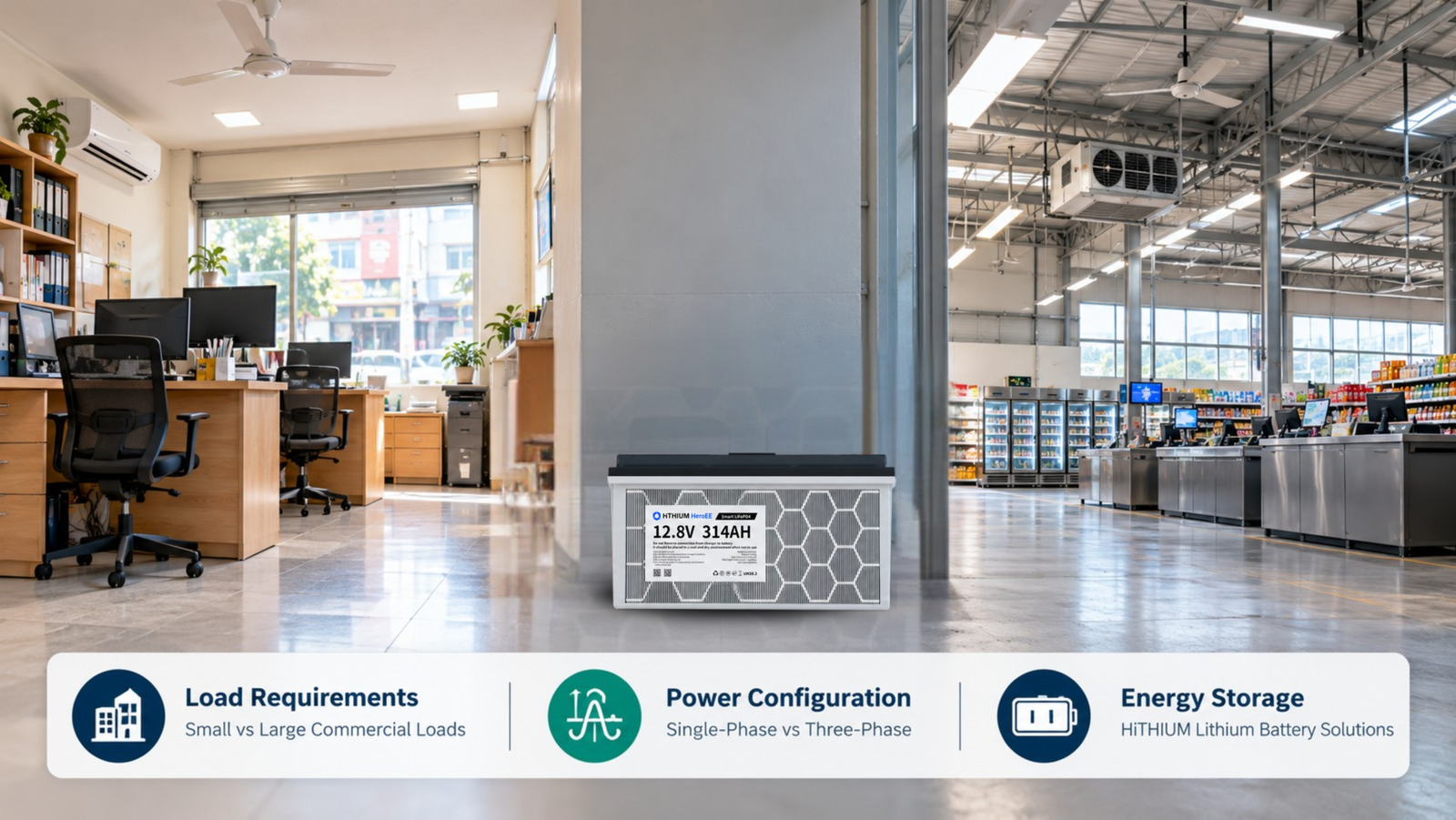
If you run a shop, office, showroom, small factory, or a multi-floor commercial building in Bangladesh, one question decides your entire backup power setup: do you need a single-phase or a three-phase IPS? Pick wrong and you either overspend on hardware you cannot use, or you install a system that trips every time the AC and lift start together.
This guide explains the difference in plain language, shows you how to check what your building actually has, and matches your load to real HiTHIUM lithium IPS models with verified specifications. No guesswork, no invented numbers.
What Is the Difference Between Single-Phase and Three-Phase IPS?
A single-phase supply delivers power through one live wire and one neutral, at 220–230V. It suits homes, small shops, and offices where the total connected load is modest. A three-phase supply uses three live wires plus a neutral (400–415V between phases) and is designed to carry heavier, balanced loads such as lifts, large motors, central air conditioning, and industrial machines.
Your IPS must match your building’s incoming connection. A single-phase IPS backs up a single-phase line. A three-phase IPS (or three coordinated single-phase units) backs up a three-phase line and keeps the phases balanced. Installing the wrong type is the most common and most expensive mistake in commercial backup power.
How Do I Know If My Building Is Single-Phase or Three-Phase?
Check your electricity meter and main distribution board (DB). A single-phase meter has one live terminal; a three-phase meter has three live terminals (often labelled R, Y, B). Your DESCO, DPDC, or NESCO bill also states the connection type and sanctioned load. If your building has a lift, a deep tube-well pump, a central chiller, or machines above roughly 5 kW, it is almost always three-phase.
Rule of thumb for Bangladesh commercial spaces:
- Single-phase: corner shops, small offices (under ~4–5 kW total), single-floor retail, salons, small clinics.
- Three-phase: restaurants with heavy kitchens, garment sub-units, multi-floor offices with lifts, cold storage, showrooms with central AC, small factories.
Single-Phase vs Three-Phase IPS: Side-by-Side Comparison
| Factor | Single-Phase IPS | Three-Phase IPS |
|---|---|---|
| Supply voltage | 220–230V | 400–415V (three lives + neutral) |
| Typical load range | Up to ~5 kW | 5 kW and above |
| Best for | Shops, small offices, clinics | Lifts, central AC, motors, factories |
| Wiring complexity | Simple (one live + neutral) | Higher (phase balancing required) |
| Motor / lift support | Limited | Designed for heavy motor starting |
| Installation cost | Lower | Higher (more cabling, DB work) |
| Load balancing | Not needed | Essential across R, Y, B phases |
Which Loads Force You Into Three-Phase?
Some equipment simply cannot run properly on single-phase. If your building has any of the following, plan for three-phase backup:
- Passenger and goods lifts — three-phase motors with high starting current.
- Central / VRF air conditioning — large compressors draw balanced three-phase power.
- Water pumps and deep tube-wells above ~2 HP.
- Industrial machines — garment stitching lines, CNC, compressors, mixers.
- Cold storage compressors and blast freezers.
For a deeper look at heavy-load sizing, see our IPS capacity planning guide for small factories.
How HiTHIUM Lithium IPS Solves Commercial Backup
Traditional lead-acid IPS units struggle with commercial loads because they lose capacity fast, need constant water top-ups, and cannot handle deep daily cycling. HiTHIUM’s LiFePO₄ (lithium iron phosphate) systems are built for the opposite: high daily cycling, maintenance-free operation, and up to 11,000 charge cycles—roughly 20–25+ years of service in typical use. That cycle life is the single biggest cost advantage for a business that draws backup power every single day.
Whether you run a single-phase shop or a three-phase building, you can build the right system by combining the correct number of units and matching inverter output to your load. Below are the verified models and how they fit commercial scenarios.
If your building outgrows a single IPS, industrial battery storage built from paralleled modules is the next step to evaluate.
HeroEE MaxPower 8 AIO — All-in-One for Solar-Ready Commercial Buildings
The HeroEE MaxPower 8 AIO is a next-generation all-in-one energy storage unit combining a 314Ah LiFePO₄ battery, a 5kW inverter, and 9kW MPPT solar charging in one compact enclosure. For three-phase buildings, multiple AIO units are configured across phases to balance the load, while its high solar input keeps running costs down during daytime operation.
| Spec | HeroEE MaxPower 8 AIO |
|---|---|
| Battery | 314Ah LiFePO₄ |
| Inverter output | 5kW |
| Solar charging (MPPT) | 9kW |
| Cycle life | 11,000+ cycles (20–25+ years) |
| Design | All-in-one, easy install |
HeroEE 16 — High-Output for Heavy Three-Phase Loads
The HeroEE 16 is a 16kWh power station with up to 11kW pure sine wave output (inverter-dependent), designed for homes, businesses, and industrial use. With built-in UPS functionality and dual solar/AC charging, it handles the surge from motors and compressors that single-phase units cannot. For large three-phase buildings, units are grouped and distributed across phases.
| Spec | HeroEE 16 |
|---|---|
| Capacity | 16kWh |
| Output | Up to 11kW pure sine wave (depends on inverter) |
| Cycle life | 11,000+ cycles |
| Charging | Dual: solar + AC |
| Extra | Built-in UPS functionality |
HeroEE MaxPower 8 (ESS) — Scalable Storage for Growing Businesses
The HeroEE MaxPower 8 residential ESS is an 8kWh LiFePO₄ storage system with 11,000+ cycles and scalable expansion up to 128kWh. This scalability matters for commercial buildings: start with what your current load needs, then add capacity as you add floors, tenants, or machines—without replacing the whole system.
HeroEE 2 — Single-Phase Backup for Small Shops and Offices
For a single-phase shop, salon, or small office, the HeroEE 2 portable IPS station delivers 2kWh capacity with 1000W pure sine wave output and the same 11,000-cycle LiFePO₄ battery. It runs lights, fans, a fridge, POS system, Wi-Fi, and a laptop through load-shedding—silent, maintenance-free, and installation-free.
| Spec | HeroEE 2 |
|---|---|
| Capacity | 2kWh |
| Output | 1000W pure sine wave |
| Cycle life | 11,000+ cycles |
| Charging | Fast solar + AC |
How to Size Your Commercial IPS (Single-Phase or Three-Phase)
Follow these steps before you buy:
- List every load you must back up (lights, fans, AC, lift, pumps, computers, machines) with wattage.
- Add starting surge for motors and compressors—they can draw 2–3× running wattage for a few seconds.
- Total the running kW and decide backup duration (hours) you need.
- Match inverter output to peak load, and battery kWh to running load × hours.
- Confirm phase type and, for three-phase, distribute units evenly across R, Y, B phases.
For office-specific numbers, our Dhaka office IPS capacity and cost guide gives worked examples. If you are weighing IPS against industrial UPS, read industrial UPS vs IPS in Bangladesh.
Installation and Load-Balancing Tips for Three-Phase Buildings
- Balance the phases: spread heavy loads and backup units evenly across R, Y, and B so no single phase overloads.
- Separate critical circuits: put the lift, pump, and essential lighting on clearly labelled backed-up circuits.
- Use correct cable size: three-phase cabling and the changeover DB must be rated for full load to avoid heating.
- Provide proper earthing: commercial installations need solid earthing for safety and stable operation.
- Plan for growth: choose scalable lithium systems so you can add capacity without ripping out wiring.
- Get a professional survey: a licensed electrician should confirm phase loads before final sizing.
Frequently Asked Questions
Can I use a single-phase IPS in a three-phase building?
Only for a single-phase sub-load, such as one floor’s lights and fans. You cannot back up the whole three-phase building or its lift and central AC with a single-phase IPS. For full-building backup you need a three-phase system or coordinated units across all three phases.
Is a three-phase IPS more expensive than single-phase?
Yes. A three-phase setup needs more battery capacity, more inverter output, and additional cabling and distribution-board work, so the upfront cost is higher. However, HiTHIUM’s lithium systems offset this over time with 11,000+ cycle life and lower maintenance versus lead-acid.
How do I know how many kW my commercial building needs?
Add up the running wattage of every load you want backed up, include motor starting surge (2–3× for a few seconds), then match inverter output to the peak and battery kWh to running load multiplied by backup hours. A licensed electrician should confirm the phase-wise load first.
Does a lift require a three-phase IPS?
Almost always. Passenger and goods lifts use three-phase motors with high starting current, so they need a three-phase backup supply with enough surge headroom. A single-phase IPS cannot start or run a standard commercial lift.
Can lithium IPS handle daily commercial cycling?
Yes—that is exactly what LiFePO₄ is built for. HiTHIUM systems are rated for 11,000 charge cycles, roughly 20–25+ years of daily use, while lead-acid batteries degrade quickly under heavy commercial cycling.
Can I start small and expand later?
Yes. Scalable systems like the HeroEE MaxPower 8 ESS expand up to 128kWh, so you can size for today’s load and add capacity as your building grows, without replacing the existing system or rewiring.
Final Recommendation
Match your IPS to your building’s actual phase and load—never the other way around. Small single-phase shops and offices are well served by the HeroEE 2, while three-phase commercial buildings with lifts, central AC, and motors need the surge capacity and scalability of the HeroEE 16, MaxPower 8 AIO, or a distributed MaxPower 8 ESS configuration.
Not sure which phase or capacity fits your building? Browse the full range in our shop or contact the HiTHIUM Bangladesh team for a free load assessment and a system sized to your exact commercial requirements.

One thought on “Single-Phase vs Three-Phase IPS for Commercial Buildings in Bangladesh”