




Blog
Lithium IPS Battery Installation & Ventilation Guide BD

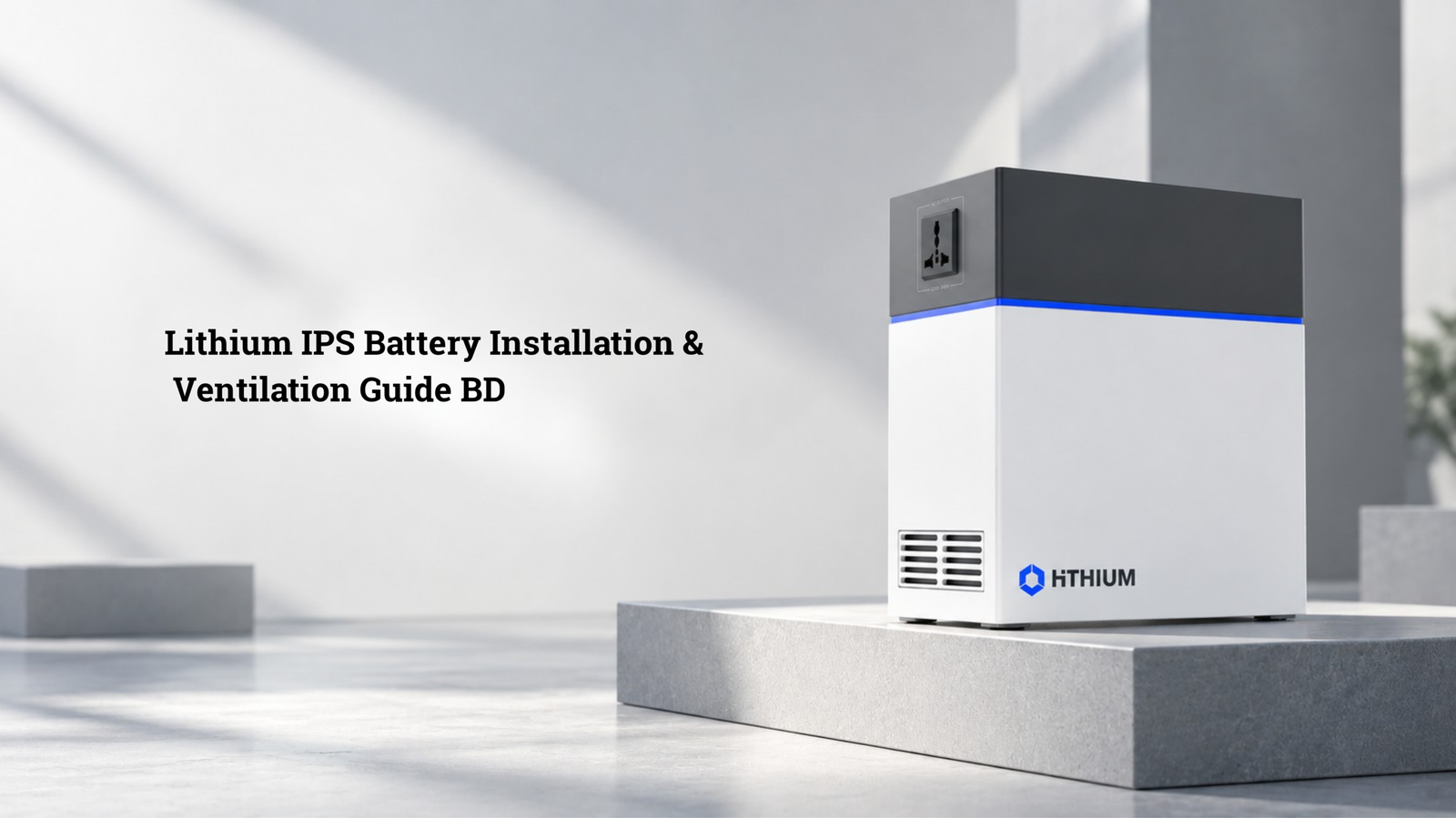
How to Properly Install and Ventilate Your Lithium IPS Battery in Bangladesh — Safety & Best Practices
Installing a lithium IPS battery at home is one of the most important decisions a Bangladeshi homeowner can make. Unlike traditional tubular batteries, LiFePO₄ units require careful attention to ventilation, mounting, and electrical connections. Get it right and your battery will deliver 11,000 cycles. Get it wrong and you risk premature failure or safety hazards.
This guide covers everything you need to know about installing your lithium IPS battery safely in a Bangladeshi home — from choosing the right location to connecting it properly to your home electrical system.
Why Ventilation Matters for Lithium IPS Batteries
Lithium iron phosphate (LiFePO₄) batteries are safer than lead-acid alternatives, but they still generate heat during charging and discharging. In Bangladesh’s hot climate — where temperatures regularly exceed 35°C — proper ventilation is not optional. It is essential.
When a lithium IPS charges from grid power or solar panels, the internal Battery Management System (BMS) regulates cell temperatures. If ambient temperatures rise above 45°C or airflow is restricted, the BMS will throttle charging current to protect the cells. This means slower charging from your solar panels and reduced performance during peak load-shedding hours.
The HeroEE Light 1, for example, features an built-in cooling fan that activates automatically when internal temperatures reach 40°C. Placing this unit in a sealed cupboard without airflow will cause the fan to run continuously, accelerating wear and reducing overall efficiency.
Choosing the Right Location for Your IPS Battery
The location you choose for your IPS battery affects both safety and performance. Here are the key factors to consider for Bangladeshi homes:
Indoor Installation (Recommended)
Most Bangladeshi homeowners install their IPS units indoors — typically in a dedicated utility room, prayer room corner, or behind a bedroom door. Indoor installation protects the battery from direct sunlight, rain, and dust. It also keeps the unit secure from theft and accidental damage.
For indoor installation, ensure the room has at least 15 cm of clearance on all sides of the IPS unit. Do not place the battery directly against a wall or inside a closed cabinet without ventilation slots. If you must use a cabinet, install mesh vents at both the top and bottom to create natural convection airflow.
Outdoor Installation (Only When Necessary)
Sometimes indoor space is limited, especially in dense urban areas like Dhaka’s older neighborhoods. If you must install outdoors, use a weatherproof enclosure rated IP65 or higher. Direct sunlight exposure can raise battery surface temperatures by 10–15°C above ambient, which significantly reduces cycle life.
Never install a lithium IPS battery in a location that collects standing water during monsoon seasons. Units like the HeroEE MaxPower 8 are designed for indoor use and lack the environmental sealing required for outdoor ground-level placement.
Temperature Considerations
LiFePO₄ batteries perform best between 10°C and 35°C. In Bangladesh, this means avoiding locations near kitchen stoves, water heaters, or direct sunlight through windows. A north-facing wall in a well-ventilated room is ideal.
Mounting Your IPS Battery Safely
Proper mounting prevents vibration damage, ensures stable electrical connections, and makes future maintenance easier. Most HiTHIUM IPS units feature mounting brackets on the back panel.
Wall-Mounted Installation
Wall mounting is the standard approach for residential IPS installations. Use the provided mounting template and mark drill points on a solid brick or concrete wall. Avoid mounting on hollow brick partitions without additional reinforcement.
For wall-mounted units like the HeroEE Light 1 (which weighs approximately 9.3 kg), use at least two M8 expansion bolts rated for 50 kg load each. Drill pilot holes slightly smaller than the bolt diameter for maximum hold in brick walls common in Bangladeshi construction.
Floor Placement
Heavier units like the MaxPower 8 AIO (approximately 75 kg) are often placed on the floor rather than wall-mounted. Use a level, flat surface and place the unit on rubber anti-vibration pads. Ensure at least 30 cm of clearance on all sides for airflow and service access.
Electrical Connections: What You Need to Know
Incorrect electrical connections are the leading cause of IPS battery failures in Bangladesh. Here is what every homeowner should understand before connecting their lithium IPS unit.
Cable Sizing
The cable size between your IPS battery and home distribution board depends on the IPS rating and distance. For a typical 1500VA IPS installed within 3 meters of your main distribution board, use 6 mm² copper cable. For longer runs or higher-capacity units (3000VA+), upgrade to 10 mm² cable.
Refer to our IPS Cable Size Guide for detailed sizing tables based on load current and run length.
Earthing Requirements
Every IPS installation in Bangladesh must include proper earthing. Connect the IPS earth terminal to your home’s main earth rod using at least 6 mm² green-yellow insulated copper wire. Poor earthing causes stray voltage on appliance casings and can damage sensitive electronics during power transitions.
Our IPS Earthing and Grounding Guide covers test methods and resistance targets for Bangladeshi soil conditions.
Connecting to Your Home Distribution Board
Most modern HiTHIUM IPS units feature auto-transfer switches that connect directly to a dedicated circuit in your home distribution board. Install a dedicated MCB (Miniature Circuit Breaker) rated 10–20% above the IPS input current. For a 1500VA IPS drawing approximately 7A at 230V, use a 10A or 16A MCB.
Do not share the IPS circuit with high-draw appliances like geysers or air conditioners. These create voltage fluctuations that can trip the IPS transfer mechanism unnecessarily.
First-Time Setup and Configuration
Once your IPS is mounted and electrically connected, follow these setup steps:
- Inspect all connections: Check that positive and negative terminals are tight and correctly polarized. Reversed polarity will trigger the BMS protection and may require a reset procedure.
- Power on the IPS: Turn on the mains input first, then the battery switch. The LCD display should illuminate showing input voltage, battery percentage, and load status.
- Initial charge: Allow the battery to charge to 100% before connecting home loads. This typically takes 2-3 hours from a empty state using grid charging.
- Test transfer switching: Simulate a power cut by switching off the mains MCB. The IPS should transfer to battery mode within 10 milliseconds — silent and seamless for connected loads.
- Verify output quality: Use a multimeter to confirm the IPS outputs 230V ±5% at 50Hz under both grid and battery mode.
Troubleshooting Common Installation Issues
Even with careful installation, problems can arise. Here are the most common issues Bangladeshi homeowners encounter:
- IPS beeping continuously: Usually indicates an overload or short circuit on the output side. Disconnect all loads and restart. If the beeping persists, check for damaged cables or wet connections.
- Battery not holding charge: Could be a blown fuse, loose terminal, or a BMS fault. Check the main fuse inside the battery compartment and verify all terminal connections are tight.
- Short backup time: If your IPS delivers only 30 minutes instead of the expected 2–3 hours, check that the battery is fully charged and no high-draw loads are connected unintentionally.
- Solar charging not working: Verify solar panel voltage exceeds battery voltage by at least 5V. Check MC4 connections and ensure the solar input polarity is correct.
For detailed diagnostic guidance, see our IPS Troubleshooting and Error Codes Guide.
When to Call a Professional Installer
While many IPS installations can be handled by competent homeowners, certain situations require professional assistance:
- Installing a three-phase IPS in a commercial or large residential property
- Integrating the IPS with an existing solar PV system that lacks isolation transformers
- Upgrading from a lead-acid IPS to lithium without verifying existing cable sizes and MCB ratings
- Any installation involving modifications to the main distribution board
HiTHIUM recommends using certified electricians registered with the Bangladesh Electricity Regulatory Commission (BERC) for complex installations. Proper installation by a qualified professional also ensures your warranty remains valid.
Maintenance Tips for Long Battery Life
After successful installation, regular maintenance keeps your lithium IPS performing at its best throughout its 125+ year lifespan:
- Monthly: Visually inspect cable connections for discoloration or warmth. Clean dust from ventilation openings using a soft brush or compressed air.
- Quarterly: Check battery state of charge during a simulated power cut. Record backup duration and compare with expectations.
- Annually: Tighten all terminal connections and inspect the earth continuity. Check that the cooling fan operates silently without unusual vibrations.
For comprehensive maintenance guidance, refer to our IPS Maintenance Checklist.
Products Featured in This Guide
| Product | Capacity | Power Output | Best For | Price (BDT) |
|---|---|---|---|---|
| HeroEE Light 1 | 1004.8 Wh | 500W | Small homes, single room | Check listing |
| HeroEE 2 | 2000 Wh | 1000W | 2–3 room apartments | Check listing |
| MaxPower 8 AIO | 8000 Wh | 5000W | Full home backup | Check listing |
| MaxPower 8 ESS | 8038.4 Wh | External inverter required | Off-grid homes, solar integration | Check listing |
Frequently Asked Questions
Q: Can I install a lithium IPS battery myself in my Bangladesh home?
A: Yes, if you have basic electrical knowledge and follow the manufacturer’s instructions carefully. However, we recommend professional installation for units above 3000VA or when modifying your home’s main distribution board. Incorrect installation voids the warranty and creates safety risks.
Q: How much clearance do I need around my IPS battery?
A: Maintain at least 15 cm of clearance on all sides for wall-mounted units and 30 cm for floor-placed heavy units. This ensures adequate airflow for cooling and provides space for maintenance access. Never block the ventilation slots on the IPS enclosure.
Q: Is it safe to install a lithium IPS battery in a bathroom or kitchen?
A: No. Lithium IPS batteries should never be installed in high-humidity areas like bathrooms or kitchens. Moisture damage voids the warranty and creates electrical hazards. Choose a dry, well-ventilated utility area instead.
Q: Do I need a special circuit breaker for my lithium IPS?
A: Yes, install a dedicated MCB rated 10–20% above the IPS input current. For a 1500VA unit, use a 10A or 16A MCB. Do not share this circuit with high-draw appliances like geysers or room coolers, as their startup currents can trip the breaker.
Q: How do I know if my IPS installation is properly earthed?
A: Use a multimeter to measure resistance between the IPS earth terminal and your earth rod. A reading below 5 ohms indicates good earthing. For detailed testing procedures and Bangladeshi soil-specific guidance, see our earthing guide linked above.
Q: Can I install my IPS battery outdoors in a rooftop shelter?
A: Only if the shelter is fully enclosed and weatherproof. Direct sunlight raises battery temperatures dangerously. If outdoor installation is unavoidable, use an insulated enclosure with passive ventilation and a temperature sensor that triggers automatic load shedding when temperatures exceed 45°C.
Q: What is the minimum battery state of charge before connecting loads?
A: Always allow the battery to reach at least 80% charge before connecting home loads during the initial setup. This ensures the BMS completes its full calibration cycle and provides accurate state-of-charge readings. Connecting loads too early can cause the BMS to miscalculate remaining capacity.
Conclusion
Proper installation and ventilation of your lithium IPS battery are critical for safety, performance, and long-term reliability. By following the guidelines in this article — choosing the right location, ensuring adequate clearance, sizing cables correctly, and maintaining proper earthing — you will maximize the 25+year lifespan of your LiFePO₄ investment.
Whether you choose a compact HeroEE Light 1 for a single room or a full-home MaxPower 8 system, professional installation by a BERC-registered electrician ensures your Bangladeshi home stays powered safely through every load-shedding episode.
Need help selecting the right IPS for your home? Visit our online shop or contact us for personalized guidance.
