




Blog
IPS Noise Level Comparison — Silent Models for Home Use in Bangladesh

IPS Noise Level Comparison — Silent Models for Home Use in Bangladesh
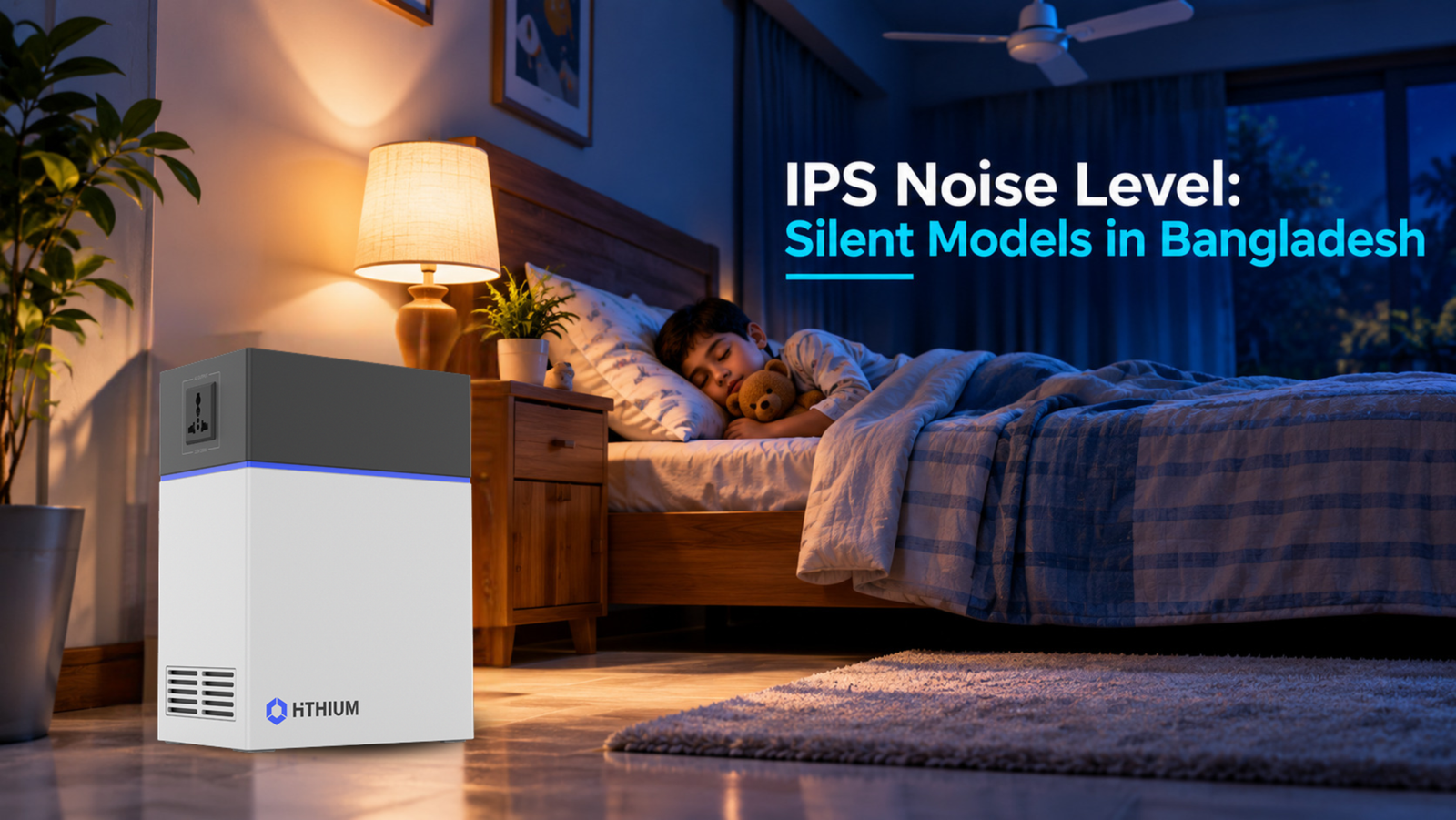
Load shedding in Bangladesh can last 4–8 hours a day in some areas. When your IPS kicks on at midnight, the last thing you want is a loud buzzing machine disturbing your sleep. Yet noise is one of the most overlooked factors when buying an IPS for home use. This guide compares IPS noise levels across the major types and brands available in Bangladesh, explains what causes the noise, and helps you choose the quietest IPS for home use — whether for a bedroom, drawing room, or home office.
Why Does an IPS Make Noise?
Before comparing models, it helps to understand what causes IPS noise in the first place. There are three main sources:
- Inverter transformer hum — The core inverter component vibrates at 50 Hz (the AC mains frequency in Bangladesh). This creates a low-frequency hum, often described as a “buzzing” sound. Modified sine wave inverters are louder than pure sine wave inverters because their waveform causes more transformer vibration.
- Cooling fan — Most IPS units have one or more cooling fans. At low loads (a few lights and fans), the fan runs slowly and quietly. Under heavy load (fridge, motor, multiple ACs), the fan speeds up and becomes the dominant noise source.
- Battery noise — Flooded lead-acid and tubular batteries release hydrogen gas during charging, producing a faint bubbling or gurgling sound. Lithium (LiFePO4) batteries have no liquid electrolyte and produce zero gas — they are completely silent during charging.
Understanding these three sources tells you immediately why lithium IPS with pure sine wave inverters are the quietest option available.
IPS Noise Level Comparison Table (dB)
The decibel (dB) scale is logarithmic — a 10 dB increase feels roughly twice as loud. Here’s how common IPS types stack up:
| IPS Type | Noise at Idle (dB) | Noise at Full Load (dB) | Battery Noise | Best For |
|---|---|---|---|---|
| Lithium IPS — Pure Sine Wave (e.g. HiTHIUM) | 0 dB | 38–45 dB | None | Bedrooms, offices, study rooms |
| Standard IPS — Pure Sine Wave (tubular battery) | 35–45 dB | 48–58 dB | Faint bubbling (charge phase) | Living rooms, general use |
| Standard IPS — Modified Sine Wave (tubular battery) | 42–55 dB | 55–65 dB | Moderate bubbling | Utility/service use only |
| Old Ferroresonant / Standby UPS | 50–60 dB | 60–70 dB | High (flooded cells) | Not recommended for home |
Reference: 30 dB = quiet library | 40 dB = quiet room at night | 50 dB = normal conversation | 60 dB = busy office
What Is a “Silent” IPS? Setting the Noise Threshold
For home use in Bangladesh, audio engineers and HVAC professionals use 35 dB as the threshold for “quiet.” Below 35 dB, most people will not notice the sound unless the room is completely silent. Above 45 dB, the hum becomes clearly perceptible during light activity like reading or watching TV at low volume.
- Bedroom standard: ≤35 dB — you should sleep without disturbance
- Home office standard: ≤40 dB — focus work is not disrupted
- Living room standard: ≤50 dB — TV at normal volume masks it
- Garage / utility standard: ≤65 dB — noise is acceptable
Based on these thresholds, only lithium pure sine wave IPS units reliably qualify as “bedroom silent” when idle.
Lithium IPS vs Tubular IPS — Noise Comparison in Detail
The noise difference between lithium IPS and traditional tubular battery IPS is significant, particularly in Bangladesh where power cuts can happen multiple times a day.
Charging Noise
A tubular battery IPS charges at C/10 to C/5 rate — meaning a 150 Ah battery may take 10–15 hours to fully charge. During this entire period, the charger is running at high current, creating transformer noise. LiFePO4 batteries charge at C/2 or faster — a 100 Ah lithium pack can recharge in 2–3 hours. Less charging time = less noise exposure.
Battery Off-Gassing
Flooded tubular batteries release hydrogen gas during the bulk and absorption charging phases. This causes a faint but audible “fizzing” sound inside the battery. In a closed room, this can be quite noticeable at night. LiFePO4 cells are sealed and produce zero gas — completely silent in this regard.
Inverter Waveform
Many budget tubular IPS units use modified sine wave (MSW) inverters, which are cheaper but significantly louder. The stepped waveform causes the transformer to vibrate more aggressively. HiTHIUM lithium IPS units use pure sine wave (PSW) inverters, which produce a smooth 230V AC waveform that creates far less transformer vibration — typically 10–15 dB quieter than equivalent MSW units.
Popular IPS Models Noise Comparison in Bangladesh
| Brand / Model | Type | Capacity | Estimated Noise (Idle) | Inverter Type | Approx. Price (BDT) |
|---|---|---|---|---|---|
| HiTHIUM LiFePO4 IPS | Lithium | 1–5 kWh | 0 dB | Pure Sine Wave | 33,725–2,87,000+ |
| Luminous Zelio+ 1100 | Tubular (lead-acid) | 900VA | 40–48 dB | Pure Sine Wave | 18,000–22,000 |
| Hamko HomeStar 1500VA | Tubular (lead-acid) | 1500VA | 45–55 dB | Modified Sine Wave | 14,000–18,000 |
| IPS Tech / Generic BD IPS | Tubular (lead-acid) | 800–2000VA | 48–62 dB | Modified Sine Wave | 8,000–25,000 |
| Microtek 1125VA EB 1050 | Tubular (lead-acid) | 900W | 42–50 dB | Pure Sine Wave | 20,000–26,000 |
Note: Noise figures are representative estimates based on manufacturer specs and user reports. Actual noise varies with load level, room size, and surface placement.
5 Practical Tips to Reduce IPS Noise at Home
Even with a quiet IPS, placement and setup matter. Here are five proven tips for Bangladeshi homes:
- Use a rubber anti-vibration mat. Place 3–5 cm thick rubber matting under the IPS unit. This decouples transformer vibration from the floor, significantly reducing the “buzz” that travels through walls. Anti-vibration mats are available at hardware stores across Dhaka for ৳200–500.
- Place on a solid concrete or tile surface — not plywood. Hollow surfaces act as a resonance chamber, amplifying low-frequency hum by 5–10 dB. A concrete floor or solid tile is far better. If you must use a shelf, use a thick MDF board (at least 18 mm) rather than thin plywood.
- Ensure adequate ventilation to keep the fan slow. A poorly ventilated IPS runs its fan at high speed continuously. Keep at least 20 cm clearance on all sides. In Dhaka’s heat (30–40°C), ventilation is especially important — a hot IPS is also a louder IPS.
- Don’t overload the IPS. Running the IPS at 80–100% capacity causes the fan to run at maximum speed. Right-size your IPS so typical daily loads are at 50–70% capacity — the fan runs slowly and noise stays low. Use our IPS backup time calculator to check your load accurately.
- Place the IPS in a dedicated utility cupboard if possible. A well-ventilated cupboard or utility alcove with a louvred door can reduce perceived noise by 10–15 dB in the adjacent room. This is a common solution in Dhaka apartment buildings with limited floor space. Note: Only do this with lithium IPS — tubular battery IPS must not be enclosed due to hydrogen gas.
Why Lithium IPS Is the Right Choice for Quiet Home Use
For Bangladeshi homes — especially in Dhaka, Chattogram, and Sylhet where apartments are compact and families live close together — a silent IPS is not a luxury. It is a basic quality-of-life requirement. Children studying at night, elders sleeping, and work-from-home professionals all benefit from a quiet backup power solution.
Lithium IPS units — specifically those using LiFePO4 (Lithium Iron Phosphate) batteries — deliver the lowest noise profile of any IPS technology available today in Bangladesh:
- No off-gassing = no bubbling battery noise, safe inside rooms
- Faster charging = less time the charger transformer is running
- Pure sine wave output = quieter inverter transformer vibration
- Smart battery management = fan runs only when truly needed
- 11,000+ cycle lifespan = the same quiet performance for 25+ years
Compared to a conventional tubular IPS that might cost ৳15,000–25,000, a HiTHIUM lithium IPS costs more upfront — but eliminates battery replacement costs every 3–4 years and gives you consistent, quiet performance throughout its life.
Frequently Asked Questions — IPS Noise
What is an acceptable IPS noise level for bedroom use?
For bedroom or sleeping areas, you want an IPS that produces 30 dB or less — roughly equivalent to a quiet library. Most modern lithium IPS units with pure sine wave inverters fall in the 25–35 dB range at idle, which is comfortable for sleeping.
Why does my IPS make a buzzing or humming sound?
IPS buzzing is usually caused by the inverter’s transformer vibrating at 50 Hz (the AC frequency). Modified sine wave inverters buzz louder because their stepped waveform causes more transformer vibration. Pure sine wave inverters are significantly quieter. Cooling fans and battery charging also contribute noise.
Is lithium IPS quieter than tubular battery IPS?
Yes, in two important ways. First, lithium (LiFePO4) batteries charge faster and need less charge time, so the charging hum lasts a shorter period. Second, lithium batteries do not release hydrogen gas during charging, so there is no bubbling or venting noise — unlike flooded tubular batteries.
Can I put my IPS inside a bedroom or bedroom closet?
Lithium IPS units (like HiTHIUM LiFePO4 models) can be placed inside rooms because they produce no gas and very low noise. Tubular battery IPS units should NOT be placed in enclosed bedrooms — they emit hydrogen gas during charging, which is a health hazard and fire risk.
What dB level is a “silent” IPS?
Any IPS below 35 dB is considered silent for home use. Top-tier models with fanless cooling achieve 25–28 dB — similar to a whisper. Most lithium IPS units are 28–40 dB depending on load. Fan speed increases at higher loads, raising noise to 40–50 dB.
How can I reduce my IPS noise at home?
Place the IPS on a rubber anti-vibration mat to dampen transformer hum. Keep it in a well-ventilated corner so the fan runs at low speed. Avoid placing it on hollow surfaces like plywood shelves that amplify vibration. Use a pure sine wave lithium IPS for the lowest baseline noise.
Conclusion — Choose Quiet Power Backup
When it comes to IPS noise level in Bangladesh, the choice is clear: pure sine wave lithium IPS units are 10–20 dB quieter than conventional tubular battery IPS systems at comparable loads. That difference is the gap between a faintly perceptible hum and an audible buzz that disrupts sleep and concentration.
HiTHIUM Bangladesh offers LiFePO4 lithium IPS solutions designed for Bangladeshi homes, apartments, and offices — delivering quiet, reliable backup power without the noise, gas, or maintenance headaches of traditional battery systems.
Ready to upgrade to a silent IPS? Browse HiTHIUM’s lithium IPS range or contact us for a free load assessment and sizing recommendation for your home.
📖 Related Guides — HiTHIUM Bangladesh
Recommended HiTHIUM Products
Based on your needs, here are the best HiTHIUM lithium IPS and power station options for Bangladesh:
| Product | Capacity | Best For | Price |
|---|---|---|---|
| HiTHIUM HeroEE 2 (1000W, 2kWh) | 1000W, 2kWh | Medium homes, fridge + fans + TV | ৳78,100 |
| HiTHIUM HeroEE 16 (16kWh) | 16kWh | Large homes, offices, factories | ৳3,36,000 |
Free delivery across Bangladesh. WhatsApp us for consultation: Contact HiTHIUM

One thought on “IPS Noise Level Comparison — Silent Models for Home Use in Bangladesh”