




Blog
How to Connect Solar Panels to Existing Lithium IPS in Bangladesh — DIY Guide

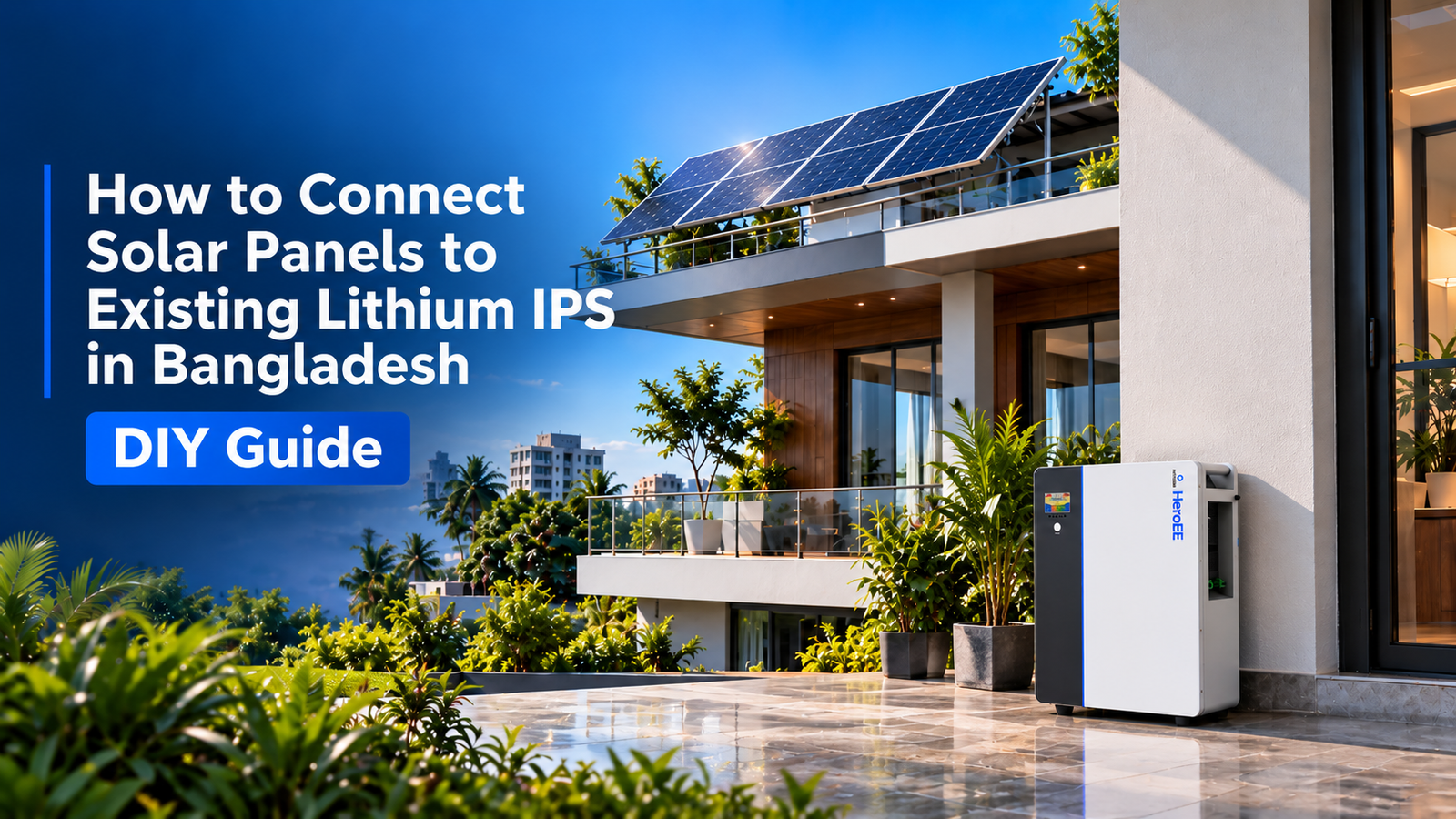
Can You Add Solar Panels to an Existing Lithium IPS?
Yes — you can connect solar panels to an existing lithium IPS in Bangladesh, but the process depends on your IPS model. Some lithium IPS units have built-in solar charge controllers (solar-ready or hybrid models), while others require an external MPPT charge controller. This guide walks you through both scenarios with wiring diagrams, safety checks, and Bangladesh-specific buying tips.
Step 1 — Identify Your IPS Type
Before buying any solar equipment, check your IPS specification label or manual. There are three common configurations in the Bangladesh market:
Type A — Solar-Ready Lithium IPS (Built-in MPPT)
Models like HiTHIUM Hybrid Series, Luminous Solar Hybrid, and Hamko Solar IPS have a dedicated PV Input terminal block on the back. These units accept solar panels directly — no extra controller needed.
- Look for terminals labeled PV+ and PV- (or Solar+/Solar-)
- Check the maximum PV voltage (Voc) and current (Isc) ratings — typically 150–250V Voc and 10–20A Isc for residential models
- Built-in controller is usually MPPT (Maximum Power Point Tracking) for 20–30% better harvest than PWM
Type B — Standard Lithium IPS (No Solar Input)
Most older or budget lithium IPS units (e.g., standard HiTHIUM 1200VA/24V, Luminous Li-ON 1100) only have Battery+ and Battery- terminals. You cannot connect panels directly — you must add an external MPPT charge controller between the panels and the battery bank.
Type C — Lead-Acid IPS Being Upgraded to Lithium
If you’re replacing tubular batteries with lithium (LiFePO4) in an existing lead-acid IPS, verify the inverter’s charge voltage profile. Lithium requires 14.4–14.6V per 12V module (28.8–29.2V for 24V systems). Many lead-acid IPS chargers output 13.8V float — too low to fully charge lithium. You may need a lithium-compatible charger or a solar MPPT with lithium profile.
Step 2 — Size Your Solar Array
Match panel capacity to your IPS battery bank and daily load. Oversizing wastes money; undersizing defeats the purpose.
| Battery Bank | Recommended PV Watts | Panel Config (Typical 550W) | Est. Daily Harvest (BD Sun) |
|---|---|---|---|
| 24V 100Ah (2.4 kWh) | 600–800W | 2 × 550W in series | 2.5–3.5 kWh |
| 24V 200Ah (4.8 kWh) | 1200–1600W | 3 × 550W in series | 5–6.5 kWh |
| 48V 100Ah (4.8 kWh) | 1200–1600W | 4 × 550W (2S2P) | 5–6.5 kWh |
| 48V 200Ah (9.6 kWh) | 2400–3000W | 5–6 × 550W (series-parallel) | 10–12 kWh |
Rule of thumb: Target 0.3–0.4 kW of solar per 1 kWh of battery capacity. In Bangladesh’s 4.5–5 peak sun hours, this recharges 80–100% of usable capacity on a clear day.
Step 3 — Wiring Configurations
For Solar-Ready IPS (Type A) — Direct Connection
- Turn off the IPS — switch off AC input, DC output, and battery breaker.
- Connect panels in series — positive of Panel 1 to negative of Panel 2. This increases voltage, reduces current, and lets you use thinner cables.
- Run PV cables — use 4mm² or 6mm² solar cable (UV-rated, double-insulated). Route through conduit; avoid sharp bends.
- Connect to PV terminals — PV+ to PV+, PV- to PV-. Polarity reversal destroys the MPPT. Use a multimeter to confirm panel Voc before connecting.
- Enable solar priority — in the IPS menu (LCD or app), set Charge Source Priority = Solar First or Solar + Grid.
- Power on and verify — check the display for PV voltage, charging current, and power (watts).
For Standard IPS (Type B) — External MPPT Controller
- Buy a lithium-compatible MPPT — EPEVER Tracer AN, Victron SmartSolar, or Must MPPT with LiFePO4 profile. Avoid cheap PWM controllers.
- Mount the MPPT — near the battery bank, ventilated, away from direct sun/rain.
- Wire: Panels → MPPT → Battery — panels to MPPT PV terminals, MPPT Battery terminals to IPS Battery+ / Battery-.
- Configure lithium profile — via Bluetooth app or PC software: set Absorption = 14.4V/28.8V, Float = 13.8V/27.6V, Equalize = OFF.
- Fuse both sides — PV fuse (1.25 × Isc) on positive PV line; Battery fuse (1.25 × max charge current) on positive battery line.
Step 4 — Safety & Code Compliance (Bangladesh Context)
- DC isolator — install a DC double-pole isolator between panels and MPPT/IPS. Required by BNBC (Bangladesh National Building Code) for rooftop arrays.
- Earthing — bond panel frames and mounting rails to earth. Use 6mm² green/yellow cable to the building’s earthing pit.
- Surge protection — add a Type 2 DC SPD (surge protection device) at the MPPT/PV input. Lightning is common in monsoon.
- Cable sizing — voltage drop < 3%. For 10m run at 10A: 4mm² drops ~0.8V (acceptable). For 20m: use 6mm².
- Fire safety — keep batteries in a ventilated cabinet. LiFePO4 is stable but not fireproof. No flammable materials within 1m.
Step 5 — Monitoring & Optimization
After installation, track performance for the first 2 weeks:
- Daily yield (kWh) — compare to the table above. Monsoon days yield 30–50% of clear-sky.
- Battery SOC at sunset — should reach 90–100% on sunny days. If stuck at 60–70%, array is undersized or shading is an issue.
- MPPT temperature — should stay < 60°C. If hot, improve airflow.
Most modern MPPTs (Victron, EPEVER, Must) have Bluetooth/WiFi monitoring. The VictronConnect and EPEVER Solar Station Monitor apps show real-time PV watts, battery SOC, and historical yields — useful for warranty claims and system sizing validation.
Cost Breakdown (2026 Bangladesh Market Prices)
| Component | Typical Price (BDT) | Notes |
|---|---|---|
| 550W Mono PERC Panel (JA/Longi/Trina) | ৳22,000–25,000 | ~৳40/Wp — buy 3+ for volume discount |
| EPEVER Tracer AN 4215BN (40A MPPT) | ৳18,000–22,000 | Lithium profile, Bluetooth, 150V Voc |
| Victron SmartSolar MPPT 150/35 | ৳35,000–40,000 | Premium, VE.Direct, excellent app |
| 4mm² Solar Cable (100m roll) | ৳4,500–5,500 | UV-rated, TUV certified |
| MC4 Connectors (10 pairs) | ৳800–1,200 | Use proper crimper — not pliers |
| DC Isolator 32A/600V (2-pole) | ৳1,200–1,800 | Mandatory for rooftop |
| Type 2 DC SPD (1000V) | ৳2,500–3,500 | Monsoon lightning protection |
| Mounting Rails & Clamps (for 3 panels) | ৳6,000–8,000 | Aluminum, adjustable tilt |
Total for 3 × 550W + MPPT + BOS: ৳1,10,000–1,40,000 (DIY). Professional installation adds ৳25,000–40,000.
Common Mistakes to Avoid
- Connecting panels in parallel on a 24V/48V system — keeps voltage low, exceeds MPPT current limit, causes overheating.
- Using PWM controller with lithium — cannot set precise absorption/float voltages; undercharges or overcharges.
- Skipping the DC isolator — no safe way to disconnect PV for maintenance; fails inspection.
- Mixing panel brands/wattages — mismatch reduces string output to the weakest panel.
- Ignoring temperature derating — panel Voc rises in cold; ensure Voc × 1.25 < MPPT max input voltage.
FAQ — Solar Panel to Lithium IPS Connection
Q: Can I connect solar panels directly to my HiTHIUM lithium IPS without a charge controller?
A: Only if your IPS has built-in PV terminals (solar-ready/hybrid model). Standard lithium IPS units require an external MPPT charge controller. Check the back panel for PV+ / PV- labels.
Q: What size solar panel do I need for a 24V 100Ah lithium battery?
A: 600–800W (2 × 550W panels in series). This provides 2.5–3.5 kWh/day in Bangladesh sun, enough to recharge the 2.4 kWh usable capacity.
Q: Can I use my existing tubular battery IPS with solar panels?
A: Yes, but you need an MPPT charge controller with a lead-acid profile (absorption 14.4–14.8V, float 13.5–13.8V per 12V). Do not connect panels directly to the battery terminals.
Q: Will solar panels charge the battery during load-shedding?
A: Yes — solar charging is independent of grid power. The MPPT charges the battery whenever sun hits the panels, even during extended outages.
Q: Do I need permission from DESCO/DPDC/REB to add solar to my IPS?
A: For off-grid / behind-the-meter solar (no net metering, no export), no utility permission is needed. If you plan to export excess via net metering, apply to your distribution company with a single-line diagram.
Q: Can I mix 12V and 24V panels on the same MPPT?
A: No. All panels in a string must have identical Voc, Isc, and Vmp. Mismatched panels reduce harvest and can damage the MPPT.
Q: How do I know if my MPPT is charging correctly?
A: Check the display/app: PV voltage should be near panel Vmp (not Voc), charging current > 0, battery voltage rising toward absorption setpoint. If PV voltage = Voc and current = 0, the MPPT is not tracking (check wiring/fuse).
Q: What happens if the battery is full and solar keeps producing?
A: The MPPT shifts to float voltage (13.8V/27.6V) and reduces current to near zero. Excess solar energy is simply not harvested — no damage occurs. Some hybrid IPS units can divert excess to loads (smart load feature).
Conclusion — Solar + Lithium IPS is a Smart Upgrade
Adding solar panels to your lithium IPS turns backup power into daily energy independence. In Bangladesh’s load-shedding reality, a 2–3 kW solar array on a 24V 200Ah lithium bank covers most daytime loads — fans, lights, router, TV, fridge — while keeping the battery topped for night. The ROI is 3–4 years at current electricity tariffs, and the system pays for itself faster if grid reliability worsens.
Start by checking your IPS model. If it’s solar-ready, you only need panels, cables, and a DC isolator. If not, budget for a quality MPPT (EPEVER or Victron) with a lithium profile. Either way, follow the safety steps: fuses, earthing, SPD, and a DC isolator. Your future self — and your wallet — will thank you.
Next step: Browse HiTHIUM solar-ready lithium IPS models or contact our technical team for a free sizing consultation.
Recommended HiTHIUM Products
Based on your needs, here are the best HiTHIUM lithium IPS and power station options for Bangladesh:
| Product | Capacity | Best For | Price |
|---|---|---|---|
| HiTHIUM HeroEE Light 1 (500W, 1kWh) | 500W, 1kWh | Small homes, 5 fans + 4 lights + router | ৳50,800 |
| HiTHIUM HeroEE 2 (1000W, 2kWh) | 1000W, 2kWh | Medium homes, fridge + fans + TV | ৳78,100 |
Free delivery across Bangladesh. WhatsApp us for consultation: Contact HiTHIUM

One thought on “How to Connect Solar Panels to Existing Lithium IPS in Bangladesh — DIY Guide”