




Blog
LiFePO4 Battery Maintenance Bangladesh 2026 Guide

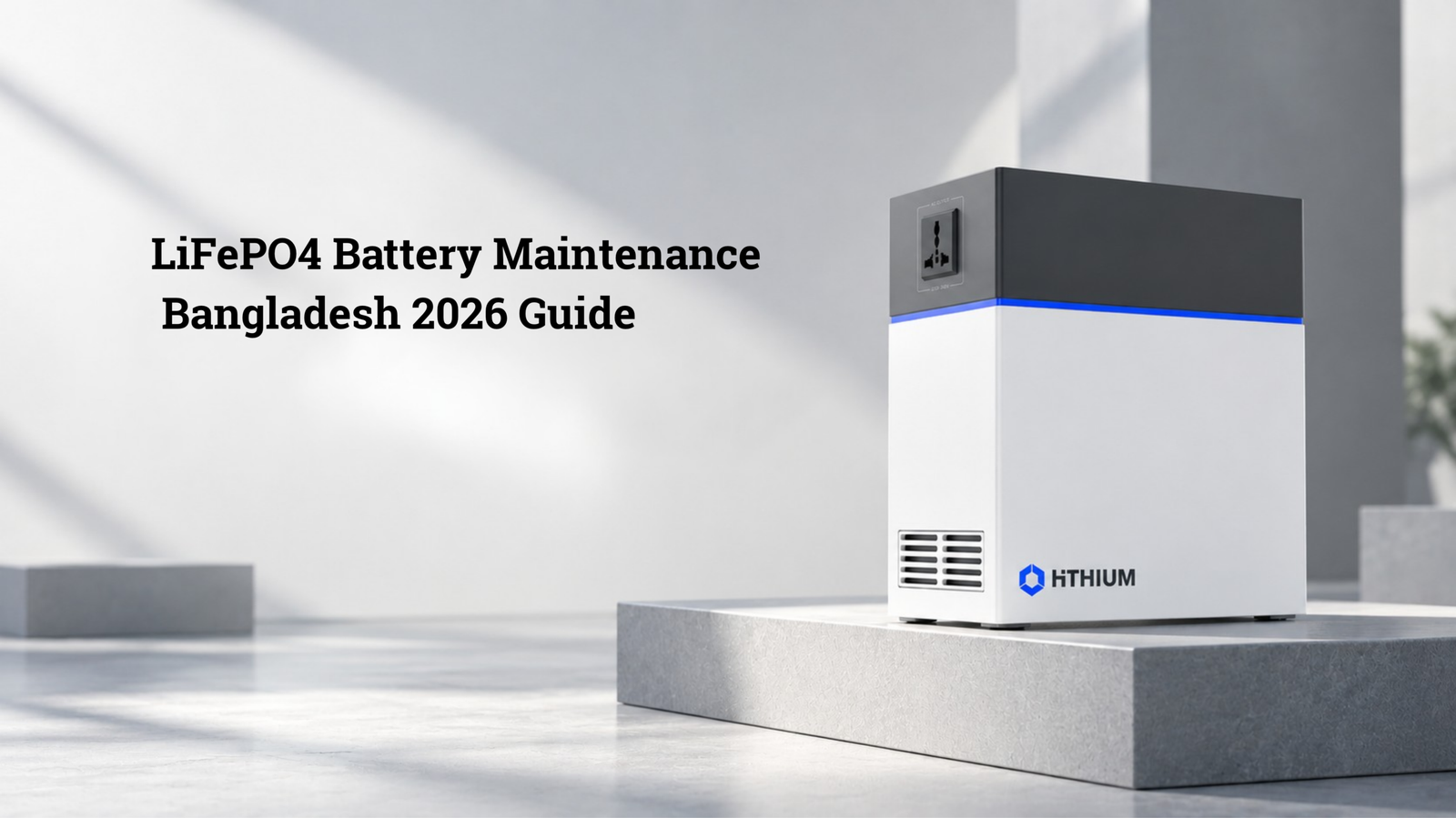
Quick Answer: LiFePO4 batteries in Bangladesh require climate-specific maintenance to achieve their full 11,000 cycle lifespan. The key practices are: keep storage temperature between 15°C and 30°C, maintain 80-95% state of charge for daily use, clean terminals every 3 months, avoid direct monsoon exposure despite IP65 ratings, and verify your charge controller settings match the battery’s voltage parameters. Following these guidelines, a quality LiFePO4 battery like the HiTHIUM HeroEE 4 4019Wh can deliver 25+ years of reliable service in Bangladesh conditions.
Why LiFePO4 Maintenance Matters More in Bangladesh
Bangladesh presents one of the most challenging climates for battery storage in South Asia. With summer temperatures regularly exceeding 40°C, monsoon humidity levels above 85%, and heavy particulate dust during dry seasons, lithium iron phosphate batteries face environmental stress that owners in temperate climates never encounter. While LiFePO4 chemistry is inherently more resilient than lead-acid alternatives, neglecting climate-specific maintenance will still reduce cycle life and performance.
The good news: LiFePO4 batteries like those in the HiTHIUM HeroEE Light 1 (500W) and HiTHIUM MaxPower 8 AIO ranges are engineered with Grade-A cells and built-in Battery Management Systems (BMS) that handle most protections automatically. Your job as an owner is to create the right environment and develop a simple maintenance routine.
Understanding Bangladesh Climate Challenges for Batteries
Extreme Heat (March through October)
Dhaka, Chittagong, and Sylhet regularly see ambient temperatures of 35-42°C during summer. For battery storage, this creates two specific problems:
- Cell temperature elevation: Ambient heat pushes internal cell temperature above optimal levels. LiFePO4 cells perform best at 20-25°C. Every 10°C increase above 25°C accelerates calendar aging by approximately 2x.
- Charge rate limitations: The BMS will throttle charging current when cell temperature exceeds 45°C, meaning your batteries charge slower during the hottest months — exactly when solar input is highest.
The HiTHIUM HeroEE 4 4019Wh addresses this with an operating temperature range of 0°C to 55°C for charging and -20°C to 55°C for discharging, but optimal performance still requires temperature management.
Monsoon Humidity (June through September)
Relative humidity in Bangladesh regularly exceeds 85-95% during monsoon season. While LiFePO4 batteries are sealed units, high humidity affects:
- Terminal corrosion: Moisture accelerates oxidation on connection points, increasing resistance and reducing efficiency
- Condensation inside enclosures: Temperature swings between air-conditioned rooms and outdoor units create condensation cycles
- PCB degradation: BMS circuit boards exposed to sustained humidity can develop micro-corrosion over years
Dust and Particulate Matter (November through February)
The dry season brings heavy dust that infiltrates battery enclosures through ventilation openings. Dust accumulation on battery surfaces acts as thermal insulation, trapping heat and reducing passive cooling efficiency.
Monthly Maintenance Routine for LiFePO4 Batteries in Bangladesh
Week 1: Visual Inspection
Perform these checks at the start of each month:
- Check battery enclosure temperature: Use a non-contact infrared thermometer on the battery casing. Normal operating temperature is 25-35°C. If consistently above 40°C, improve ventilation or relocate the battery.
- Inspect for physical damage: Look for swelling, discoloration, or unusual odors. LiFePO4 batteries rarely swell, but if you notice any bulging, disconnect immediately and contact your supplier.
- Verify LED/BMS indicators: Most HiTHIUM batteries have status LEDs. Confirm they show normal operation (typically green or blue steady light).
- Check mounting stability: Vibrations from ceiling fans or nearby machinery can loosen connections over time. Ensure mounting brackets are secure.
Week 2: Electrical Connections
- Torque terminal bolts: Use a calibrated torque wrench to verify terminal connections are at manufacturer specification (typically 4-6 Nm for most LiFePO4 terminals).
- Inspect cable insulation: Look for cracked, brittle, or heat-damaged cable insulation, especially near terminals.
- Check fuse/breaker operation: Test that protective devices trip correctly. Replace any fuses showing signs of heat discoloration.
- Measure resting voltage: With no load connected, measure battery voltage. A fully charged 12.8V LiFePO4 pack should read 13.2-13.4V. Below 12.0V indicates a problem.
Week 3: Cleaning and Environmental Control
- Clean battery surfaces: Use a dry, anti-static cloth to remove dust accumulation. Never use water or liquid cleaners on battery terminals.
- Clean ventilation openings: Remove dust from intake and exhaust vents on battery enclosures. Use compressed air at low pressure (under 30 PSI) to avoid damaging internal components.
- Check humidity levels: Place a hygrometer near the battery enclosure. If sustained humidity exceeds 80%, consider adding silica gel desiccant packs inside the enclosure.
- Verify airflow: Ensure at least 15cm clearance on all sides of the battery for passive cooling. In Bangladesh heat, active cooling (a small fan) can reduce cell temperature by 5-8°C.
Week 4: Performance Review
- Review charge/discharge logs: If your system has monitoring (many HiTHIUM products include LCD displays or app connectivity), check the cycle count and state of health (SOH) readings.
- Compare backup duration: Time how long your battery sustains your typical load. A significant reduction from baseline indicates capacity degradation.
- Check solar charging efficiency: During sunny hours, verify that your solar panels are charging the battery at expected rates. A 300W panel should deliver approximately 1.2-1.5kWh per day in Bangladesh summer conditions.
Temperature Management: The Most Critical Factor
Temperature is the single most important variable affecting LiFePO4 battery lifespan in Bangladesh. Here is a practical guide based on the operating specifications of HiTHIUM batteries:
| Temperature Range | Effect on Battery | Action Required |
|---|---|---|
| Below 0°C | Charging disabled by BMS; discharge reduced | Move battery indoors; use insulation blanket |
| 0°C – 15°C | Reduced charge acceptance; normal discharge | Accept slower charging; no action needed |
| 15°C – 30°C | Optimal performance zone | Maintain this range for maximum lifespan |
| 30°C – 40°C | Accelerated calendar aging; reduced efficiency | Improve ventilation; consider shade/cooling |
| 40°C – 55°C | Significant capacity reduction; BMS throttling | Active cooling required; reduce charge rate |
| Above 55°C | Safety shutdown by BMS | Immediate intervention; check for faults |
The HiTHIUM HeroEE 4 4019Wh has a storage temperature specification of -5°C to 35°C. For Bangladesh, this means during the hottest months (April-May), indoor storage with air conditioning or at minimum good ventilation is essential for long-term battery health.
Practical Tips for Common Bangladesh Scenarios
Scenario 1: Battery in a Non-AC Room
Many Bangladesh homes store IPS batteries in living rooms or bedrooms without air conditioning. During summer, room temperatures can reach 35-38°C.
Solutions:
- Place the battery near a window with good cross-ventilation
- Install a small 12V DC fan (powered by the battery itself) directed at the battery enclosure
- Use light-colored or reflective enclosure materials to reduce solar heat absorption
- Position the battery on the floor level — heat rises, so lower positions are cooler
- Consider the HiTHIUM HeroEE Light 1 (500W) which is designed for portable placement and can be moved to cooler areas as needed
Scenario 2: Solar Battery Bank in Rooftop Enclosure
Many solar installations in Bangladesh place batteries in rooftop enclosures that can reach 50°C+ in direct sun.
Solutions:
- Never place LiFePO4 batteries in direct sunlight — even with IP67 rating like the HiTHIUM HeroEE 4 4019Wh, thermal stress reduces lifespan
- Insulate the enclosure with reflective bubble wrap or foam board on sun-facing sides
- Install a small exhaust fan powered by excess solar to actively ventilate during peak sun hours
- Relocate batteries to the ground floor if rooftop temperatures consistently exceed 40°C
Scenario 3: Monsoon Season Preparation
Before monsoon season (May-June), perform these preparations:
- Seal all enclosure openings: Use foam gaskets or weather stripping to prevent water ingress through ventilation holes
- Apply dielectric grease: Coat terminal connections with dielectric grease to prevent moisture-induced corrosion
- Check drainage: Ensure the battery enclosure area has proper floor drainage to prevent flooding
- Install dehumidifier: For critical installations, a small electric dehumidifier inside the enclosure maintains humidity below 60%
- Inspect after heavy rain: After any flooding event, inspect the battery enclosure immediately for water ingress
Scenario 4: Power Cuts and Deep Discharge Management
Bangladesh experiences extended load shedding, sometimes 8-12 hours daily. This puts extra demand on battery systems.
- Avoid deep discharge: While LiFePO4 batteries can handle 95-100% DOD, regular deep cycling in high temperatures accelerates aging. Aim to keep daily discharge between 40-60% when temperatures exceed 35°C.
- Use load prioritization: During extended outages, prioritize essential loads (fans, lights, router) over non-essential ones (TV, computer) to extend backup duration.
- Monitor state of charge: The HiTHIUM MaxPower 8 AIO features an LCD display showing real-time SOC — use this to manage discharge carefully.
- Have a charging plan: If grid power returns briefly during load shedding, prioritize charging. LiFePO4 batteries charge faster than lead-acid — a typical 4kWh battery can reach 90-95% in 2-3 hours.
Seasonal Maintenance Calendar for Bangladesh
| Month | Primary Concern | Key Maintenance Tasks |
|---|---|---|
| January-February | Dry season dust | Deep clean terminals and vents; replace dust filters |
| March-April | Rising heat | Check cooling systems; verify ventilation; measure baseline temps |
| May-June | Pre-monsoon heat + humidity | Apply dielectric grease; seal enclosures; test drainage |
| July-August | Peak monsoon | Weekly water ingress checks; monitor humidity; inspect corrosion |
| September-October | Post-monsoon | Full inspection; clean any moisture residue; check all connections |
| November-December | Cool dry season | Annual performance review; cycle count check; benchmark backup time |
What NOT to Do with LiFePO4 Batteries
- Do not equalize charge: Unlike lead-acid batteries, LiFePO4 batteries do not need periodic equalization charges. Doing so can damage cells.
- Do not mix battery brands or ages: If expanding your battery bank, use the same brand, model, and age. Mixing creates imbalance that the BMS cannot fully compensate.
- Do not install in sealed airtight enclosures: Even sealed LiFePO4 batteries need some air circulation for thermal management.
- Do not use lead-acid charge profiles: Ensure your charge controller is set to LiFePO4 charging parameters (typically 14.4V absorption, 13.6V float for 12V systems).
- Do not expose to direct water spray: While IP65+ ratings protect against rain, sustained direct water exposure is not recommended.
- Do not store at 100% SOC for extended periods: If not using the battery for weeks, store at 50-60% state of charge for optimal cell longevity.
When to Seek Professional Help
Contact your battery supplier or a qualified technician if you observe:
- Battery voltage dropping below 11.5V under moderate load (indicates cell imbalance)
- Unusual heat generation from the battery (warm to touch, not just warm ambient)
- BMS error codes or warning LEDs that persist after power cycling
- Visible swelling or deformation of the battery casing
- Significant reduction in backup time (more than 20% from baseline)
- Water ingress evidence (rust spots, moisture visible through vents)
HiTHIUM Bangladesh provides technical support for all their products. For the HiTHIUM HeroEE 4 4019Wh, HiTHIUM MaxPower 8 AIO, and other HiTHIUM products, contact their team for warranty service or technical consultation.
Expected Lifespan with Proper Maintenance
When maintained correctly in Bangladesh conditions, here is what you can expect from quality LiFePO4 batteries:
| Product | Cycle Rating | Expected Lifespan (Bangladesh) | Key Maintenance Factor |
|---|---|---|---|
| HiTHIUM HeroEE Light 1 (500W) | 11,000 cycles | 25+ years | Temperature control (portable, easy to move to cool areas) |
| HiTHIUM HeroEE 4 4019Wh | 11,000 cycles | 25+ years | Ventilation and dust management (IP67 helps) |
| HiTHIUM MaxPower 8 AIO | 11,000 cycles | 25+ years | All-in-one design simplifies maintenance |
| HiTHIUM HeroEE 16 | 11,000 cycles | 25+ years | Industrial-grade build; needs proper ventilation for high capacity |
These estimates assume daily cycling with proper temperature management. Batteries stored or operated in consistently hot environments (above 40°C) may see 30-50% reduction in expected cycle life.
Frequently Asked Questions
How often should I check my LiFePO4 battery in Bangladesh?
Perform a quick visual check weekly and a detailed inspection monthly. During monsoon season (June-September), increase inspections to bi-weekly for water ingress and corrosion checks.
Can I use a LiFePO4 battery outdoors in Bangladesh?
HiTHIUM batteries with IP65 or IP67 ratings like the HiTHIUM HeroEE 4 4019Wh (IP67) can handle outdoor placement, but direct sunlight and extreme heat will reduce lifespan. Shaded, ventilated outdoor placement is acceptable. Direct sun exposure is not recommended.
Do LiFePO4 batteries need a fan in Bangladesh heat?
A fan is not required but recommended when ambient temperatures regularly exceed 35°C. A small 12V DC fan consuming 2-3W can reduce battery temperature by 5-8°C, significantly extending lifespan. The HiTHIUM MaxPower 8 AIO includes built-in thermal management.
What is the best temperature for LiFePO4 battery storage in Bangladesh?
The ideal range is 15-25°C. In practice, maintaining 20-30°C in a well-ventilated indoor space provides the best balance of performance and longevity. The HiTHIUM HeroEE 4 4019Wh specifies -5°C to 35°C for storage.
How does monsoon humidity affect LiFePO4 batteries?
High humidity (above 80%) can cause terminal corrosion and potentially affect BMS circuit boards over time. Apply dielectric grease to terminals before monsoon season and ensure enclosures have drainage. LiFePO4 batteries are sealed, so internal cell damage from humidity is unlikely with quality units.
Should I disconnect my battery during lightning season?
Yes, during severe thunderstorms, disconnecting the battery from solar panels and loads is recommended. Lightning-induced voltage surges can damage BMS components even through surge protectors. The HiTHIUM HeroEE Light 1 (500W) is easy to disconnect due to its portable design.
Can I clean my LiFePO4 battery with water?
Never use water to clean battery terminals or electrical connections. Use a dry anti-static cloth for the battery casing. For terminals, use contact cleaner spray designed for electrical connections. IP67-rated batteries can handle rain but should not be pressure-washed or sprayed directly.
Conclusion
LiFePO4 batteries are the most practical long-term power storage solution for Bangladesh, but they are not completely maintenance-free. The combination of extreme heat, monsoon humidity, and dust creates specific challenges that require a structured maintenance approach. By following the monthly inspection routine, seasonal preparation checklist, and temperature management guidelines in this guide, you can expect your LiFePO4 battery to deliver its full rated lifespan — potentially 20+ years of reliable backup power.
The investment in proper maintenance is minimal compared to the cost of premature battery replacement. A quality battery like the HiTHIUM HeroEE 4 4019Wh at ৳74,500 or the HiTHIUM MaxPower 8 AIO at ৳287,000 represents a 15-25 year commitment — protecting that investment with basic monthly maintenance takes less than 30 minutes and saves thousands in replacement costs.
For more information about LiFePO4 battery systems and solar solutions in Bangladesh, visit hithiumbd.com or contact the HiTHIUM team for personalized recommendations based on your specific power needs and installation environment.

3 thoughts on “LiFePO4 Battery Maintenance Bangladesh 2026 Guide”