




Blog
What Can a Lithium IPS Run During Load Shedding? Real Backup Times for a Bangladeshi Home

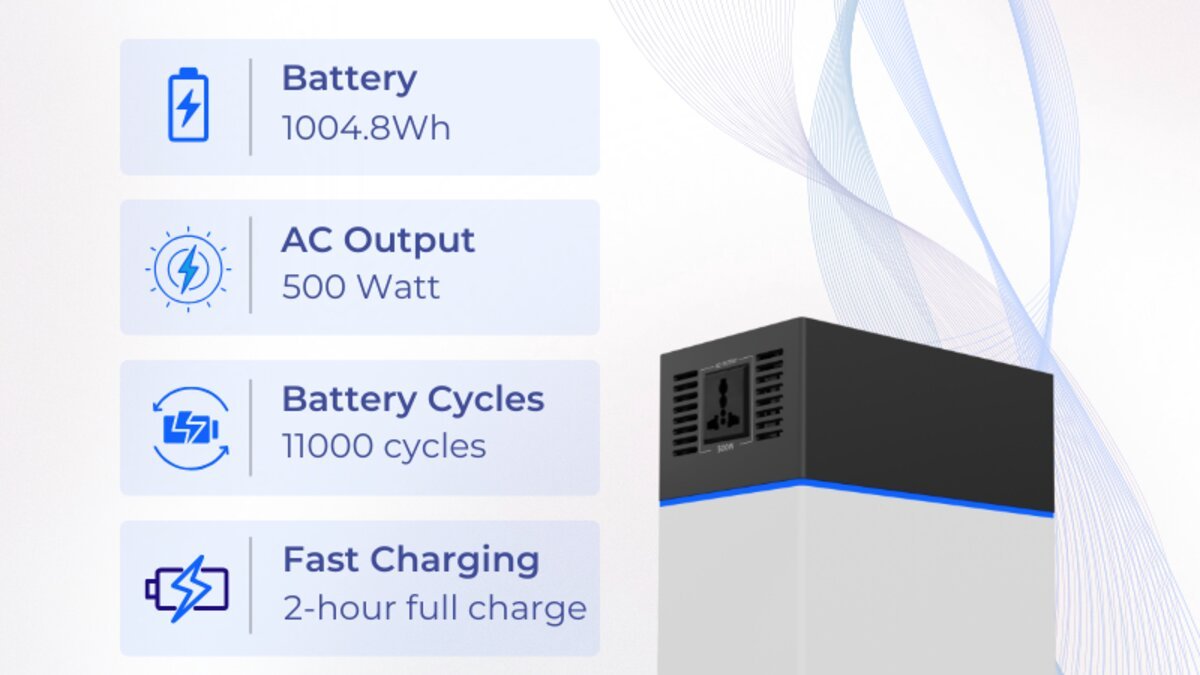
The question people actually ask at the counter is never about watt-hours or depth of discharge. It’s simpler: “If the power goes, how long will this thing run my fans and the router?” That’s the right question, and it has a real answer. It comes down to two numbers — how much energy the battery holds, and how much your appliances draw. Get those two right and you can predict your backup time fairly closely. This guide gives you actual runtimes for common Bangladeshi setups across the three sizes most homes consider: roughly 1 kWh, 2 kWh, and 8 kWh.
How to read your own backup time
The math is just division. Take the energy a battery can deliver, divide by the power your appliances pull, and you get hours of runtime. A lithium battery never gives you 100% of its label to the socket, though. After deep discharge and the small loss in the inverter that converts battery DC into the 230V AC your appliances need, you actually get about 85% of the nameplate capacity at the plug. A 2 kWh battery delivers around 1.7 kWh of real, usable power. Every number in this guide already accounts for that, so what you see is close to what you’ll get.
First, know your load
Before any battery makes sense, you need a rough idea of what you want to keep running. Here are the appliances most Bangladeshi homes care about during an outage, with typical power draw:
|
Appliance |
Typical power draw |
| LED light | 9–15 W |
| Wi-Fi router + ONU | 15–25 W |
| Ceiling fan | 60–80 W |
| Pedestal fan | 50–60 W |
| LED TV (32–43″) | 60–100 W |
| Laptop | 50–65 W |
| Desktop PC | 150–250 W |
| Refrigerator | 100–200 W (cycles on and off) |
| Water pump (0.5 HP) | ~400 W |
| Rice cooker | 600–800 W |
| 1.5-ton air conditioner | 1,400–1,800 W |
Add up what you’d run at the same time and you have your load in watts. If you want an exact figure for your own appliances, the free HiTHIUM Watt Calculator has local brands like Walton, Vision, and Miyako built in and does the totalling for you. For most flats, an “essentials” bundle — two ceiling fans, four LED lights, the router, and a TV — comes to around 300 W. Keep that number in mind, because it’s the one most people are really trying to cover.
The number people forget: output, not just capacity
Capacity tells you how long. Output tells you whether it can run at all. Every IPS has a maximum wattage it can deliver at once. A 1 kWh unit might hold plenty of energy, but if its inverter tops out at 500 W, it will never start a 1,600 W air conditioner — not for a second, regardless of how full the battery is. This is the most common mistake buy IPSers make: they size for energy and ignore the output ceiling. So two questions, not one. Can the unit handle my load (output), and can it sustain it long enough (capacity)?
What each size actually runs
Around 1 kWh — the essentials machine
The HeroEE Light 1 holds 1,004.8 Wh and delivers up to 500 W. That 500 W ceiling means no air conditioner and no rice cooker, but it covers the everyday outage comfortably:
- Essentials bundle (~300 W): about 2.5 to 3 hours
- A single ceiling fan: around 11 hours
- Just the Wi-Fi router: over two days
- Work-from-home setup, laptop plus fan, light, and router (~200 W): roughly 4 hours
For a one or two-bedroom flat that loses power in short, frequent spells, this is usually enough to make load shedding a non-event. The cheaper HeroEE 1 portable station sits in the same capacity tier if you want a more portable option.
2 kWh — the half-day-of-essentials option
The HeroEE 2 doubles the energy to 2 kWh and the output to 1,000 W, which adds real flexibility:
- Essentials bundle (~300 W): close to 6 hours
- Essentials plus a refrigerator (~450 W average): around 4 hours
- A single fan overnight: more than 20 hours
- The router and lights alone: most of a day
The 1,000 W output now covers a fridge, a desktop, even a water pump in short bursts. It still won’t run a 1.5-ton AC, since that draw sits above the output limit. This is the size that suits a family flat wanting to keep the living room, the kitchen essentials, and the internet alive through a longer evening cut.
8 kWh — the whole-home, AC-included tier
The MaxPower 8 AIO is a different class of machine: 8 kWh of storage and a 5,000 W inverter, with a built-in solar IPS guide input. The high output is what finally puts air conditioning on the table.
- Essentials bundle (~300 W): around 22 hours
- A 1.5-ton AC on its own (~1,600 W): roughly 4 hours
- AC plus fans, lights, fridge, and TV (~2,000 W): about 3.5 hours
- A whole flat at a moderate ~1,000 W mix: nearly 7 hours
This is the unit for a larger home, or anyone who refuses to lose the AC during a summer outage. For all-day rural outages or whole-house backup, the HeroEE 16 doubles the runtime again.
A quick side-by-side
Here’s the same essentials bundle across all three sizes, plus what each can and can’t power:
| ~1 kWh (Light 1) | 2 kWh (HeroEE 2) | 8 kWh (MaxPower 8 AIO) | |
| Essentials (~300 W) | ~2.5–3 hrs | ~6 hrs | ~22 hrs |
| Max output | 500 W | 1,000 W | 5,000 W |
| Runs a fridge? | Tight | Yes | Yes |
| Runs a 1.5-ton AC? | No | No | Yes (~4 hrs) |
| Best for | Small flat, short cuts | Family flat, long evenings | Large home, AC, all-day backup |
What changes the real number
These figures are honest estimates, but a few things move them in practice, and it’s worth knowing which.
Refrigerators and ACs don’t draw power steadily — their compressors switch on and off, so a fridge rated at 150 W might average closer to 80 W over an hour. That works in your favour and stretches runtime. Working against you is the startup surge: motors in pumps, fridges, and ACs pull two to three times their rated power for the split second they kick on, which is why output headroom matters more than the label suggests. Running several appliances at once obviously shortens everything, and extreme heat shortens it slightly more. None of these are dramatic on their own, but together they’re why your real backup time can land a little above or below the table.
The safe approach: size for a bit more than you think you need. A battery that’s comfortably larger than your load also lasts longer over the years, because it works less hard on every cycle.
How to size yours in three steps
Add up the appliances you actually want running at the same time, in watts. Be honest — every fan and light counts. The Watt Calculator does this in a minute. Decide how long you need them to last. A short, frequent outage pattern needs far less than a single long daily cut.
Match both numbers to a system that clears your output with room to spare and holds enough energy for your worst expected outage. If you’re not sure, send your appliance list to the HiTHIUM Bangladesh team and we’ll size it for you and quote the right unit.
One caution worth repeating: buy from HiTHIUM Bangladesh or an authorised dealer. Grey-market units routinely overstate capacity, so a battery sold as “2 kWh” may deliver far less than the runtimes here. Genuine Grade-A cells are the only way the math in this guide holds up. Once you’ve bought, register your product to activate the warranty. If you’re still weighing lithium against the alternatives on cost, the LiFePO₄ vs tubular battery comparison covers the 10-year math in detail.
Frequently asked questions
How long will a 2 kWh battery run a ceiling fan?
A single 75 W ceiling fan runs for more than 20 hours on a 2 kWh lithium battery — easily through the longest overnight outage with energy to spare.
Can a portable best lithium IPS run an air conditioner?
Only the larger units can. A 1.5-ton AC draws around 1,600 W, which exceeds the output of 1 kWh and 2 kWh systems. You need a high-output unit like the 5,000 W MaxPower 8 AIO, which runs a 1.5-ton AC for roughly four hours.
Why does my real backup time differ from the rated capacity?
Because no battery delivers its full label to the socket. After depth-of-discharge limits and inverter conversion losses, you get about 85% of the nameplate at the plug. Appliance cycling and running several devices at once also shift the figure.
What size do I need for a typical runtime in Dhaka flat?
For fans, lights, a TV, and the router during short outages, around 1 kWh is usually enough. To add a fridge and cover longer evening cuts, step up to 2 kWh. To keep an AC running, you need an 8 kWh system.
Does running more appliances damage the battery?
No, as long as you stay under the output limit. Going over it simply triggers the protection system and shuts off the load. A genuine HiTHIUM unit guards against overload automatically.
Related Reading
Explore our complete library of IPS guides and resources for Bangladesh.
During load shedding, the HeroEE Light 1 can run fans, LED lights, TV, laptop, and WiFi for hours. The HeroEE 2 adds fridge and microwave support.
For a complete overview of the best IPS options for Bangladesh homes, read our Best IPS in Bangladesh guide.
Related Runtime & Buying Guides
- Best Lithium IPS in Bangladesh 2026
- How Long Does a Lithium IPS Run During Dhaka Load Shedding?
- Lithium IPS vs Generator — 5-Year Cost Comparison
- Best Lithium Battery for IPS in Bangladesh
Related reading: What Makes an IPS the Best in Bangladesh? | IPS Price in Bangladesh 2026 | Lithium IPS Maintenance Guide
