




Blog
How to Choose the Right IPS Capacity for Your Bangladeshi Home — 500VA to 5kVA Guide

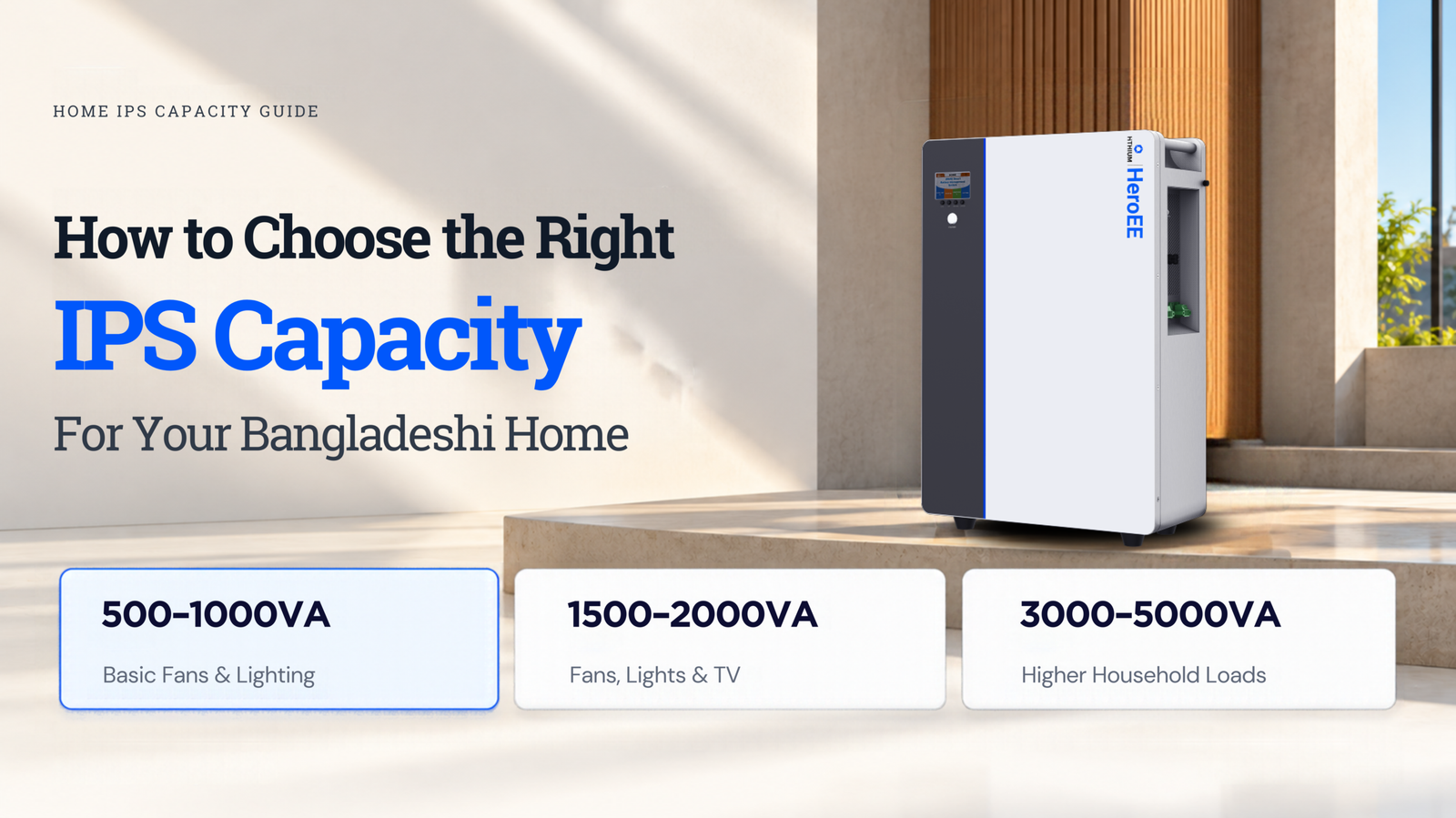
How to Choose the Right IPS Capacity for Your Bangladeshi Home — 500VA to 5kVA Guide
Choosing the right IPS capacity for your home in Bangladesh is one of the most important decisions you’ll make. Get it wrong, and your IPS will trip during peak load or leave you in the dark when you need it most. Get it right, and you’ll have reliable backup that lasts for years.
This guide walks you through exactly how to calculate your home’s power needs and match them to the right IPS size — from compact 500VA units for essential loads to 5kVA systems for whole-home backup. We’ll use real product examples from HiTHIUM Bangladesh, the leading lithium IPS provider in Bangladesh.
Why IPS Capacity Matters in Bangladesh
Bangladesh faces regular load-shedding across urban and rural areas. A properly sized IPS means:
- Reliable power during outages — No more sudden blackouts when your fridge or TV kicks on
- Lower electricity bills — Use grid power when available, switch to IPS during peaks
- Longer equipment life — Stable power protects sensitive electronics from voltage spikes
- Silent, maintenance-free operation — Unlike noisy generators that need regular service
The problem? Most Bangladeshi buyers either oversize (wasting money) or undersize (getting tripped protection). Understanding your actual load is the key to getting the right balance.
Step 1: Calculate Your Home’s Total Power Load
Before buying any IPS, you need to know how much power your home actually uses. Here’s how to calculate it:
List All Devices You Want to Run
Start by writing down every device you want backup power for:
| Device | Power (Watts) | Quantity | Total Watts |
|---|---|---|---|
| LED Fan | 50-80W | 4 | 200-320W |
| LED Light (18W) | 20W | 6 | 120W |
| Fans (ceiling) | 80W | 2 | 160W |
| TV (32-inch LED) | 40-60W | 1 | 50W |
| Mobile/Laptop Charger | 20-65W | 3 | 120W |
| Wi-Fi Router | 10-15W | 1 | 15W |
| Refrigerator (120-150L) | 100-150W | 1 | 125W |
| Computer/Laptop | 60-150W | 1 | 100W |
Example Total: For a typical 2-3 room home with fans, lights, TV, fridge, and laptop, your running load is approximately 600-1000W.
Account for Starting Current (Inrush)
Some devices — especially motors in fridges and fans — draw 2-3x their rated power when they first start. This is called inrush current. Your IPS must handle this spike:
- Resistive loads (lights, chargers): No special consideration needed
- Inductive loads (fans, fridge): Add 50-100% extra capacity for starting surge
- Heavy motors (pump, AC): Require dedicated heavy-duty IPS with 2-3x surge capacity
Step 2: Match Your Load to IPS Size
Here’s a practical sizing guide based on common Bangladeshi home setups:
Scenario A: Essential Loads Only (500VA – 1kVA)
Ideal for: Small apartments, budget-conscious homes, or backup for critical devices only
If you mainly need to run:
- 2-3 fans
- 4-6 LED lights
- 1 TV
- Mobile/laptop charging
- Wi-Fi router
Recommended IPS: 500VA – 800VA
Example Product: HiTHIUM HeroEE Light 1 — 1004.8Wh capacity, 500W output, portable and maintenance-free.
Scenario B: Standard Home (1kVA – 2kVA)
Ideal for: 2-3 bedroom homes with fans, lights, TV, fridge, and laptop
This covers the most common Bangladeshi household. Your total running load will be 800-1500W:
- All Scenario A devices
- 1 small refrigerator (120-150L)
- Additional fans or lights
Recommended IPS: 1kVA – 2kVA (1000W – 2000W)
Example Product: HiTHIUM HeroEE 2 — 2kWh LiFePO4 battery, 1000W pure sine wave output, 11,000+ cycle life.
Scenario C: Whole Home Backup (3kVA – 5kVA)
Ideal for: Larger homes, homes with multiple fridges, or those wanting full coverage
You’ll need 3000-5000W capacity to run:
- All Scenario B devices
- Multiple refrigerators or freezers
- Water pump
- Iron or other high-power appliances
Recommended IPS: 3kVA – 5kVA (3000W – 5000W)
Example Product: HiTHIUM MaxPower 8 AIO — 8kWh LiFePO4 battery, 5kW inverter, 9kW MPPT solar charging, all-in-one design.
Understanding IPS Ratings: VA vs Watts
Many buyers confuse VA (Volt-Ampere) with Watts. Here’s the difference:
| Rating | What It Means | Real Power Output |
|---|---|---|
| 500VA | Apparent power rating | ~400-450W actual output |
| 1000VA (1kVA) | Standard home IPS size | ~800-1000W actual output |
| 2000VA (2kVA) | Medium home backup | ~1600-2000W actual output |
| 3000VA (3kVA) | Large home / small business | ~2400-3000W actual output |
| 5000VA (5kVA) | Whole-home / light commercial | ~4000-5000W actual output |
Key takeaway: A 1000VA IPS typically delivers 800-1000W. Always check the wattage rating, not just the VA rating.
Lithium IPS vs Lead-Acid: Which Capacity Makes Sense?
When choosing between lithium (LiFePO4) and lead-acid batteries, capacity comparison looks different:
| Feature | Lithium IPS (LiFePO4) | Lead-Acid IPS |
|---|---|---|
| Usable Capacity | 80-100% of rated | 50% of rated |
| Cycle Life | 11,000+ cycles | 500-1,000 cycles |
| Depth of Discharge | Can use 80-90% | Only 50% recommended |
| Weight | Lightweight (portable) | Very heavy |
| Maintenance | Zero maintenance | Regular water top-up |
| Price (BDT) | Higher upfront, lower TCO | Lower upfront, higher TCO |
For example: A 2kWh lithium IPS gives you nearly 2,000Wh of usable power. A 2kWh lead-acid system might only give you 1,000Wh usable because you shouldn’t discharge it below 50% regularly.
FAQ: IPS Capacity Sizing
Q: How do I calculate how many VA IPS I need for my home?
A: Add up the wattage of all devices you want to run simultaneously. Then multiply by 1.25 for starting surge. For a 800W total load, you need at least a 1000VA IPS. For 1500W, go for 2000VA (2kVA).
Q: Can a 1000VA IPS run a refrigerator?
A: Yes, most small to medium refrigerators (100-150W running) work fine on a 1000VA IPS. Just ensure the IPS has enough surge capacity (2x running watts) for the compressor startup.
Q: What’s the difference between 1kVA and 2kVA IPS?
A: A 1kVA IPS can run about 800W of continuous load — suitable for fans, lights, TV, and a small fridge. A 2kVA IPS handles 1600W — adding comfort items like a water heater or additional appliances.
Q: Should I buy a bigger IPS than I need?
A: It’s generally better to slightly oversize (10-20% buffer) than undersize. An oversized IPS runs quieter, cooler, and has longer battery life since it doesn’t work at full capacity constantly.
Q: How long will a 2kWh IPS run my home?
A: A 2kWh IPS running 500W of load provides about 3.5-4 hours of backup (accounting for inverter efficiency losses). Running 1000W gives roughly 1.8-2 hours.
Summary: Quick Reference Chart
| Home Size | Typical Load | Recommended IPS | Example Product |
|---|---|---|---|
| 1-2 room apartment | 300-500W | 500VA – 800VA | HeroEE Light 1 |
| 2-3 bedroom home | 600-1200W | 1kVA – 2kVA | HeroEE 2 |
| Large home / small shop | 1500-3000W | 3kVA – 5kVA | MaxPower 8 AIO |
| Whole home / office | 3000W+ | 5kVA+ | HeroEE 16 |
Ready to Choose Your IPS?
Still unsure about the right capacity for your home? Contact HiTHIUM Bangladesh for a free consultation:
- WhatsApp: +880-1788-686788
- Phone: +880-1788-686788
- Showroom: Dhaka, Bangladesh
- Website: hithiumbd.com/shop
Our team will help you calculate your exact load and recommend the perfect IPS for your home’s needs.
Related reading: IPS Backup Time Calculator | Best Lithium IPS Bangladesh | Contact Us
